
If you just got your first 1099 and your tax software showed a number far bigger than you expected, you’re not alone. The surprise almost always has the same cause: self-employment tax.
Self-employment tax is the Social Security and Medicare tax that freelancers, contractors and gig workers pay on their own. When you work for an employer, half of it is quietly paid for you and the other half is taken from your paycheck. When you work for yourself, you pay both halves.
This guide explains exactly how self-employment tax works in 2026, how to calculate it, what freelancers really pay once income tax is added, and the legal ways to lower the bill.
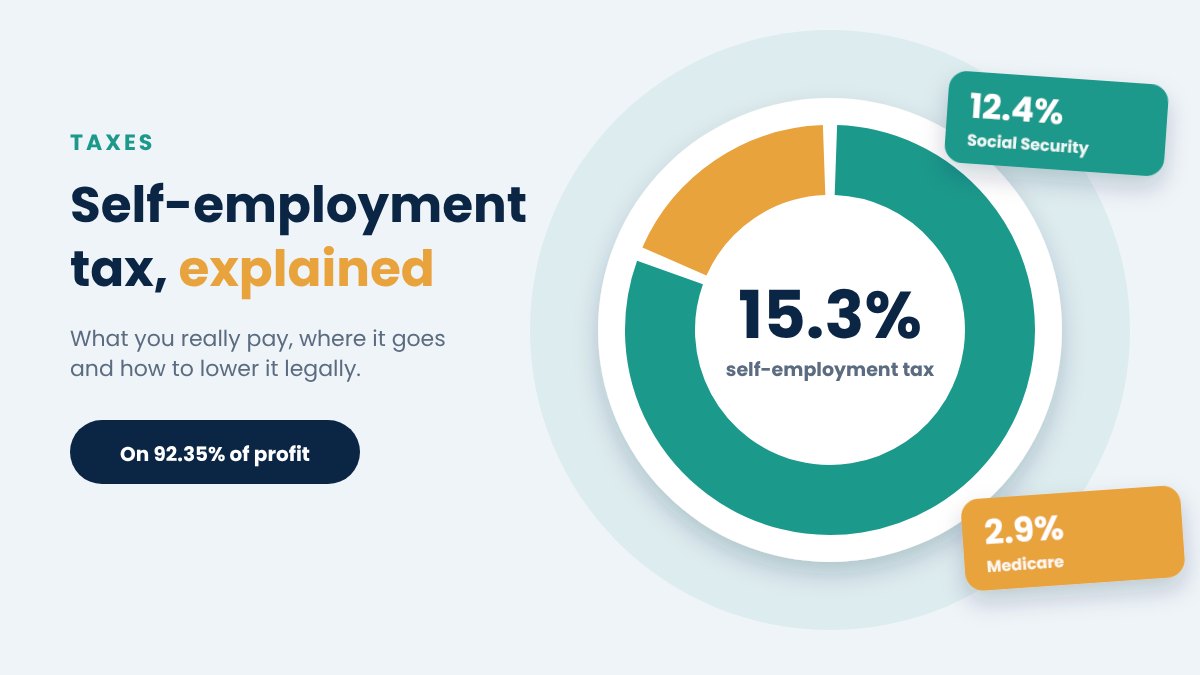
Quick answer: in 2026, self-employment tax is 15.3% of 92.35% of your net self-employment profit (12.4% for Social Security up to $184,500 of earnings, plus 2.9% for Medicare with no cap). You owe it if your net earnings are $400 or more. You can deduct half of it when calculating your income tax.
What is self-employment tax?
Self-employment tax (sometimes called SECA tax, after the Self-Employment Contributions Act) funds the same two programs as the FICA taxes on a regular paycheck:
- Social Security (12.4%) – retirement, disability and survivor benefits.
- Medicare (2.9%) – health coverage once you reach 65.
An employee pays 7.65% and their employer pays another 7.65%. A self-employed person is both the employee and the employer, so the full 15.3% lands on them.
It’s important to understand that self-employment tax is separate from income tax. Freelancers pay both:
- Self-employment tax on their net profit, calculated on Schedule SE.
- Federal income tax on their taxable income, calculated with the normal tax brackets.
- State income tax in most states (not covered in this guide).
Most first-year freelancers budget for income tax and forget about the first item. That’s where the surprise comes from.
Who has to pay self-employment tax?
You generally owe self-employment tax if you have $400 or more in net earnings from self-employment in a year. That includes:
- Freelancers and independent contractors paid on a 1099-NEC or 1099-K
- Gig workers (rideshare, delivery, task apps)
- Content creators, consultants and coaches
- Sole proprietors and single-member LLC owners who haven’t elected S-Corp status
- Partners in a partnership (on their share of business income)
- People with a side business on top of a full-time job
Two points catch people out:
- It doesn’t matter whether you received a 1099. Cash, Venmo, PayPal and direct payments count. The form is just a report; the income is taxable either way.
- The $400 threshold is for net earnings, not revenue. If you invoiced $3,000 but had $2,700 in legitimate business expenses, your net earnings are $300 and you don’t owe self-employment tax on them (you still report the income).
Self-employment tax rates for 2026
| Part | Rate | Applies to |
|---|---|---|
| Social Security | 12.4% | Net self-employment earnings up to $184,500 |
| Medicare | 2.9% | All net self-employment earnings, no cap |
| Additional Medicare Tax | 0.9% | Earnings above $200,000 (single), $250,000 (married filing jointly), $125,000 (married filing separately) |
The $184,500 cap is the Social Security wage base for 2026, up from $176,100 in 2025. It changes every year. Once your combined wages and self-employment earnings pass it, you stop paying the 12.4% portion, which is why the effective self-employment tax rate falls for high earners.
How to calculate self-employment tax, step by step
The calculation has one quirk that confuses people: you don’t pay 15.3% on your whole profit. You pay it on 92.35% of your profit.
Why 92.35%? Because an employer deducts its half of payroll taxes as a business expense. To put freelancers on equal footing, the IRS first reduces your profit by 7.65% (100% − 7.65% = 92.35%) before applying the tax.
Here’s the full process:
- Calculate your net profit. Business income minus business expenses. For sole proprietors this is the bottom line of Schedule C.
- Multiply by 92.35%. This gives your net earnings from self-employment.
- Multiply by 15.3% (up to the Social Security wage base; above it, only 2.9%).
- Add the 0.9% Additional Medicare Tax if you’re above the threshold for your filing status.
- Deduct half of your self-employment tax from your income when calculating income tax.
Example: $60,000 net profit
- Net profit: $60,000
- × 92.35% = $55,410 in net self-employment earnings
- × 15.3% = $8,478 self-employment tax
- Deductible half: $4,239
That $8,478 is owed on top of your income tax. We’ll add the income tax in a moment.
Want to skip the math? Use our self-employment tax calculator to estimate what you owe in seconds.
The deduction for half of self-employment tax
You get back part of the pain through an above-the-line deduction for the “employer” half of your self-employment tax. In the example above, that’s $4,239.
The deduction:
- Reduces your adjusted gross income (AGI), so it lowers your income tax.
- Is available whether you take the standard deduction or itemize.
- Does not reduce the self-employment tax itself.
In practice, it’s worth a few hundred to a few thousand dollars, depending on your tax bracket.
How much do freelancers really pay? Three real-world examples
Self-employment tax is only part of the picture. Below are complete federal estimates for 2026 for a single filer with no other income who takes the standard deduction ($16,100) and qualifies for the Qualified Business Income (QBI) deduction. State taxes are not included.
| Side gig | Full-time freelancer | High earner | |
|---|---|---|---|
| Net profit | $20,000 | $60,000 | $120,000 |
| Self-employment tax | $2,826 | $8,478 | $16,955 |
| Federal income tax | $199 | $3,559 | $11,506 |
| Total federal tax | $3,025 | $12,037 | $28,461 |
| Share of net profit | 15.1% | 20.1% | 23.7% |
How the $60,000 example works
- Self-employment tax: $8,478 (calculated above).
- Adjusted gross income: $60,000 − $4,239 (half of SE tax) = $55,761.
- Minus standard deduction: $55,761 − $16,100 = $39,661.
- QBI deduction: 20% of qualified business income, but limited to 20% of taxable income before the deduction. Here the limit applies: 20% × $39,661 = $7,932.
- Taxable income: $39,661 − $7,932 = $31,729.
- Income tax: 10% on the first $12,400 ($1,240) + 12% on the remaining $19,329 ($2,319) = $3,559.
- Total: $8,478 + $3,559 = $12,037, about 20% of net profit.
Notice something in the table: at lower incomes, self-employment tax is by far the biggest part of the bill. The $20,000 side-gig earner pays almost nothing in income tax, thanks to the standard deduction, but still owes more than $2,800 in self-employment tax. This is the number that surprises new freelancers the most.
To see how the QBI deduction works in detail, read our guide to the QBI deduction for freelancers.
Self-employment tax vs. being an employee
A common question is whether freelancers pay “double” tax. They pay double the payroll tax rate, but the comparison isn’t quite that simple.
| $60,000 of earnings | Employee (W-2) | Freelancer (1099) |
|---|---|---|
| Social Security + Medicare paid by the worker | $4,590 (7.65%) | $8,478 (15.3% × 92.35%) |
| Paid by the employer on the worker’s behalf | $4,590 | $0 |
| Deduction for half of payroll tax | No | Yes ($4,239) |
| Can deduct business expenses | Generally no | Yes |
The employer’s half isn’t free money for employees: companies factor it into what they can afford to pay. That’s why many freelancers set their rates 20–30% higher than an equivalent salary.
What if you have a job and freelance on the side?
If you have a W-2 job and a side business, a few rules apply:
- Your wages count toward the Social Security wage base first. If your salary is already above $184,500, you only pay the 2.9% Medicare portion on your freelance earnings. If your salary is $150,000, only the first $34,500 of self-employment earnings are subject to the 12.4% Social Security tax.
- You still owe self-employment tax on side income of $400 or more, even if your employer withholds correctly from your paycheck.
- You can cover it through withholding. Instead of making quarterly estimated payments, you can increase the withholding on your W-4 at your day job to cover the tax on your freelance income.
For the full picture, read our guide to side hustle taxes with a full-time job.
How and when you pay self-employment tax
Self-employment tax is reported on your annual return:
- Schedule C – calculates your business profit or loss.
- Schedule SE – calculates your self-employment tax.
- Schedule 2 of Form 1040 – where the self-employment tax is added to your total tax.
- Schedule 1 of Form 1040 – where you take the deduction for half of it.
But you’re not supposed to wait until April to pay. The US tax system is pay-as-you-go. Employees pay through withholding; freelancers generally pay through quarterly estimated taxes using Form 1040-ES. If you expect to owe $1,000 or more for the year, you usually need to make estimated payments or you may face an underpayment penalty.
The usual due dates are mid-April, mid-June, mid-September and mid-January of the following year. Check the exact dates in our estimated tax due dates guide, and see quarterly estimated taxes for freelancers for how to calculate each payment.
Safe harbor tip: you generally avoid the underpayment penalty if your estimated payments cover at least 100% of last year’s total tax (110% if your prior-year AGI was over $150,000), even if you end up owing more when you file.
How much should you set aside?
A practical rule for most freelancers:
- 25–30% of net profit if you earn up to around $100,000 and live in a state with income tax.
- 20–25% if you live in a state without income tax.
- 30–35% for higher earners or high-tax states.
The simplest system is to open a separate savings account and move that percentage over every time a client pays you. You’ll never have to find thousands of dollars in April. For a breakdown by income, see how much a freelancer should set aside for taxes.
6 legal ways to reduce self-employment tax
Because self-employment tax is based on net profit, the only way to reduce it directly is to reduce that profit legitimately or change how your business is structured.
1. Track and claim every business expense
Every legitimate business expense on Schedule C reduces both self-employment tax and income tax. At a 15.3% self-employment rate plus a 12% income tax bracket, each $1,000 of deductible expenses saves roughly $250 in federal tax. Common examples include software, equipment, a portion of your phone and internet, professional services and business travel. Start with our complete list of freelancer tax deductions.
2. Take the home office deduction
If you use part of your home regularly and exclusively for work, you can deduct it on Schedule C. That reduces self-employment tax as well as income tax. Compare both methods in our guide to the home office deduction.
3. Deduct vehicle expenses correctly
Business miles add up fast, especially for gig drivers. Choosing between the standard mileage rate and actual expenses can make a meaningful difference. See standard mileage vs actual expenses.
4. Consider an S-Corp election once your profit is high enough
With an S-Corp, you pay yourself a reasonable salary (subject to payroll taxes) and can take the rest of the profit as distributions, which aren’t subject to self-employment tax. It comes with extra costs: payroll, a separate tax return and usually an accountant. It tends to make sense only above a certain level of profit. Find out where the break-even point sits in our guide on when a freelancer should become an S corp.
5. Know what doesn’t reduce self-employment tax
Several popular strategies lower your income tax but not your self-employment tax:
- Contributions to a SEP IRA or Solo 401(k)
- The self-employed health insurance deduction
- The QBI deduction
- The standard deduction
They’re still worth using. Retirement contributions in particular can save a lot of income tax. Just don’t count on them to shrink your Schedule SE. See our comparison of SEP IRA vs Solo 401(k) vs Roth IRA.
6. Don’t under-report to “save” tax
Self-employment tax also builds your Social Security record. Your future retirement and disability benefits are based on reported earnings, so under-reporting income isn’t just risky with the IRS: it also reduces what you’ll collect later.
Common mistakes to avoid
- Budgeting only for income tax. At lower incomes, self-employment tax is often the larger bill.
- Waiting until April to pay. This can trigger underpayment penalties on top of a large balance due.
- Mixing personal and business money. It makes expenses harder to prove and easier to miss. A separate account solves it; see our picks for the best business bank accounts for freelancers.
- Assuming that no 1099 means no tax. All self-employment income counts.
- Forming an LLC to save tax. A single-member LLC is taxed the same as a sole proprietorship by default. The savings only come with an S-Corp election. See LLC vs sole proprietor for freelancers.
Frequently asked questions
What is the self-employment tax rate for 2026?
The rate is 15.3%: 12.4% for Social Security on net self-employment earnings up to $184,500, and 2.9% for Medicare on all net earnings. An extra 0.9% Medicare tax applies above $200,000 for single filers ($250,000 for married couples filing jointly).
Do I pay self-employment tax if I made less than $400?
No. If your net earnings from self-employment are under $400 for the year, you don’t owe self-employment tax. You may still need to report the income for income tax purposes.
Is self-employment tax the same as income tax?
No. Self-employment tax funds Social Security and Medicare, and it’s calculated on Schedule SE. Income tax is calculated separately using the federal tax brackets. Most freelancers owe both.
Why is self-employment tax calculated on 92.35% of profit?
It mirrors the fact that employers can deduct their half of payroll taxes. Reducing your profit by 7.65% before applying the tax puts self-employed people on a similar footing to employees.
Can I deduct self-employment tax?
You can deduct half of it as an adjustment to income on Schedule 1. The deduction lowers your income tax, not the self-employment tax itself.
Do single-member LLCs pay self-employment tax?
Yes. By default, a single-member LLC is a “disregarded entity” and its owner pays self-employment tax on the profit just like a sole proprietor. Electing S-Corp tax treatment changes this.
Do I have to pay self-employment tax if I already have a full-time job?
Yes, if your side income is $400 or more. However, if your wages already exceed the Social Security wage base ($184,500 in 2026), you’ll only owe the 2.9% Medicare portion on your self-employment earnings.
Key takeaways
- Self-employment tax is 15.3% of 92.35% of your net profit, on top of income tax.
- In 2026, the Social Security part stops at $184,500 of earnings; the Medicare part has no cap.
- You can deduct half of it, which lowers your income tax.
- Most freelancers end up paying roughly 15–25% of net profit in total federal tax, plus state tax where it applies.
- Set aside 25–30% of every payment, pay quarterly, and track every business expense.
This article is for general educational purposes and is not tax, legal or financial advice. Tax rules change and your situation may differ. Consult a CPA or Enrolled Agent before making decisions. Figures are for tax year 2026 and are based on IRS and Social Security Administration published amounts.