
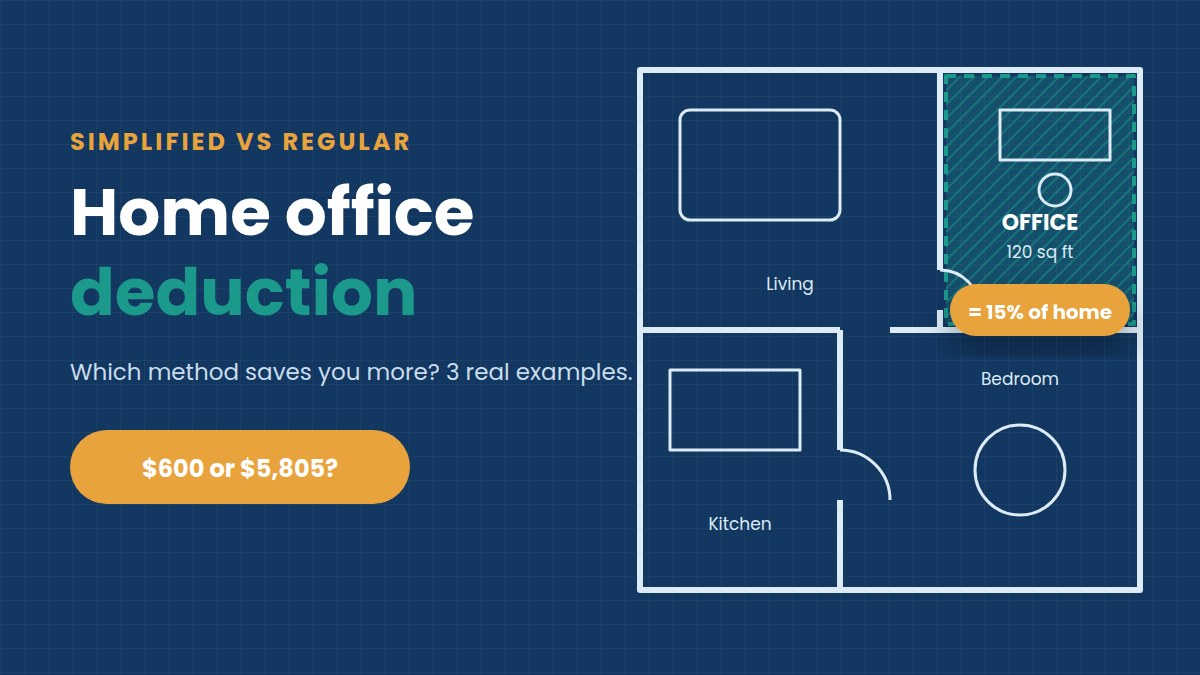
The home office deduction lets freelancers deduct part of their housing costs when they work from home. You can calculate it in two ways, and picking the right one can be worth thousands of dollars a year.
Quick answer:
- Simplified method: $5 per square foot of office space, up to 300 square feet, so a maximum of $1,500. No receipts, no extra form.
- Regular method: your office’s share of your real home costs (rent or mortgage interest, utilities, insurance, repairs and depreciation), calculated on Form 8829. No upper limit.
Rule of thumb: renters in expensive cities usually save far more with the regular method. Homeowners with a small office often do just as well with the simplified one.
The home office is one of the most valuable freelancer tax deductions, because it lowers both your income tax and your self-employment tax. Below you’ll see who qualifies, how each method works, and three real examples with the numbers worked out.
Who qualifies for the home office deduction
Before choosing a method, make sure your space qualifies. The IRS has two main tests, both explained in Publication 587.
Test 1: regular and exclusive use
You must use a specific area only for your business, and on a regular basis. A spare room used as an office qualifies. So does a clearly defined corner of a room, as long as nothing personal happens there.
- Qualifies: a desk area in your bedroom used only for work; a converted garage studio.
- Doesn’t qualify: the dining table where you also eat; a guest room where friends sometimes sleep; a couch where you watch TV in the evening.
Test 2: principal place of business
Your home office must be your main place of business. For most freelancers, that’s easy: if you do your administrative work there (invoicing, emails, bookkeeping) and have no other fixed office, it counts, even if you do the actual work at clients’ sites.
Employees can’t claim it
If you work from home as a W-2 employee, you can’t take the home office deduction for that job. However, if you also freelance on the side and use a dedicated space for your freelance work, you can claim it for your side business.
The simplified home office deduction
The simplified method is exactly what it sounds like. Measure your office, multiply by $5, and you’re done.
The formula: office square feet (up to 300) × $5 = your deduction.
| Office size | Deduction |
|---|---|
| 80 sq ft | $400 |
| 120 sq ft | $600 |
| 200 sq ft | $1,000 |
| 300 sq ft or more | $1,500 (the maximum) |
Pros:
- No need to track rent, utilities or repairs for the deduction.
- No depreciation, so nothing to “recapture” if you sell your home later.
- Homeowners who itemize can still deduct all their mortgage interest and property taxes on Schedule A.
Cons:
- Capped at $1,500, however expensive your home is.
- If the deduction is more than your business income, you lose the excess: you can’t carry it to next year.
The details are on the IRS simplified option page. For a freelancer with a modest office and simple finances, it’s often the right call.
The regular home office deduction
The regular method deducts the real cost of your office. It takes more work, but it has no cap.
Step 1: find your business percentage
Divide your office’s square footage by your home’s total square footage. For example, a 120 sq ft office in an 800 sq ft apartment is 15% of the home.
Step 2: sort your expenses
| Type | Examples | How much you deduct |
|---|---|---|
| Direct | Painting or repairing the office itself | 100% |
| Indirect | Rent, mortgage interest, property taxes, home insurance, utilities, general repairs, HOA fees | Your business percentage |
| Depreciation (owners only) | The office’s share of your home’s cost, minus land, spread over 39 years | Your business percentage |
| Not deductible | Lawn care, repairs only to other rooms | 0% |
Step 3: fill in Form 8829
Form 8829 adds it all up, and the result goes on line 30 of Schedule C. Most tax software walks you through it with simple questions.
Two rules to know:
- Income limit. Your home office deduction can’t create a loss. If it’s bigger than your business profit, the excess carries over to next year, unlike with the simplified method.
- Depreciation recapture. Homeowners who claim depreciation may owe tax on it when they sell the home, at a rate of up to 25%. It’s not a reason to skip the deduction, but it’s worth knowing.
Home office deduction examples: three real cases
Example 1: a renter in a big city
Sofia rents an 800 sq ft apartment in New York and works from a 120 sq ft room (15%).
| Expense | Yearly cost | Business share (15%) |
|---|---|---|
| Rent ($3,000/month) | $36,000 | $5,400 |
| Utilities | $2,400 | $360 |
| Renters insurance | $300 | $45 |
| Regular method total | $5,805 | |
| Simplified method (120 × $5) | $600 |
Winner: regular, by $5,205. At a combined tax rate of around 30%, that’s roughly $1,500 more in her pocket every year.
Example 2: a homeowner with a mortgage
Marcus owns a 2,400 sq ft house and works from a 150 sq ft office (6.25%). The house cost $300,000, not counting the land.
| Expense | Yearly cost | Business share (6.25%) |
|---|---|---|
| Mortgage interest | $9,000 | $563 |
| Property taxes | $4,000 | $250 |
| Home insurance | $1,500 | $94 |
| Utilities | $3,600 | $225 |
| Depreciation ($300,000 ÷ 39 years) | $7,692 | $481 |
| Regular method total | $1,613 | |
| Simplified method (150 × $5) | $750 |
Winner: regular, by $863, but with more paperwork and some depreciation recapture when he sells. Many homeowners in his position still choose it; some prefer the simplicity of $750.
Example 3: a small office in a paid-off house
Linda owns a 2,500 sq ft home with no mortgage and uses a 90 sq ft office (3.6%). Her property taxes are $3,000, insurance $1,200 and utilities $3,000, and the house cost $200,000 without the land.
- Regular method: $259 of expenses + $185 of depreciation = $444
- Simplified method: 90 × $5 = $450
Winner: simplified. It’s slightly higher, needs no records and creates no depreciation recapture.
Want to see what each method does to your actual tax bill? Enter your profit with and without the deduction in our self-employment tax calculator.
How to choose your home office deduction method
A quick way to decide: calculate the regular method once. If it beats the simplified number by only a few hundred dollars, the simplicity may be worth more. If it’s thousands higher, use it.
| Use the simplified method if… | Use the regular method if… |
|---|---|
| Your office is small or your home costs are low | You rent in an expensive area |
| You don’t want to track home expenses | Your office takes up a large share of your home |
| You own your home and want to avoid depreciation recapture | Your business profit is low this year and you want to carry over the excess |
| You just want it done in five minutes | You already use tax software that does the math for you |
You can switch every year. Choosing one method this year doesn’t lock you in. Many freelancers start with the simplified method and switch to the regular one when they move or their rent goes up.
Where it goes on your return. Either way, the deduction goes on line 30 of Schedule C. With the simplified method, you fill in a short worksheet in the Schedule C instructions; with the regular method, you attach Form 8829.
Frequently asked questions
Does the home office deduction increase my audit risk?
Not if you qualify and keep records. It’s a common, legitimate deduction. Take a few photos of your office, note its measurements, and keep your rent or mortgage statements. That’s usually all the proof you need.
Can I claim the home office deduction if I also rent a coworking space?
Possibly. If your home office is still where you do your administrative work and you use it regularly and exclusively, it can qualify. The coworking membership is deductible separately.
Can I deduct my home internet as part of the home office?
With the regular method, utilities are shared by your business percentage. Many freelancers instead deduct the business share of internet separately, based on actual use, which is often higher. With the simplified method, you can still deduct a business phone line and the business share of internet separately.
What if I move during the year?
You can claim each home for the months you used it. With the simplified method, use the average square footage for the year; with the regular method, figure each home separately.
This article is for general information only and isn’t tax advice. Talk to a CPA or Enrolled Agent about your situation.