
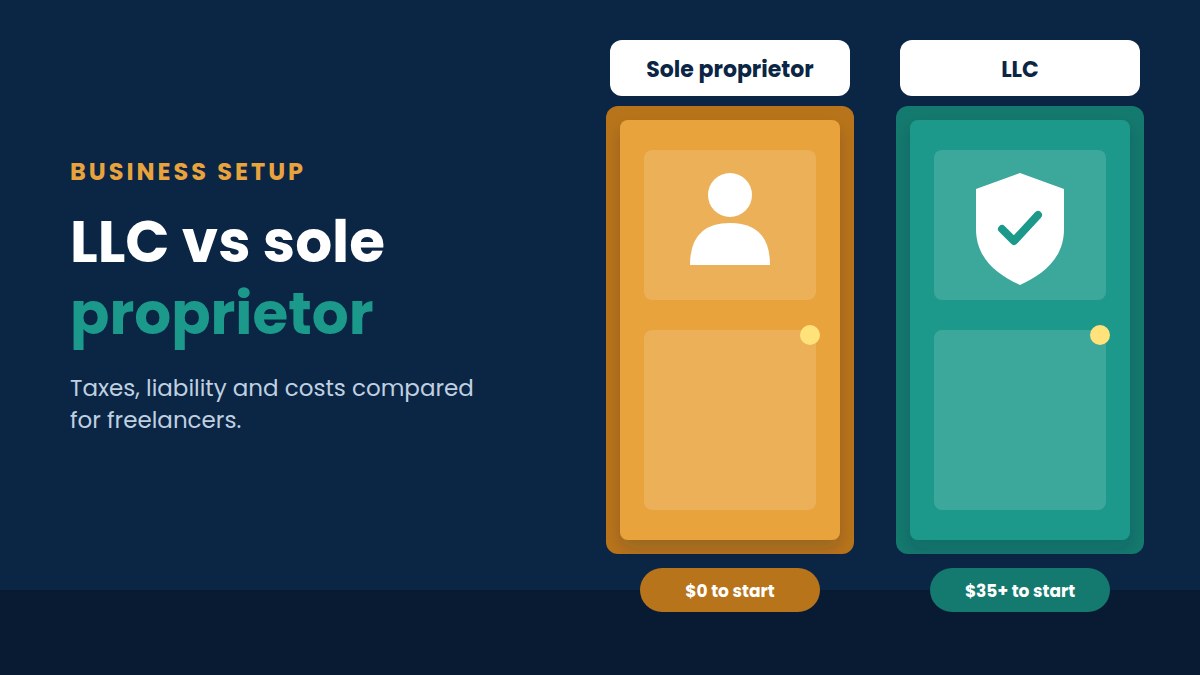
LLC vs sole proprietor is the first big decision most freelancers face. The honest answer surprises many people: by default, both pay exactly the same taxes. The real differences are liability protection, cost and paperwork. In other words, you are mainly paying for a legal wall between your business and your personal assets.
For most new freelancers, a sole proprietorship is fine at first. An LLC starts to make sense when you sign bigger contracts, take on more risk or earn enough to consider the S corp election.
| Sole proprietor | Single-member LLC | |
|---|---|---|
| How to start | Automatic, no filing | File with your state |
| Setup cost | $0 | About $35 to $500 |
| Yearly state fee | $0 | $0 to $800 |
| Federal taxes | Schedule C + SE tax | Same, by default |
| Can elect S corp | No | Yes |
| Personal liability for business debts | Yes | Generally no |
| Paperwork | Minimal | Annual report in most states |
What a sole proprietor is
A sole proprietorship is the default setup for anyone who works for themselves. You become one the moment you take your first paid gig. There is nothing to file, and you can work under your own name.
For taxes, you and the business are the same person. Therefore, you report your profit on Schedule C and pay income tax plus 15.3% self-employment tax on it.
The downside is legal. Since there is no separation, business debts and lawsuits are your personal debts and lawsuits too. So a client who sues your business can go after your savings, your car or your home.
What an LLC is
A limited liability company (LLC) is a legal entity you create with your state. As the owner, you are called a member. Most freelancers form a single-member LLC, with themselves as the only owner.
The LLC exists separately from you under state law. As a result, the business owns its contracts, its bank account and its debts. However, for federal taxes, the IRS ignores a single-member LLC unless you choose otherwise. That is the key point many people miss.
Sole proprietor vs self-employed: is there a difference?
Yes, but the two overlap. “Self-employed” describes how you earn money: you work for yourself and pay self-employment tax. “Sole proprietor” describes a business structure: one owner, with no separate legal entity.
Every sole proprietor is self-employed. However, not every self-employed person is a sole proprietor. For example, LLC owners and business partners are also self-employed.
In practice, if you freelance and haven’t registered a business, you’re automatically a sole proprietor. You report your profit on Schedule C and pay self-employment tax on it.
LLC vs sole proprietor: taxes
The default: no tax difference
The IRS treats single-member LLCs as “disregarded entities” by default. In plain terms, your LLC files no separate federal return. Instead, you report its profit on Schedule C, exactly like a sole proprietor. Likewise, you pay the same 15.3% self-employment tax and the same income tax.
So forming an LLC alone does not lower your federal taxes. It also doesn’t unlock new deductions. A home office, mileage or software subscription is deductible either way.
The S corp election changes the math
The tax benefit appears only when your LLC elects to be taxed as an S corporation. To do that, you file Form 2553 with the IRS. After that, you pay yourself a reasonable salary through payroll. The rest of your profit comes out as distributions, which are not subject to the 15.3% payroll tax.
Here is a simple example with $100,000 of profit:
- As a sole proprietor or default LLC: self-employment tax is about $14,130.
- As an S corp paying a $60,000 salary: payroll taxes on the salary are about $9,180.
- Difference: roughly $4,950 a year before extra costs.
However, an S corp is not free. You need payroll software, a separate business tax return and often a CPA. Those costs typically run $1,500 to $3,000 a year. For that reason, the election usually pays off only once your profit is well above $50,000. You can estimate your current bill with our self-employment tax calculator.
State taxes and fees can tip the scale
Some states charge LLCs every year, whether they earn money or not. California is the best-known case, with an $800 annual tax. Meanwhile, a sole proprietor in California pays no such fee. On the other hand, states like Texas and Arizona charge no annual fee for most LLCs. So always check your own state before deciding.
LLC vs sole proprietor: liability
What an LLC protects
An LLC puts a legal wall between business debts and your personal assets. For example, if your business can’t pay a supplier or loses a contract dispute, your home and personal savings are generally out of reach. The SBA guide to business structures explains this as the main reason owners form an LLC.
What it doesn’t protect
Still, the wall has holes. An LLC does not protect you in these cases:
- Your own mistakes. If you personally cause harm through negligence, you can still be sued personally.
- Personal guarantees. Loans, leases or credit cards you guarantee stay your responsibility.
- Mixed finances. Paying personal bills from the LLC account can let a court ignore the LLC.
- Unpaid taxes. Payroll and sales taxes can follow you personally.
That is why many freelancers buy professional liability insurance as well. In fact, for a designer, writer or consultant, insurance often protects more than the LLC itself.
LLC vs sole proprietor: costs and paperwork
A sole proprietorship costs nothing to start. At most, you may pay for a local business license or a DBA (a “doing business as” name).
An LLC, by contrast, has state fees. These are some real examples:
- Montana: $35 to form, $20 a year
- Kentucky: $40 to form, $15 a year
- Arizona: $50 to form, no annual fee
- Florida: $125 to form, $138.75 a year
- Texas: $300 to form, no annual fee for most LLCs
- New York: $200 to form, plus a newspaper publication rule that can cost much more
- Massachusetts: $500 to form, $500 a year
- California: $70 to form, $800 a year
Besides the fees, an LLC adds some paperwork. You file an annual report in most states, keep a separate bank account and write a simple operating agreement. Also, if you form your LLC in another state, such as Delaware or Wyoming, you usually have to register in your home state too. As a result, you pay two sets of fees.
One piece of paperwork has disappeared, though. Since 2025, LLCs created in the U.S. no longer have to file a beneficial ownership report with FinCEN.
When a sole proprietorship makes sense
Staying a sole proprietor is a smart choice in many cases:
- You are just starting and testing whether freelancing works for you.
- Your work carries low risk, such as writing or online tutoring.
- Your profit is modest, so the S corp election wouldn’t pay off yet.
- You live in a state with high LLC fees, like California.
- You already carry good liability insurance.
When an LLC makes sense
On the other hand, an LLC is usually worth it when:
- Clients sign larger contracts or ask you to carry the risk of a project.
- You hire subcontractors, rent a studio or sign a business lease.
- Your profit is high enough to consider the S corp election.
- You own a home or significant savings you want to protect.
- Bigger clients prefer to work with a registered business.
How to switch from sole proprietor to LLC
The switch is easier than it sounds. Here are the steps:
- Choose your state. In most cases, form the LLC where you live and work.
- File articles of organization. Most states let you do it online in a day.
- Write an operating agreement. Even a one-page version helps protect your liability shield.
- Get an EIN. It’s free on IRS.gov, and banks usually ask for one.
- Open a business bank account. Keep every business dollar there.
- Update your clients. Send a new W-9 and use the LLC name on contracts and invoices.
- Keep paying taxes the same way. You still file Schedule C and make quarterly estimated taxes unless you elect S corp status.
Frequently asked questions
Does an LLC save on taxes vs a sole proprietor?
Not by default. A single-member LLC pays the same federal taxes as a sole proprietor. Savings only start if you elect S corp taxation and your profit is high enough to cover the extra costs.
Can a single-member LLC file Schedule C?
Yes. Unless you choose to be taxed as a corporation, you report the LLC’s income and expenses on Schedule C with your personal Form 1040.
Do I need an EIN for an LLC?
Not always. The IRS says a single-member LLC with no employees and no excise taxes doesn’t need one. Still, most banks require an EIN to open a business account, and it keeps your Social Security number off client forms.
Is an LLC or sole proprietor better for a side hustle?
For most side hustles, a sole proprietorship is enough at first. If the side business grows, carries real risk or starts earning serious money, an LLC becomes worth the cost.
This article is for general information only and is not legal or tax advice. LLC rules and fees vary by state, so check with your state’s business office or a qualified professional before you decide.