
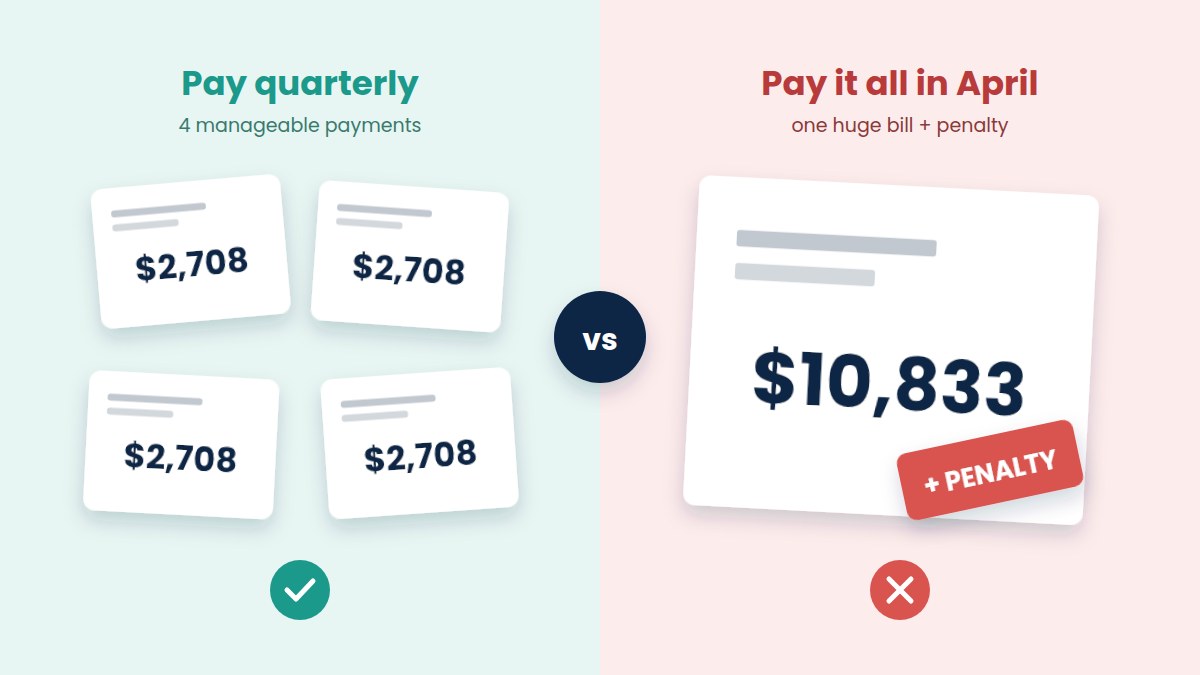
Quarterly estimated taxes are how freelancers pay the IRS during the year, since no employer withholds tax from their income. Instead of one big bill in April, you send four payments, each covering part of the year’s income tax and self-employment tax.
Quick answer: If you expect to owe $1,000 or more when you file, you generally need to make quarterly estimated tax payments. For the 2026 tax year, they’re due April 15, June 15 and September 15, 2026, and January 15, 2027. You can avoid penalties by paying at least 100% of last year’s tax (110% if your income was over $150,000), spread across the four dates.
This guide covers everything you need: who has to pay, exactly when, how to calculate each payment, how to pay online, and what happens if you’re late.
Who has to pay quarterly estimated taxes?
You generally need to pay quarterly estimated taxes if both of these are true:
- You expect to owe $1,000 or more in federal tax for the year after subtracting withholding and credits.
- Your withholding and credits will cover less than the smaller of 90% of this year’s tax or 100% of last year’s tax.
In practice, that includes most full-time freelancers, independent contractors, gig workers and single-member LLC owners once their profit reaches a few thousand dollars. Remember, the tax you’re estimating includes both income tax and the 15.3% self-employment tax.
You probably don’t need to pay if:
- You owed no tax last year and were a US citizen or resident for the whole year. In that case, you can’t be penalized for underpaying this year, although you’ll still owe the full tax when you file.
- Your paycheck withholding already covers it. For example, if you have a job and raise your withholding to cover your side income.
- Your side income is small and your expected balance due stays under $1,000.
If you’re unsure, it’s safer to pay. An estimated payment is never lost: whatever you overpay comes back as a refund or can be applied to next year.
Quarterly estimated taxes due dates for 2026
Despite the name, the four payment periods aren’t equal quarters. Here are the dates for the 2026 tax year:
| Payment | Covers income earned | Due date |
|---|---|---|
| 1 | January 1 – March 31 (3 months) | April 15, 2026 |
| 2 | April 1 – May 31 (2 months) | June 15, 2026 |
| 3 | June 1 – August 31 (3 months) | September 15, 2026 |
| 4 | September 1 – December 31 (4 months) | January 15, 2027 |
A few details that trip people up:
- The second payment comes quickly. It’s due just two months after the first, so plan your cash flow around April and June.
- Weekends and holidays move the date. If a due date falls on a weekend or federal holiday, the payment is due the next business day.
- You can skip the January payment if you file your full 2026 return by February 1, 2027, and pay the whole balance with it.
- The first payment shares a date with your annual return. On April 15 you’ll often pay last year’s balance and this year’s first estimate at the same time, which makes April the most expensive month of the year for freelancers.
Tip: add all four dates to your calendar now, with a reminder a week before each one.
How to calculate your quarterly estimated taxes
There are three ways to work out how much to pay. Most freelancers use the first or second.
Method 1: last year’s tax (the simplest)
Take the total tax on last year’s return Form 1040, including self-employment tax and divide it by four. If your adjusted gross income was over $150,000, use 110% of last year’s tax instead.
This method is the easiest, and it protects you from penalties even if you earn much more this year. However, if your income has grown, you’ll still owe the difference in April, so set that money aside as you go.
Method 2: this year’s projected tax
Estimate your profit for this year, calculate the tax, and pay at least 90% of it in four parts. You can use the worksheet in Form 1040-ES, or simply enter your projected profit in our self-employment tax calculator, which shows the quarterly amount directly.
This method fits better if your income dropped, or if you’re in your first year and have no useful prior-year figure.
Method 3: annualized income (for irregular income)
If most of your income arrives late in the year, equal payments can mean paying too early. With the annualized income installment method, each payment is based on what you actually earned up to that point. It’s more work, and you’ll need to attach Schedule AI of Form 2210 to your return, but it can prevent penalties for uneven years.
Example: a freelancer with $60,000 of profit
Jamie is a single freelance designer. Last year her total tax was $9,000. This year she expects $60,000 of profit, which means about $12,037 in federal tax.
| Method | Calculation | Each payment |
|---|---|---|
| Last year’s tax | $9,000 ÷ 4 | $2,250 |
| 90% of this year’s tax | $12,037 × 90% ÷ 4 | $2,708 |
Either amount avoids a penalty. If Jamie pays $2,250 a quarter, she’ll owe about $3,037 more in April 2027, so she keeps saving a share of every invoice. Our guide on how much to set aside for taxes explains the system.
Most tax software also calculates next year’s estimated payments for you when you file, and prints the payment vouchers.
How to pay quarterly estimated taxes
Paying online is fastest and gives you instant confirmation. These are the main options:
| Method | Cost | Good to know |
|---|---|---|
| IRS Direct Pay | Free | Pay straight from your bank account, no sign-up. Choose “Estimated Tax” and Form 1040-ES as the reason |
| IRS Online Account | Free | Same bank payment, plus a history of every payment you’ve made. Handy at tax time |
| EFTPS | Free | The Treasury’s payment system. Requires enrollment, mostly used by businesses |
| Debit or credit card | Processing fee | Paid through IRS-approved processors. Only worth it for card rewards larger than the fee |
| Check or money order | Free (plus postage) | Mail it with the Form 1040-ES voucher. Slowest and hardest to track |
Whichever method you use, save the confirmation. At tax time you’ll enter the total of your four payments on your return, and the IRS will compare it with its own records.
Also, make sure each payment is applied to the right tax year. A payment in January 2027 must be marked for the 2026 tax year, not 2027. It’s one of the most common mistakes.
Penalties for missing quarterly estimated taxes
If you pay too little or too late, the IRS charges an underpayment penalty. It works like interest: a yearly rate applied to the amount you underpaid, for the number of days it was late. For October to December 2026, that rate is 7% per year, and the IRS updates it every quarter.
The good news is that the penalty is usually smaller than people fear. For example, paying $2,000 three months late costs roughly $35. Even so, it adds up across several missed payments, and it’s easy to avoid.
How to avoid the penalty: the safe harbor
You won’t owe a penalty if your withholding and estimated payments, made on time, add up to at least the smaller of:
- 90% of this year’s tax, or
- 100% of last year’s tax (110% if last year’s adjusted gross income was over $150,000).
The IRS also skips the penalty if you owe less than $1,000 after withholding and credits.
If you already missed a payment
Pay as soon as you can. The penalty keeps growing daily, so a late payment is always better than none. Then, at tax time, the IRS uses Form 2210 to work out any penalty. Most tax software fills it in for you, or you can let the IRS calculate it and send you a bill. If your income was uneven, the annualized method on that form can reduce or remove the penalty.
State quarterly estimated taxes
Most states with an income tax also expect quarterly estimated taxes from freelancers. These are separate payments, made to your state’s tax agency, not the IRS. Many states follow the federal due dates, but some use different dates or thresholds, so check your state’s revenue department website. Freelancers in states with no income tax, such as Texas and Florida, only make federal payments.
Pay through your paycheck instead
If you also have a W-2 job, you may be able to skip quarterly payments entirely. Give your employer a new Form W-4 asking for extra withholding to cover your freelance income. The IRS treats withholding as paid evenly through the year, even if you start late, which makes it a very forgiving option. Our guide to side hustle taxes shows how to work out the amount.
Frequently asked questions
Can I pay quarterly estimated taxes all at once?
Yes, you can pay the full year’s estimate on April 15. However, you can’t pay it all in January to make up for missed quarters without a possible penalty, since each payment counts from its own due date.
What if my income changes during the year?
Recalculate before the next due date and adjust the remaining payments. If you earn more, pay more on the next dates; if you earn less, you can lower them.
Do I need to send a form with my payment?
Not if you pay online. The Form 1040-ES voucher is only needed when you pay by check.
Are estimated payments deductible?
No. They’re simply prepayments of your tax. On your return, you enter the total you paid, and it’s credited against what you owe.
This article is for general information only and isn’t tax advice. Due dates and rates are for the 2026 tax year; talk to a CPA or Enrolled Agent about your situation.