
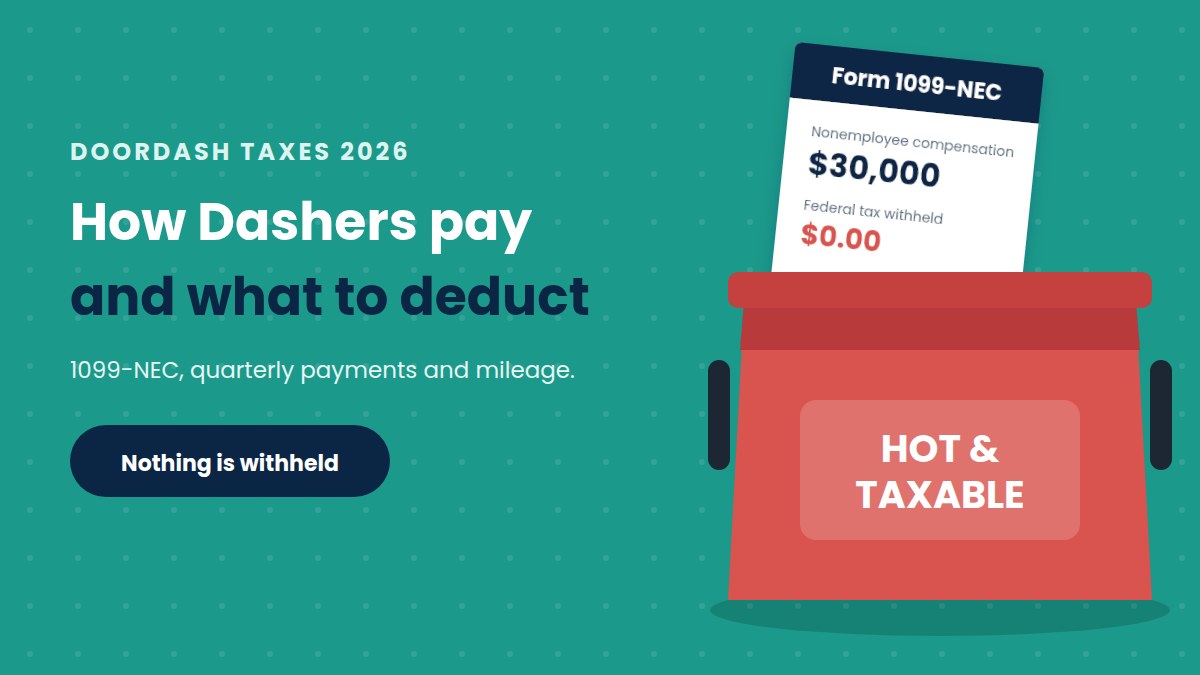
DoorDash taxes work differently from a regular job. DoorDash doesn’t withhold anything from your pay, so you handle your own taxes as a self-employed contractor. In practice, that means three things: you set money aside from every payout, you send the IRS quarterly payments, and you deduct your business costs.
The good news is that deductions shrink the bill a lot. Mileage alone often cuts a Dasher’s taxable profit nearly in half. As a result, many part-time Dashers owe far less than they fear.
Quick facts for 2026: DoorDash sends a Form 1099-NEC if you earn $2,000 or more. You owe 15.3% self-employment tax on your profit, plus income tax. Business miles are worth 72.5 cents (January to June) and 76 cents (July to December) per mile.
How DoorDash taxes work
You get a 1099-NEC, not a W-2
As a Dasher, you are an independent contractor, not an employee. For that reason, DoorDash reports your pay on Form 1099-NEC, which you download from Stripe Express by January 31. For payments made in 2026, the form goes to Dashers who earned $2,000 or more. Your tips are included in that total.
Still, the form is only a report. Even if you earn less and never get one, you must report every dollar. In fact, you have to file a return once your net self-employment earnings reach $400. The IRS Gig Economy Tax Center explains these rules for all app-based workers.
The two taxes Dashers pay
First, there is self-employment tax. It is 15.3% of about 92% of your profit, and it pays for your Social Security and Medicare. Employees split this tax with their employer, but Dashers pay both halves.
Second, there is regular income tax. It depends on your total income, including any other job. However, your standard deduction of $16,100 (single, 2026) and the 20% QBI deduction often wipe it out for part-time Dashers. Also, most states charge their own income tax on top.
How much to set aside for DoorDash taxes
A simple rule works for most Dashers: set aside 25% to 30% of your profit. Profit is what DoorDash paid you minus your deductions. For a Dasher who drives a lot, that usually works out to roughly 10% to 20% of each payout.
Aim for the higher end if you also have a W-2 job. In that case, your Dashing income stacks on top of your salary, so it is taxed at your top bracket. Our guide on how much to set aside for taxes shows how to find your exact percentage.
A separate savings account makes this painless. For example, move 20% of every weekly payout there on the day it arrives.
How Dashers pay: quarterly estimated taxes
Since nothing is withheld, the IRS expects you to pay during the year. You do this with quarterly estimated taxes. Otherwise, you may owe an underpayment penalty, which works like interest at 7% a year right now.
Due dates for 2026
These are the deadlines for your 2026 DoorDash income:
- Q1: April 15, 2026
- Q2: June 15, 2026
- Q3: September 15, 2026
- Q4: January 15, 2027
See our page on estimated tax due dates for reminders and a calendar file. Keep in mind that you don’t owe a penalty if you will owe less than $1,000 when you file. Similarly, paying 100% of last year’s total tax (110% if your AGI was over $150,000) keeps you safe.
How to make a payment
The easiest option is IRS Direct Pay, which is free and takes money straight from your bank account. You can even schedule all four payments up to 365 days ahead. Alternatively, you can pay through your IRS online account or EFTPS. If you also have a W-2 job, there is another shortcut: raise the withholding on your W-4 and skip quarterly payments entirely.
What Dashers can deduct
Every deduction lowers both your income tax and your self-employment tax. So tracking them is worth real money.
Mileage
For most Dashers, mileage is by far the biggest deduction. In 2026, each business mile is worth 72.5 cents from January to June and 76 cents from July to December. Business miles include driving to the restaurant, to the customer, and between orders while you are dashing. Driving from home to your zone before you start, however, usually counts as commuting.
The Dasher app doesn’t give you a full mileage log. Therefore, use a mileage tracking app from the moment you start a dash. You can also deduct actual car costs instead of the mileage rate. Our guide on standard mileage vs actual expenses helps you choose.
On top of the mileage rate, you can also deduct:
- Parking fees at busy restaurants or apartment complexes
- Tolls on delivery routes
- The business share of interest on your car loan
Phone, hot bags and other supplies
Smaller costs add up over a year of dashing:
- Phone and data plan. Deduct the business share, such as 60% if that is how much you use it for DoorDash.
- Hot bags and drink carriers. Insulated bags you buy yourself are deductible supplies.
- Car accessories. Phone mounts, chargers and a trunk organizer all count.
- Fast Pay fees. Fees you pay to cash out early are a business cost.
The new tips deduction
Delivery drivers who work through apps are on the official list for the No Tax on Tips deduction. From 2025 through 2028, you can deduct up to $25,000 of tips a year, even if you don’t itemize. It phases out above $150,000 of modified AGI ($300,000 for joint filers).
However, there are two limits. It can’t exceed your net profit from dashing, and it lowers only income tax, not self-employment tax. You claim it on Schedule 1-A.
What Dashers can’t deduct
Some costs look like work expenses but are not deductible:
- Gas and repairs with the mileage rate. The rate already covers them.
- Your own food. Lunch between orders is a personal cost.
- Parking and traffic tickets. Fines are never deductible.
- Clothing. Everyday clothes don’t count, even if you only wear them to dash.
- Personal miles. Errands with the app off stay personal.
Example: DoorDash taxes on $30,000 of deliveries
Leo dashes full time in 2026. His 1099-NEC shows $30,000, including $8,000 in tips. Here is what he deducts:
- Mileage, 18,000 business miles split evenly across the year: $13,365
- Phone, 60% business share: $576
- Hot bags, mounts and chargers: $120
In total, his deductions come to $14,061. Therefore, his profit is $15,939.
So what does Leo owe? His self-employment tax comes to about $2,252. Meanwhile, his federal income tax is $0, because the standard deduction and the QBI deduction cover his remaining income. Without any deductions, he would owe about $5,181. In short, his deductions save him roughly $2,929, and his tax bill is only about 7.5% of what DoorDash paid him.
How to file DoorDash taxes
At tax time, you put everything on a few forms:
- Your profit: Schedule C. Report your 1099-NEC income on line 1. Then list your expenses, with mileage on line 9.
- Self-employment tax: Schedule SE. This form calculates the 15.3% tax from your Schedule C profit.
- Tips: Schedule 1-A. Claim the tips deduction here, if it helps you.
- Everything else: Form 1040. Your main return pulls it all together, along with the quarterly payments you made.
Most tax software handles these forms with a step-by-step interview. Even so, keep your mileage log and receipts for at least three years.
Frequently asked questions
Do I have to pay DoorDash taxes if I made less than $2,000?
Yes, if your net earnings from all self-employment reach $400. You won’t get a 1099-NEC below $2,000, but you still report the income. In that case, use the earnings summary in your Dasher account.
Does DoorDash take out taxes?
No. DoorDash pays you the full amount, with no income tax, Social Security or Medicare withheld. That is why setting money aside matters so much.
Can I deduct mileage if I deliver by bike or scooter?
Not with the standard mileage rate, because it only applies to cars, vans and trucks. Instead, you deduct the actual costs of your bike or e-scooter, such as repairs, batteries and the bike itself.
What if I also drive for Uber or Lyft?
Then you report each app’s income, either on one Schedule C or on separate ones. Just keep one mileage log for all your driving. For rideshare-specific costs, such as app service fees, see our guide on tax deductions for Uber drivers.
This article is for general information only and is not tax advice. Tax rules change often, so check with a CPA or enrolled agent before you file.