
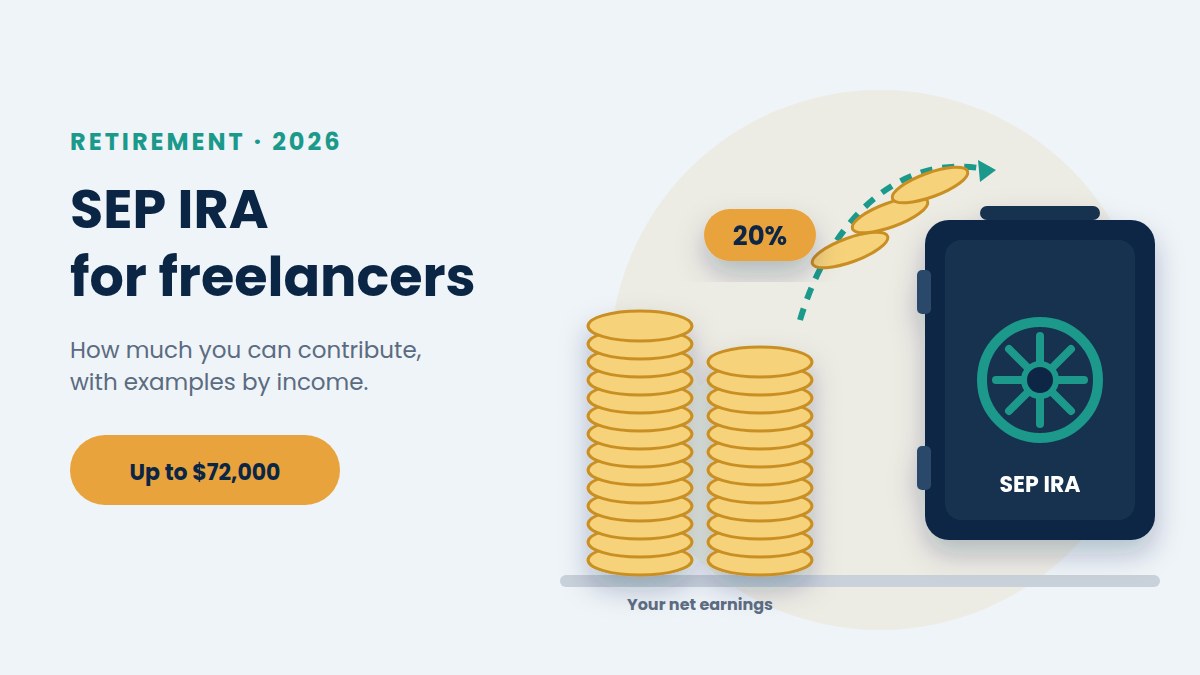
A SEP IRA for freelancers lets you save up to 20% of your net self-employment earnings for retirement, with a cap of $72,000 in 2026. Every dollar you put in lowers your income tax. It’s also one of the simplest accounts to run: no annual IRS filing, and you can open and fund it as late as October of the following year.
The trade-off is that a SEP has no “employee” contribution, so at most incomes you can save less than with a Solo 401(k). To compare every option side by side, see our guide to retirement plans for self-employed people.
2026 SEP IRA limits for freelancers
| Limit | 2026 |
|---|---|
| Maximum contribution | Lesser of 25% of compensation or $72,000 |
| For a sole proprietor, in practice | 20% of net earnings after half of self-employment tax |
| Maximum compensation counted | $360,000 |
| Catch-up contributions | Not allowed |
These are the official SEP contribution limits from the IRS. Unlike a 401(k), there are no catch-up contributions for people 50 and older.
How to calculate your SEP IRA contribution
- Start with your net profit from Schedule C.
- Subtract half of your self-employment tax. The IRS lets you deduct this half, so it’s not part of your plan earnings.
- Multiply the result by 20%. That’s your maximum contribution, up to $72,000.
Why 20% and not 25%? For employees, the 25% applies to their salary. For a sole proprietor, the contribution itself also comes out of your earnings first, which brings the effective rate down to 20%.
Examples: SEP IRA contributions by income
These examples are for a single sole proprietor in 2026.
| Net profit | Half of SE tax | Maximum SEP contribution |
|---|---|---|
| $30,000 | $2,119 | $5,576 |
| $50,000 | $3,532 | $9,294 |
| $100,000 | $7,065 | $18,587 |
| $150,000 | $10,597 | $27,881 |
| $250,000 | $14,787 | $47,043 |
You’d need about $376,000 of net profit to reach the full $72,000. In the 22% federal bracket, a $9,294 contribution saves roughly $2,045 in income tax.
SEP IRA vs Solo 401(k) for freelancers
| Net profit | SEP IRA | Solo 401(k) | Difference |
|---|---|---|---|
| $50,000 | $9,294 | $33,794 | +$24,500 |
| $100,000 | $18,587 | $43,087 | +$24,500 |
| $150,000 | $27,881 | $52,381 | +$24,500 |
At most incomes, a Solo 401(k) lets you save $24,500 more, because it adds an employee contribution on top of the same employer part. See the full Solo 401(k) contribution limits for 2026.
So why choose a SEP? It still wins in a few cases:
- You’re opening the plan late. A SEP can be opened as late as your extended tax deadline in October.
- Paperwork matters to you. A SEP never needs Form 5500-EZ, however large it grows.
- You only want to save a modest amount, such as 10% of your profit.
- A day-job 401(k) already uses your employee limit. The $24,500 is shared, so a Solo 401(k) adds less.
Roth SEP IRA
Since the SECURE 2.0 Act, a SEP can accept Roth contributions. You pay income tax on them now, and qualified withdrawals in retirement are tax-free. Not every provider offers this option yet, so check before you open an account.
Deadlines: open and fund it as late as October
A SEP has the most flexible deadlines of any self-employed plan. According to the IRS SEP FAQs, you can open the plan and make your contribution for a year as late as your tax filing deadline, including extensions.
| For tax year | Without an extension | With an extension |
|---|---|---|
| 2026 | April 15, 2027 | October 15, 2027 |
That means you can wait until you’ve finished your return, see your exact profit and then decide how much to put in. You also don’t have to contribute every year.
How to open a SEP IRA
- Pick a provider. Most big brokerages offer free SEP IRAs, including the ones we compare among the best Solo 401(k) providers.
- Sign the plan agreement. Most providers use the IRS model, Form 5305-SEP. You keep it in your records, and you don’t file it with the IRS.
- Open the SEP IRA account in your name.
- Contribute from your business or personal account by the deadline, and tell the provider which tax year it’s for.
The employee rule
If you hire employees, you must contribute the same percentage of pay for every eligible one. In 2026, an employee is eligible if they’re at least 21, worked for you in 3 of the last 5 years and earned at least $800 from you. For a solo freelancer this doesn’t matter, but keep it in mind before you hire.
Pros and cons of a SEP IRA for freelancers
| Pros | Cons |
|---|---|
| Very simple, no annual IRS filing | Lower limit than a Solo 401(k) at most incomes |
| Open and fund it as late as October | No catch-up contributions after 50 |
| Contributions are optional each year | Must cover eligible employees at the same rate |
| Free at most brokerages | No loans |
How much a SEP IRA saves you in tax
Take a single freelancer with $100,000 of net profit. Her maximum SEP contribution is $18,587, and she lands in the 22% federal bracket.
| Federal bracket | Tax saved on an $18,587 contribution |
|---|---|
| 12% | About $2,230 |
| 22% | About $4,090 |
| 24% | About $4,460 |
| 32% | About $5,950 |
Most states add a further saving. In addition, if you expect a large contribution, you can lower your quarterly estimated taxes during the year instead of waiting for a refund.
A SEP IRA alongside a day job
Many freelancers also have a job with a 401(k). In that case, a SEP for your side business can be a smart fit. Your day-job 401(k) uses the $24,500 employee limit. A SEP, by contrast, only makes employer contributions, so it doesn’t touch that limit.
For example, $30,000 of side profit lets you add up to $5,576 to a SEP. That’s on top of everything you save through work.
Withdrawals and required distributions
A SEP IRA follows the same withdrawal rules as a traditional IRA:
- Before age 59½, withdrawals are taxed and usually carry a 10% extra tax, unless an exception applies.
- After 59½, you pay normal income tax on what you take out of a traditional SEP.
- Required minimum distributions start at age 73 for most people today, and at 75 for people born in 1960 or later.
- No loans. Unlike many 401(k) plans, you can’t borrow from a SEP.
You can also roll a SEP IRA into another IRA, or into a Solo 401(k) if that plan accepts rollovers. So starting with a SEP doesn’t lock you in.
5 SEP IRA mistakes freelancers make
- Using gross income instead of net profit. The 20% applies after expenses and half of self-employment tax, not to your total sales.
- Not telling the provider the tax year. A deposit in March 2027 for 2026 must be marked as a 2026 contribution.
- Leaving the money in cash. Contributions often land in a cash fund. Choose an investment, or the money won’t grow much.
- Forgetting eligible employees. Once you hire, skipping them can disqualify the plan.
- Ignoring the Solo 401(k) option. At incomes under about $150,000, a Solo 401(k) usually lets you save far more.
If you’re not sure which plan fits, run both numbers with your own profit. The difference often decides it for you.
Frequently asked questions
Does a SEP IRA for freelancers lower self-employment tax?
No. Your contribution lowers your income tax only. You still pay the full self-employment tax on your net earnings.
Can I have a SEP IRA and a Roth IRA?
Yes. They have separate limits. In 2026, you can also put up to $7,500 in a Roth IRA, or $8,600 if you’re 50 or older, as long as your income is below the Roth limits.
Can I have a SEP IRA and a Solo 401(k) for the same business?
It’s possible, but rarely worth it. The employer contributions share one limit, and the simple IRS model agreement (Form 5305-SEP) can’t be used if you also have another plan. For most freelancers, it’s better to pick one.
What happens if I put in too much?
Take out the extra amount, plus any earnings on it, before your tax deadline. Otherwise, the IRS charges a 6% tax on the excess for every year it stays in the account.
This article is for general information only and is not legal, tax or financial advice.