
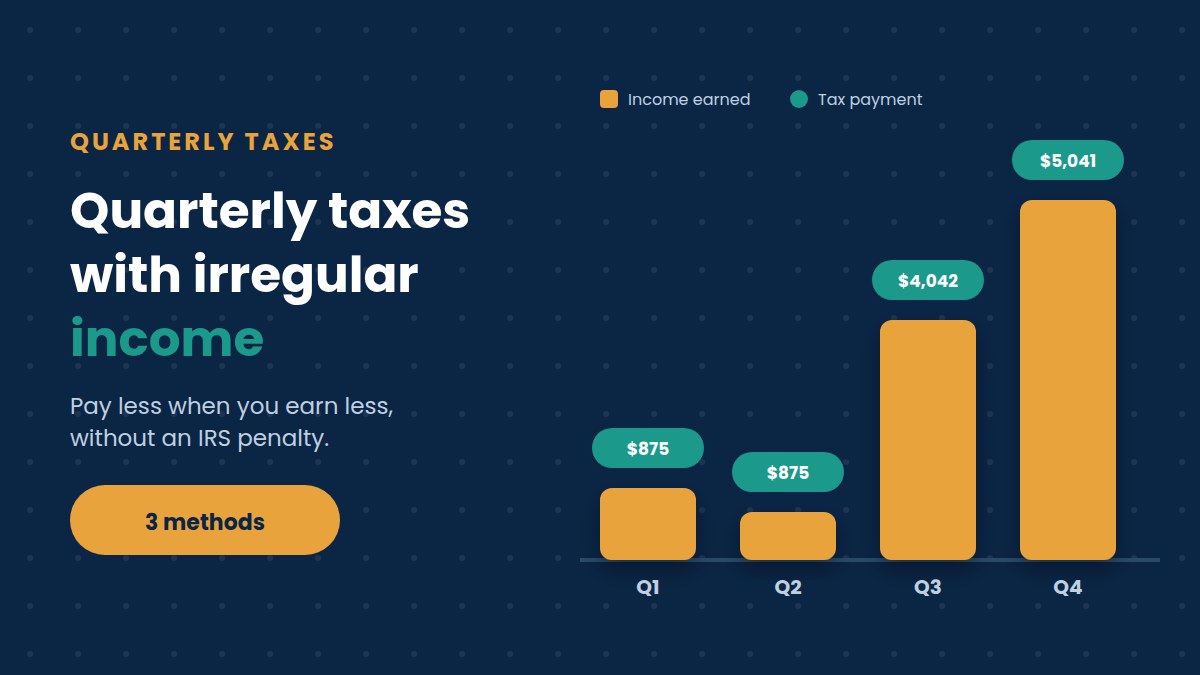
Paying quarterly taxes with irregular income is easier than it looks. You don’t have to split your tax into four equal payments. Instead, you can pick one of three IRS-approved methods: pay a fixed amount based on last year, pay a share of whatever you earn each quarter, or use the annualized income method to pay less in slow months.
Used correctly, each one keeps you clear of the underpayment penalty. If you’re new to estimated taxes, start with our full guide to quarterly estimated taxes.
Method 1: the safe harbor
This is the simplest option. Take last year’s total tax, divide it by four and pay that amount on each due date. If last year’s adjusted gross income was over $150,000, use 110% of last year’s tax instead.
Under the safe harbor rule, you won’t owe a penalty even if this year’s income turns out much higher. You just pay the rest when you file in April.
- Best for: freelancers whose income was similar or lower last year.
- Watch out for: a big April bill if your income has grown a lot.
Method 2: pay as you earn
Set aside a fixed share of every client payment, usually 25% to 30%. Then, on each due date, send the IRS what you’ve saved for that period. In a slow quarter you pay less, and in a busy one you pay more.
This works especially well with a separate tax savings account and a steady salary, like the system in our guide on how to budget with irregular income.
- Best for: freelancers who want their payments to match their cash flow.
- Watch out for: smaller early payments can still trigger a penalty, unless you also use Method 3 when you file. The two methods work best together.
Method 3: the annualized income method
The IRS normally expects four equal payments. But if most of your income arrives late in the year, the annualized income method lets you pay less in early quarters without a penalty. The IRS mentions it on its page about estimated taxes as the option for income that varies during the year.
- Best for: seasonal work or a year with a big project late on.
- Watch out for: extra paperwork, since you have to file Form 2210 with Schedule AI.
Example: quarterly taxes with irregular income, step by step
Kira is a single freelance video editor. Her 2026 profit arrives very unevenly:
| Period | Profit earned | Payment due |
|---|---|---|
| January to March | $6,000 | April 15, 2026 |
| April to May | $4,000 | June 15, 2026 |
| June to August | $20,000 | September 15, 2026 |
| September to December | $30,000 | January 15, 2027 |
| Total | $60,000 |
Her total 2026 tax works out to about $12,037: roughly $8,478 of self-employment tax and $3,559 of income tax. To avoid a penalty based on this year, she needs to pay 90% of it, or about $10,833.
Here’s how the payments compare:
| Due date | Equal payments | Annualized method |
|---|---|---|
| April 15, 2026 | $2,708 | $875 |
| June 15, 2026 | $2,708 | $875 |
| September 15, 2026 | $2,708 | $4,042 |
| January 15, 2027 | $2,708 | $5,041 |
| Total | $10,833 | $10,833 |
The total is the same. However, with the annualized method Kira pays $3,666 less in the first half of the year, when she simply didn’t have the money. Then she catches up once the big projects pay.
How the annualized method works for quarterly taxes with irregular income
The method asks one question at each due date: if you kept earning at this pace all year, what would your tax be? You then pay a set share of that tax, minus what you’ve already paid.
| Due date | Income counted | Multiply it by | Share of the annual tax due so far |
|---|---|---|---|
| April 15 | January 1 to March 31 | 4 | 22.5% |
| June 15 | January 1 to May 31 | 2.4 | 45% |
| September 15 | January 1 to August 31 | 1.5 | 67.5% |
| January 15 | The whole year | 1 | 90% |
For Kira’s first payment, $6,000 × 4 = $24,000 of annualized profit. The tax on $24,000 is about $3,887, and 22.5% of that is $875.
You report all of this on Form 2210, Schedule AI, when you file your return. Keep in mind that if you use it for one due date, you must use it for all four. The IRS Form 2210 instructions walk through every line, and most tax software can fill in Schedule AI for you.
Which method should you use?
- Your income is steady or lower than last year: use the safe harbor. It’s simple and fully protected.
- Your income swings but your total is predictable: pay as you earn, and keep records of what you earned in each period.
- Most of your income comes late in the year: combine pay-as-you-earn with the annualized method at tax time.
How to adjust if your income jumps mid-year
- Recalculate at each due date. Look at your profit so far, not your original estimate.
- Raise your next payment to cover any gap. A larger payment stops the penalty from growing from that day on.
- Keep saving 25% to 30% of each new payment, so the January payment doesn’t catch you short.
The hybrid plan: a safe floor plus savings
Many freelancers with irregular income mix two methods. They pay the safe harbor amount as a fixed minimum each quarter. Meanwhile, they keep saving a share of every payment for the rest.
For example, Leo’s total tax last year was $8,000, and his income was under $150,000. So his safe floor is $2,000 per quarter. He also saves 28% of every client payment in a separate account.
| Due date | Saved that period (28%) | Paid to the IRS | Left in savings |
|---|---|---|---|
| April 15 | $1,400 | $2,000 | −$600 |
| June 15 | $2,800 | $2,000 | $200 |
| September 15 | $4,200 | $2,000 | $2,400 |
| January 15 | $5,600 | $2,000 | $6,000 |
Leo is protected from penalties all year, because he always pays the floor. In addition, the $6,000 left over covers the rest of his bill in April. In a slow first quarter he tops up from his buffer, which is why a small cash cushion helps.
Records that make irregular income easy
The annualized method only works if you can show when you earned each dollar. Most freelancers use the cash method, so income counts on the day you’re paid, not the day you send the invoice.
- Log every payment by the date it arrived. A simple spreadsheet with date, client and amount is enough.
- Log expenses by the date you paid them. They lower the profit for that period.
- Total each IRS period: January to March, April to May, June to August and September to December.
- Save your payment confirmations. You’ll need the date and amount of each one for Form 2210.
Don’t forget state estimated taxes
Most states with an income tax also expect estimated payments. Their rules usually mirror the IRS, but not always. California, for example, asks for 30% of the year’s tax in April, 40% in June, nothing in September and 30% in January.
So check your state’s tax agency for its own dates and forms. Then add your state rate to the share you save from each payment.
4 mistakes freelancers with irregular income make
- Counting invoices instead of payments. A December invoice paid in January belongs to next year’s income.
- Treating the periods as equal. The second period is only two months, and the last one is four. Check every estimated tax due date and what it covers.
- Spending the busy-season cash. A great September often means a big January payment. Keep that money in savings.
- Paying at the last minute. Schedule each payment a few days early when you pay estimated taxes online, so a bank delay doesn’t make it late.
Frequently asked questions
Do I still owe quarterly taxes if my income is irregular?
Yes, if you expect to owe $1,000 or more for the year. Irregular income changes how much you pay each quarter, not whether you pay.
What if one quarter has no income at all?
You can pay nothing for that quarter, as long as you use the annualized method at tax time, or your other payments already cover the safe harbor. Just make sure your records show when you earned each payment.
How much will a missed quarter cost me?
Usually less than people fear. The penalty works like interest, around 7% a year on the shortfall. Try our underpayment penalty calculator to see the exact cost for your situation.
This article is for general information only and is not legal, tax or financial advice. The example is simplified and rounded.