
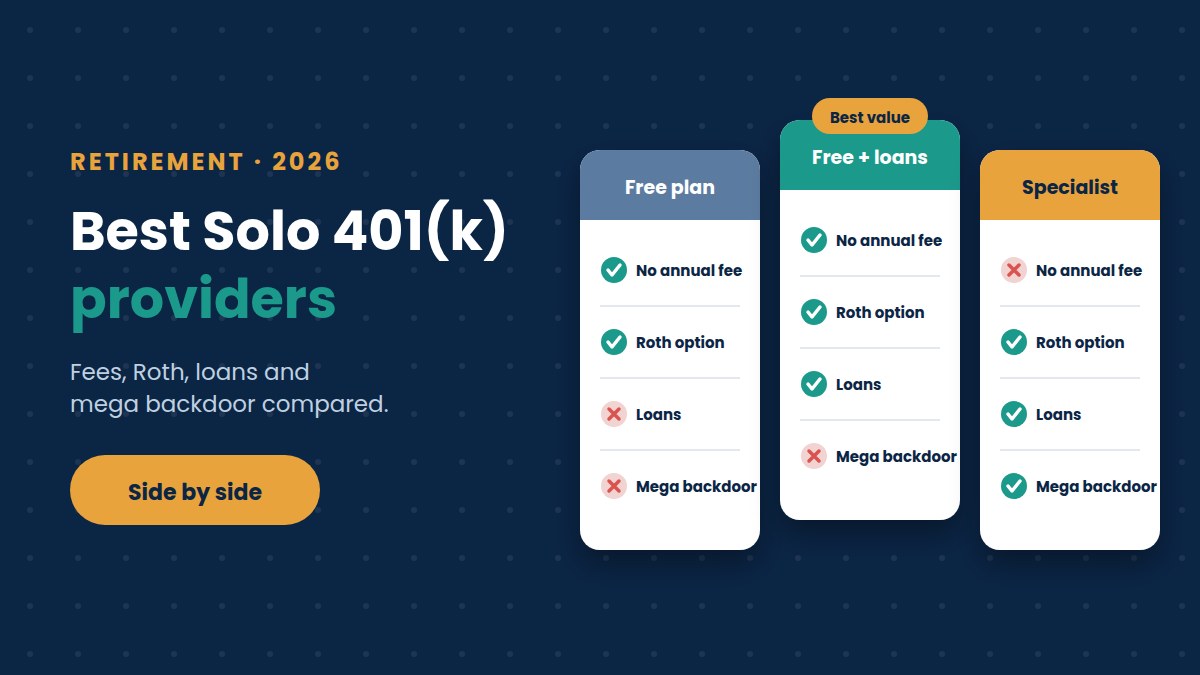
For most freelancers, the best Solo 401(k) providers are the big brokerages: Fidelity, E*TRADE and Charles Schwab. All three charge no setup or annual fee, offer Roth contributions and let you trade stocks and ETFs commission-free. E*TRADE stands out because it also allows loans.
If you earn a lot and want to save beyond the normal limits through a mega backdoor Roth, you’ll need a specialist provider instead. They cost a few hundred dollars a year but unlock extra features. To see how much you can put in, check the 2026 Solo 401(k) contribution limits.
The best Solo 401(k) providers compared
| Provider | Setup fee | Annual fee | Roth | Loans | Mega backdoor Roth | Best for |
|---|---|---|---|---|---|---|
| Fidelity | $0 | $0 | Yes | No | No | Most freelancers |
| E*TRADE | $0 | $0 | Yes | Yes | No | Loans and rolling in old accounts |
| Charles Schwab | $0 | $0 | Yes | No | No | Existing Schwab customers |
| Ascensus (formerly Vanguard) | $0 | $20 a year plus $20 per fund | Yes | No | No | Only if you already have one |
| Specialist providers | About $285 to $999 | About $125 to $400 | Yes | Yes | Yes | High earners and alternative investments |
Fees and features as of October 2026. Commissions on other trades, such as options or bonds, may still apply.
Fidelity: best free all-rounder
With Fidelity’s Self-Employed 401(k), you pay no opening, closing or annual fee. You can make traditional or Roth contributions, roll in money from other plans and invest in a huge range of funds, stocks and ETFs.
- Pros: no fees, Roth option, strong low-cost index funds, $0 online stock and ETF trades.
- Cons: no loans, no hardship withdrawals and no in-plan Roth conversions.
- Best for: freelancers who want a simple, free plan and don’t expect to borrow from it.
E*TRADE: best for loans and rollovers
With E*TRADE’s Individual 401(k), you can make both traditional and Roth contributions. Unlike most free plans, it also lets you take a loan from either account. Stocks and ETFs trade for $0 online.
- Pros: loans allowed, Roth option, accepts rollovers from most account types.
- Cons: fewer in-house low-cost funds than Fidelity.
- Best for: anyone who wants the option to borrow, or plans to consolidate several old accounts.
Charles Schwab: best for existing Schwab customers
Schwab charges no fee to open or maintain an Individual 401(k), and there’s no minimum deposit. Roth contributions are available, and online stock and ETF trades cost $0.
- Pros: no fees, no minimum, Roth option.
- Cons: no loans, and fewer types of rollovers accepted.
- Best for: freelancers who already bank or invest with Schwab.
Ascensus (formerly Vanguard): only if you already have one
Vanguard sold its small business retirement plans to Ascensus in 2024, and it no longer opens new Solo 401(k) accounts. Ascensus charges $20 a year per participant plus $20 a year for each fund you hold.
If you already have one, compare the yearly cost with a free plan. Holding three funds, for example, costs $80 a year, money a free provider would let you keep.
Specialist Solo 401(k) providers: best for mega backdoor Roth
The free plans above use standard plan documents with limited features. Specialist providers, such as My Solo 401k, Nabers Group, IRA Financial and Ubiquity, write custom plans that can include:
- Voluntary after-tax contributions, which make the mega backdoor Roth possible.
- Checkbook control, to invest directly in things like real estate.
- Loans and in-plan Roth conversions.
That flexibility costs money: usually a one-time setup fee of about $285 to $999 and an annual fee of about $125 to $400. It’s mainly worth it for high earners whose regular contributions don’t reach the $72,000 limit.
How to choose among the best Solo 401(k) providers
Ask yourself four questions:
- Do you want to pay any fees? If not, choose Fidelity, E*TRADE or Schwab.
- Might you need a loan? If so, E*TRADE is the only big free provider here that offers one.
- Do you earn enough to hit the limit with regular contributions? If you want to save even more, a specialist plan with after-tax contributions makes sense.
- Where is your money now? Opening the plan where you already invest makes transfers and logins easier.
Still deciding between a Solo 401(k) and other accounts? Our guide to retirement plans for self-employed people compares it with the SEP IRA and Roth IRA.
How to open a Solo 401(k) before December 31
- Get an EIN. Most providers ask for one to set up the plan, and you’ll need it for Form 5500-EZ later. If you don’t have one yet, here’s how to get an EIN for free in minutes.
- Fill out the plan adoption agreement. This is the provider’s standard plan document, and it takes 15 to 30 minutes.
- Open the account in the plan’s name and link your business bank account.
- Choose your investments and set up contributions.
To make employee contributions for 2026, open the plan by December 31, 2026. There’s one exception: a sole proprietor or single-member LLC opening its first plan can wait until the tax filing deadline, April 15, 2027. Even so, opening early gives you time to sort out paperwork without a rush.
Frequently asked questions
Which of the best Solo 401(k) providers has no fees?
Fidelity, E*TRADE and Charles Schwab all charge $0 to open and maintain the account. You only pay the expense ratios of the funds you choose, plus commissions on some trades such as options or bonds.
Can I switch Solo 401(k) providers later?
Yes. You open a new plan with the new provider and move the money over as a direct transfer. Done this way, it isn’t taxed and doesn’t count toward your yearly limit.
Do I have to file anything each year?
Only once the plan holds $250,000 or more at year-end. Then, you must file Form 5500-EZ with the IRS every year. Most free providers don’t file it for you, so put a reminder in your calendar.
Should I fill my HSA or my Solo 401(k) first?
If you have a bronze or other HSA-eligible plan, many experts suggest maxing the HSA first, because money spent on medical costs is never taxed. Our guide to the HSA for self-employed people explains how the two work together.
This article is for general information only and is not legal, tax or financial advice. Provider fees and features can change, so check each provider’s current terms before you open an account.