
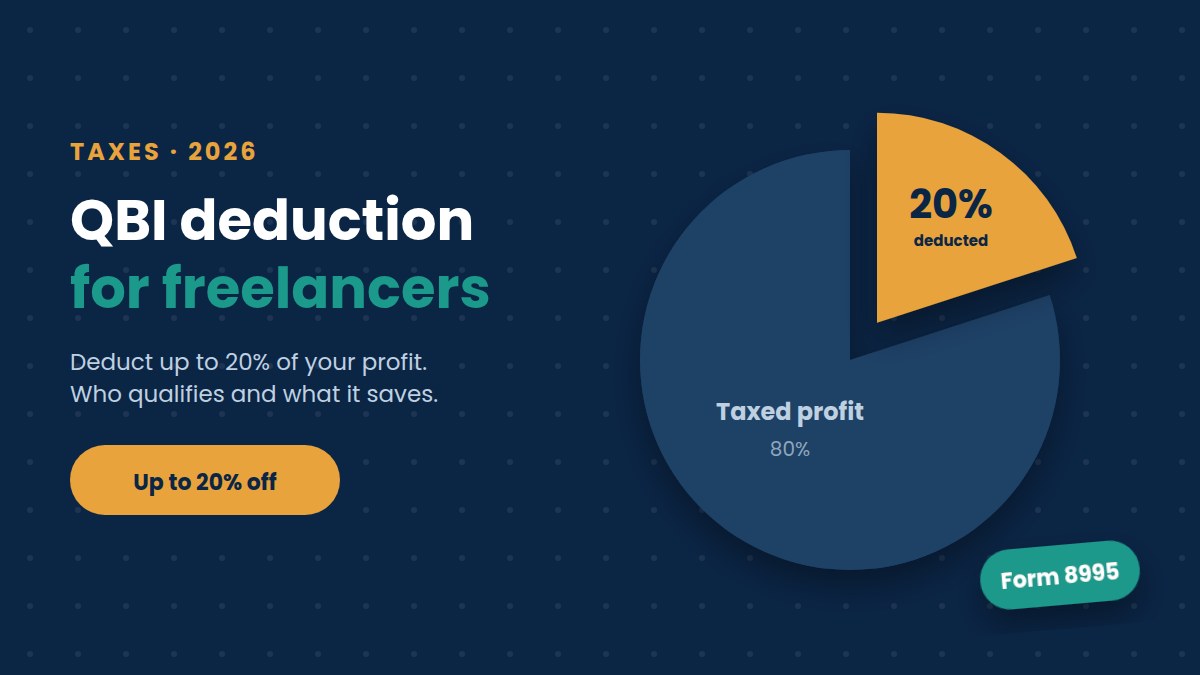
The QBI deduction for freelancers lets most self-employed people deduct up to 20% of their business profit from their taxable income. You don’t need to itemize, and you don’t need to spend any money to get it. Since a 2025 law made it permanent, it will stay available in 2026 and beyond.
The IRS calls it the qualified business income deduction, or Section 199A. If your taxable income is below $201,750 (single) or $403,500 (married filing jointly) in 2026, the rules are simple and nearly every freelancer qualifies.
How the QBI deduction works for freelancers
In most cases, your deduction is the smaller of two amounts:
- 20% of your qualified business income, or
- 20% of your taxable income before the QBI deduction, minus any net capital gains.
The second limit catches many freelancers by surprise. Because the standard deduction lowers your taxable income first, the 20% often ends up applying to that smaller number.
What counts as qualified business income
Qualified business income (QBI) is the net profit from your business. For a freelancer, it starts with the profit on Schedule C. Then, you reduce it by a few related deductions:
- the deductible half of your self-employment tax
- the self-employed health insurance deduction, and
- contributions to a SEP IRA, Solo 401(k) or other retirement plan.
QBI doesn’t include investment income such as capital gains, dividends or interest. It also excludes wages from a job. Keep in mind that the deduction lowers your income tax only. It doesn’t reduce your self-employment tax.
Which freelancers qualify for the QBI deduction
You can usually claim it if you earn business income as a:
- sole proprietor or independent contractor,
- single-member LLC owner,
- partner in a partnership, or
- shareholder in an S corporation.
There’s one catch for S corp owners. The salary you pay yourself isn’t QBI, only the profit left after it. So if you become an S corp, your QBI deduction usually gets smaller. Employees and C corporation owners can’t take the deduction at all.
2026 QBI deduction income limits for freelancers
The limits are based on your taxable income before the QBI deduction.
| Filing status | Simple rules apply up to | Phase-in range | Service businesses get nothing above |
|---|---|---|---|
| Single, head of household | $201,750 | $201,750 to $276,750 | $276,750 |
| Married filing jointly | $403,500 | $403,500 to $553,500 | $553,500 |
Below the threshold, you just take 20% of QBI, subject to the taxable income limit. Above it, two extra limits phase in. First, service businesses lose the deduction step by step. Second, every business is capped by the W-2 wages it pays and the property it owns. Most solo freelancers have neither, so their deduction shrinks quickly once they pass the threshold.
Service businesses (SSTBs): the extra limit
The IRS treats some fields as specified service trades or businesses (SSTBs). They include health, law, accounting, actuarial science, performing arts, consulting, athletics, financial services and investment management.
Many freelance fields are not on the list. Writers, graphic designers, photographers, web developers and delivery drivers usually aren’t SSTBs. Consultants and bookkeepers often are.
If your taxable income is below the threshold, none of this matters. The SSTB rule only applies above $201,750 (single) or $403,500 (joint).
The new $400 minimum deduction
Starting in 2026, a new floor helps freelancers with small profits. If you have at least $1,000 of QBI from a business you actively work in, your deduction is at least $400. Both amounts will rise with inflation after 2026.
This mainly helps side hustlers. For example, a freelancer with $1,500 of QBI would normally get a $300 deduction. With the new rule, that becomes $400.
Example: what the QBI deduction for freelancers saves
Nina is a single web developer with $80,000 of net profit in 2026 and no other income.
| Step | Amount |
|---|---|
| Net profit (Schedule C) | $80,000 |
| Half of self-employment tax | −$5,652 |
| Qualified business income | $74,348 |
| Taxable income before QBI ($74,348 minus the $16,100 standard deduction) | $58,248 |
| 20% of QBI | $14,870 |
| 20% of taxable income | $11,650 |
| QBI deduction (the smaller amount) | $11,650 |
The deduction lowers Nina’s taxable income to $46,598. As a result, her federal income tax drops from about $7,527 to about $5,344. That’s a saving of roughly $2,183 a year, just for filling in one extra form.
How to claim it on Form 8995
You claim the deduction on your Form 1040, but the amount comes from one of two IRS forms:
- Form 8995, the simplified version, if your taxable income is at or below the threshold.
- Form 8995-A if your income is above the threshold, or if you’re a patron of an agricultural cooperative.
Most freelancers only need Form 8995, and it takes a few minutes. Good tax software fills it in for you from your Schedule C. If you’re choosing a program, see our picks for the best tax software for freelancers.
3 ways to get a bigger QBI deduction
- Claim every business expense, but know the trade-off. Expenses lower your QBI, yet they save you far more in income and self-employment tax than the 20% you lose. Never skip a real expense to boost QBI.
- Watch the taxable income limit. If your deduction is capped at 20% of taxable income and you file jointly, a spouse’s income raises that cap.
- Stay below the threshold if you’re close. A contribution to a SEP IRA or Solo 401(k) lowers your taxable income. For a service business near $201,750, that can protect the full deduction.
Frequently asked questions
Does the QBI deduction lower self-employment tax?
No. It only reduces your federal income tax. You still pay the full 15.3% self-employment tax on your net earnings.
Do I need to itemize to get it?
No. You take it on top of the standard deduction, so almost every eligible freelancer benefits.
Can freelancers with an LLC take the QBI deduction?
Yes. A single-member LLC is taxed like a sole proprietorship by default, so its profit counts as QBI. If the LLC elects S corp status, only the profit after your salary counts.
Is the QBI deduction permanent?
Yes. It was set to expire after 2025, but the 2025 tax law made it permanent. The same law also widened the phase-in range and added the $400 minimum deduction from 2026.
This article is for general information only and is not legal, tax or financial advice.