
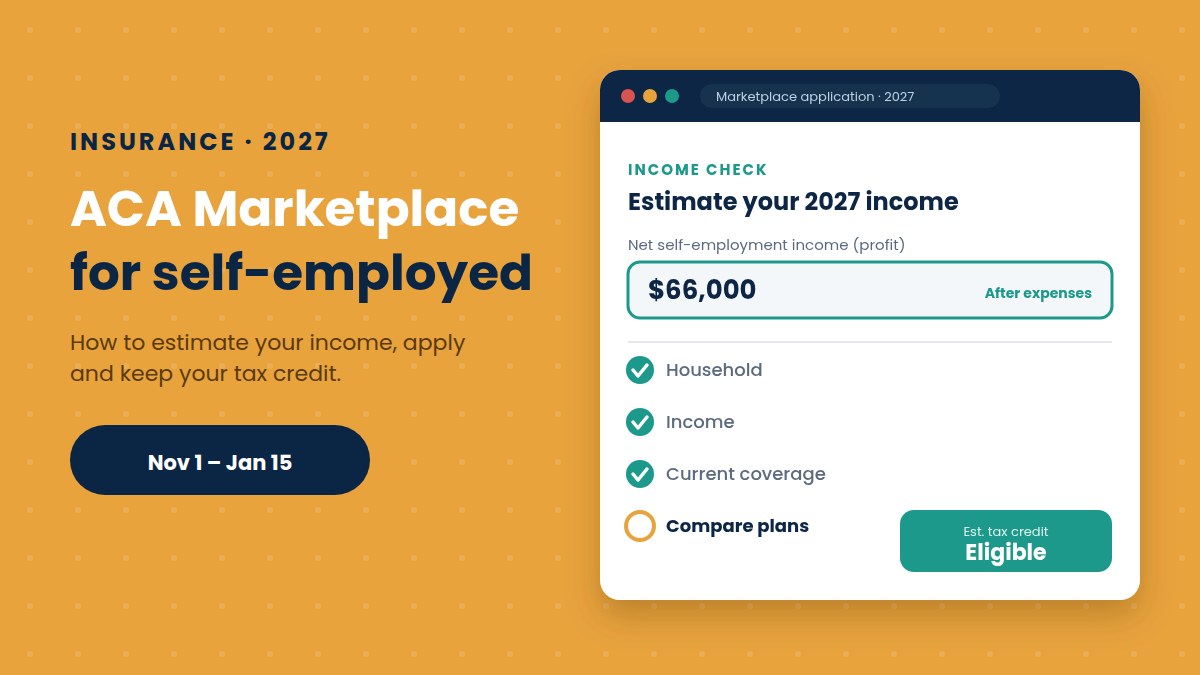
Using the ACA Marketplace for self-employed coverage works much like it does for anyone else. You apply at HealthCare.gov or your state’s exchange, report your household and income, and pick a plan. The big difference is your income. Since nobody hands you a W-2, you have to estimate your net profit for the year, and that number decides your tax credit.
For 2027 coverage, Open Enrollment runs from November 1, 2026, to January 15, 2027. Sign up by December 15 for coverage that starts on January 1. If you’re still comparing all your options, start with our guide to health insurance for freelancers.
What you need before you apply
Gather these before you start. Most people finish the application in under an hour.
- Basic details for everyone in your household: names, birth dates and Social Security numbers.
- Your most recent tax return, including Schedule C.
- Your 2027 income estimate: expected business income, minus expected business expenses.
- Details of any other income, such as a spouse’s salary.
- Information on any job-based coverage you or your family could get, even if you don’t take it.
- Policy numbers for any current health plans.
How self-employed people estimate income for the ACA Marketplace
The Marketplace asks for your net self-employment income, which is your profit after business expenses. It’s the same number you report on Schedule C. HealthCare.gov has its own short guide to estimating self-employment income, and the steps below follow it.
Your tax credit is based on your modified adjusted gross income (MAGI). For most self-employed people, MAGI works out like this:
- Start with your expected business income for the whole year.
- Subtract your expected business expenses. The result is your net profit.
- Subtract half of your self-employment tax. This is a standard adjustment on your tax return.
- Take off other adjustments you expect, such as contributions to a SEP IRA, a Solo 401(k) or an HSA.
- Add any other household income, like a spouse’s wages.
If your income goes up and down, base your estimate on last year’s Schedule C. Then adjust it for clients you’ve won or lost. A steady monthly salary from our system for how to budget with irregular income also makes the yearly figure easier to predict.
How to apply: ACA Marketplace for self-employed workers in 7 steps
- Create an account at HealthCare.gov, or on your state’s own exchange if it has one.
- List your tax household. Include everyone you’ll claim on your tax return, even if they don’t need coverage.
- Enter your income. Use your net self-employment income, not your gross sales.
- Answer the questions about job-based coverage. An affordable employer offer to you or your family can affect your tax credit.
- Review your eligibility results. You’ll see your estimated tax credit. You can take all of it in advance, part of it, or none and claim it when you file.
- Compare plans. Look at the total yearly cost, the provider network and the drug list, not just the monthly premium.
- Enroll and pay your first premium. Your coverage doesn’t start until the insurer receives that first payment.
Example: a self-employed designer applies for 2027
Sam is a single graphic designer. In November 2026, he applies for 2027 coverage and estimates his year like this:
| Line | Amount |
|---|---|
| Expected business income | $78,000 |
| Expected business expenses | −$12,000 |
| Net profit (Schedule C) | $66,000 |
| Half of self-employment tax | −$4,663 |
| Estimated MAGI | $61,337 |
The 2027 income cap for a single person should be about $63,840, so Sam qualifies for a tax credit. If he had typed his $78,000 in sales instead of his profit, the Marketplace would have shown him no help at all.
Now suppose a big client arrives and his profit ends up at $70,000. His MAGI rises to $65,055, which is above the cap. In that case, he’d have to pay back every dollar of advance credit when he files.
Sam has a simple fix. A $5,000 contribution to a SEP IRA brings his MAGI down to $60,055, back under the cap. That’s why the retirement plans for self-employed people are also one of the best tools for keeping a Marketplace subsidy.
Which metal level self-employed people should choose on the ACA Marketplace
| Level | Plan pays, on average | Good for |
|---|---|---|
| Bronze | 60% | Healthy people who want low premiums; works with an HSA |
| Silver | 70% | Lower incomes, since only Silver plans get extra cost-sharing reductions |
| Gold | 80% | People who see doctors often |
| Platinum | 90% | High, predictable medical costs |
If your income is low enough for cost-sharing reductions, a Silver plan is usually the best deal. Otherwise, many healthy freelancers choose Bronze and put the savings in an HSA. If you’re under 30, you can also look at a catastrophic plan.
After you enroll: report changes and file Form 8962
Your estimate isn’t final. If your income changes during the year, update your Marketplace application as soon as possible. Your advance credit then adjusts for the rest of the year, which lowers the risk of a big bill.
Early the next year, you’ll get Form 1095-A from the Marketplace. You use it to complete Form 8962, which compares the credit you received with the credit you actually qualified for. Since 2026, if you got too much, you repay the full difference with your return.
Frequently asked questions
Can I use the ACA Marketplace as self-employed with no income history?
Yes. If you just started freelancing, estimate your profit from the clients and rates you expect. Keep notes on how you got your number, and update your application once you have a few months of real income.
What if my business has a loss?
Report it. A net loss lowers your household income. If your total income ends up too low for a tax credit, you may qualify for Medicaid instead, depending on your state.
Can I buy a small business plan instead?
Not on your own. Small business plans through the Marketplace are for employers with at least one employee. If you work alone, you buy an individual plan like everyone else.
Can I deduct my Marketplace premiums?
Usually, yes, through the self-employed health insurance deduction. However, you can only deduct the part you paid yourself, not the part covered by the tax credit.
This article is for general information only and is not legal, tax, medical or financial advice. Marketplace rules and income limits change every year, so check current details before you apply.