
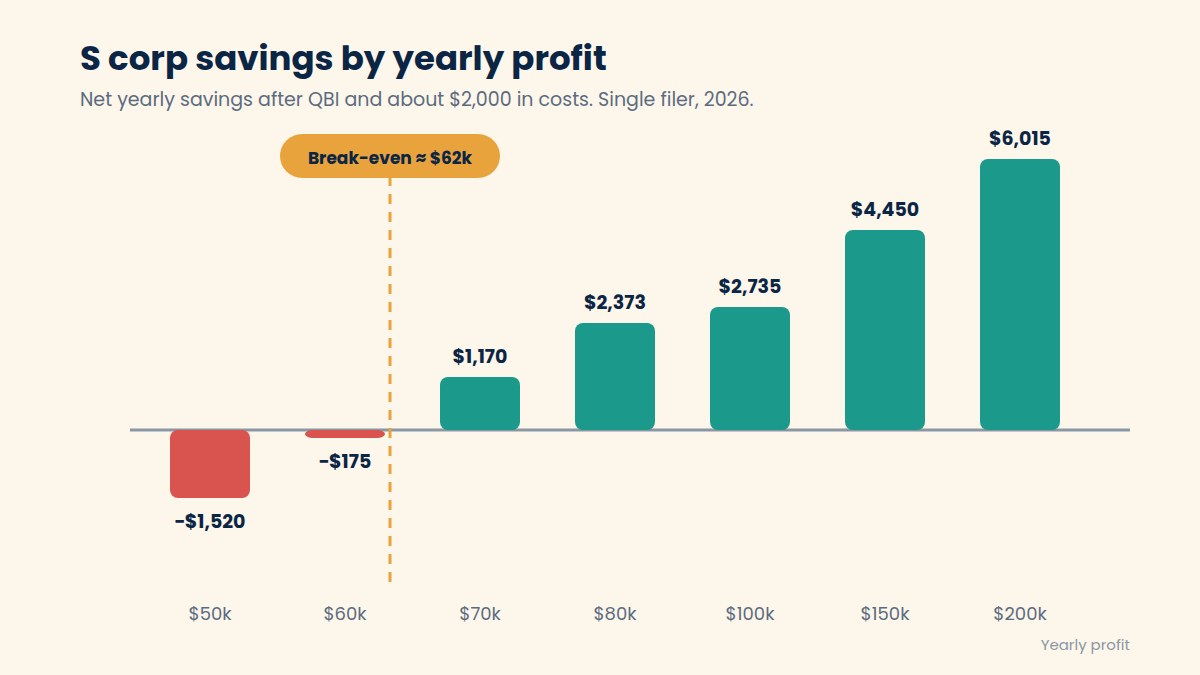
When to become an S corp depends on one number: your yearly profit. For most single freelancers in 2026, the S corp election starts to pay off at about $60,000 to $65,000 of profit. Below that, the extra costs usually eat the savings. Above it, the savings grow steadily, from about $1,000 a year at $70,000 to $6,000 a year at $200,000.
An S corp is a tax status, not a type of company. In practice, most freelancers first form an LLC and then ask the IRS to tax it as an S corp. If you haven’t chosen a structure yet, start with our guide to LLC vs sole proprietor.
How an S corp saves you money
Salary vs distributions
As a sole proprietor, you pay 15.3% self-employment tax on almost all of your profit. With an S corp, by contrast, you split your profit into two parts:
- A salary. You pay yourself through payroll, and the usual 15.3% payroll taxes apply.
- Distributions. The rest of the profit comes out as distributions, with no payroll tax at all.
As a result, every dollar you move from salary to distributions saves about 15 cents. That is the whole S corp advantage in one sentence.
What “reasonable salary” means
Of course, you can’t pay yourself $1 and take the rest as distributions. The IRS requires reasonable compensation for the work you do. In other words, your salary should match what a business would pay someone else for the same job.
The IRS looks at your training, duties, hours and what similar workers earn. Therefore, a full-time designer or developer can rarely justify a salary below $40,000. Setting it too low is the most common S corp audit trigger.
What an S corp costs
The savings come with new yearly costs:
- Payroll service. Running payroll for one person costs roughly $500 to $1,200 a year.
- Business tax return. Your S corp files Form 1120-S, and a CPA usually charges $800 to $2,000 for it.
- Unemployment taxes. Federal unemployment tax is $42 a year on your salary, plus your state’s version.
- State fees. Some states charge S corps extra, as explained below.
In total, most freelancers spend about $2,000 a year to run an S corp. Keep that number in mind, because the election only makes sense when the savings beat it clearly.
The break-even point: when to become an S corp
The table below compares a single freelancer as a sole proprietor and as an S corp in 2026. It includes payroll taxes, income tax, the QBI deduction and about $2,000 a year in S corp costs. For the salary, we assume 50% of profit, but never less than $40,000.
| Yearly profit | S corp salary | Payroll tax saved | Net yearly savings |
|---|---|---|---|
| $50,000 | $40,000 | $945 | −$1,520 |
| $60,000 | $40,000 | $2,358 | −$175 |
| $70,000 | $40,000 | $3,771 | $1,170 |
| $80,000 | $40,000 | $5,184 | $2,373 |
| $100,000 | $50,000 | $6,480 | $2,735 |
| $150,000 | $75,000 | $9,719 | $4,450 |
| $200,000 | $100,000 | $12,934 | $6,015 |
Notice the gap between the last two columns. Payroll tax savings look big, but the net savings are much smaller. That difference comes from the hidden effects in the next section and from the yearly costs.
So the break-even point sits at roughly $62,000 of profit. However, your own number can move. A lower reasonable salary pulls it down, while higher CPA fees or state taxes push it up. To see what you pay today, start with our self-employment tax calculator.
Hidden effects that shrink the savings
Smaller QBI deduction
The 20% qualified business income (QBI) deduction applies to your business profit, but not to your S corp salary. As a result, paying yourself a salary shrinks the deduction. At $100,000 of profit, this alone costs about $1,700 in extra income tax in our example.
Lower retirement contributions
With a Solo 401(k) or SEP IRA, your employer contribution is based on your W-2 salary, not your total profit. So a low salary also means a lower limit on what you can save for retirement.
State and city taxes
Some places tax S corps on their own. For example, California charges S corps a 1.5% franchise tax on net income, with an $800 minimum. Likewise, New York City doesn’t recognize the S corp election for its own corporate tax. Always check your state before you file.
Smaller Social Security benefits
Your future Social Security check depends on the earnings you paid tax on. Therefore, a lower salary today means a slightly smaller benefit when you retire.
Signs it’s time to become an S corp
The election usually makes sense when most of these are true:
- Your profit has been above $70,000 for a full year, and you expect it to stay there.
- Your income is steady, not a one-time spike.
- You already have an LLC, or you plan to form one.
- You are ready to run payroll every month or quarter.
- Your state doesn’t add a heavy S corp tax.
When not to become an S corp
On the other hand, wait if any of these apply:
- Your profit is below about $60,000.
- Your income swings a lot from year to year.
- You live in a high-cost place for S corps, such as New York City.
- Simple paperwork matters more to you than saving $1,000 or so.
- Freelancing is only temporary for you.
How to become an S corp
The process is simpler than most people expect:
- Form an LLC in your state, if you don’t have one yet.
- Get an EIN from the IRS for free.
- File Form 2553 to elect S corp status. An LLC doesn’t need to file Form 8832 first.
- Set up payroll and choose a reasonable salary.
- Pay yourself on schedule. Payroll withholding replaces the quarterly estimated taxes on your salary, but you may still owe estimates on distributions.
- File Form 1120-S each year by March 15, and send yourself a Schedule K-1.
Form 2553 deadlines
Timing matters here. To make the election effective for a tax year, you must file Form 2553 within 2 months and 15 days after that year starts. For a calendar year, that means by March 15. Alternatively, you can file at any time during the year before. So if you want S corp status for 2027, file by March 15, 2027.
Missed the deadline? The Form 2553 instructions explain late election relief, which is often available within 3 years and 75 days if you had reasonable cause.
Frequently asked questions
Do I need an LLC to become an S corp?
No, but it’s the most common route. You can also form a corporation and elect S status. However, a sole proprietor can’t elect S corp status without first creating a business entity.
Can I switch back from an S corp?
Yes. You can revoke the election by sending the IRS a signed statement from the owners. Keep in mind, though, that you generally can’t elect S corp status again for five years.
Is $50,000 enough profit to become an S corp?
Usually not. At $50,000, the payroll tax savings are smaller than the yearly costs in most cases. Instead, revisit the decision once your profit stays above $65,000 or so.
This article is for general information only and is not tax advice. Our break-even table uses simplified 2026 federal numbers for a single filer with no other income. Talk to a CPA or enrolled agent before you elect S corp status.