
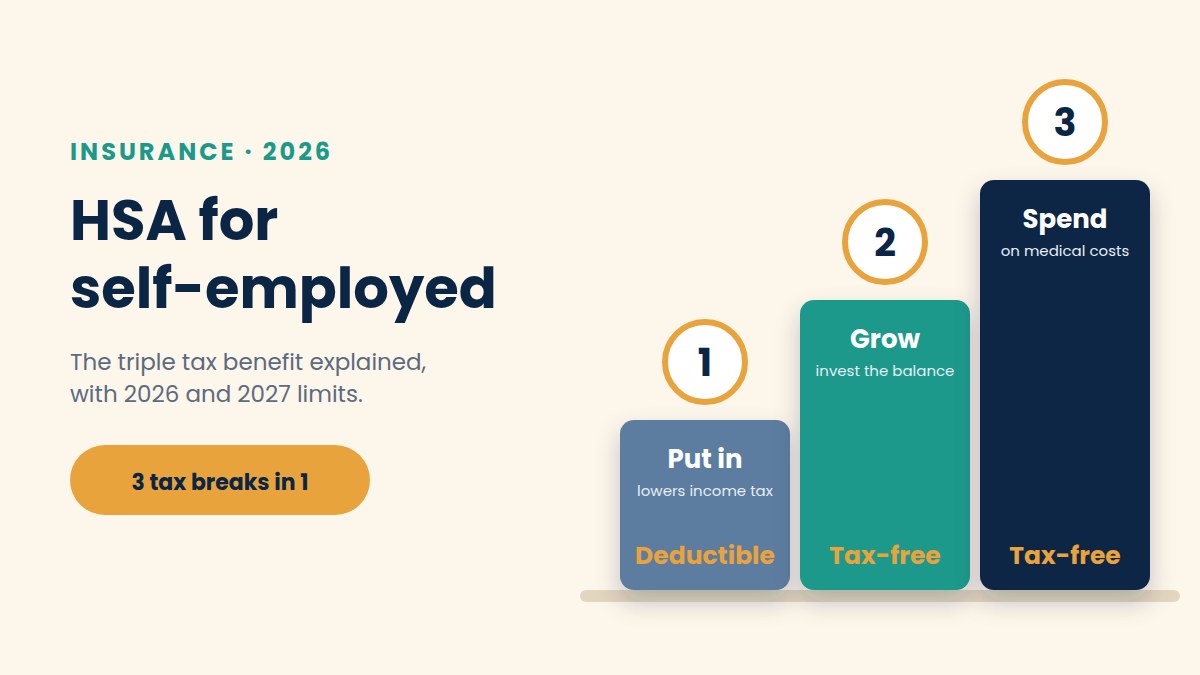
An HSA for self-employed people is a savings account for medical costs with a rare triple tax benefit. You can open one if you have a high-deductible health plan, even without an employer. In 2026, you can put in up to $4,400 with self-only coverage or $8,750 with family coverage.
It pairs naturally with the cheaper plans many freelancers choose. If you’re still picking coverage, start with our guide to health insurance for freelancers.
The triple tax benefit, explained
- Money in is deductible. Your contributions lower your taxable income, whether or not you itemize.
- Growth is tax-free. You can invest the balance in funds, and you pay no tax on interest, dividends or gains.
- Money out is tax-free when you spend it on qualified medical expenses.
No other account gets all three. A traditional IRA taxes withdrawals, and a Roth IRA gives no deduction.
Who qualifies for an HSA as a self-employed person
You can contribute for any month in which you:
- are covered by a high-deductible health plan (HDHP),
- have no other health coverage that isn’t an HDHP, such as a spouse’s regular plan,
- aren’t enrolled in Medicare, and
- can’t be claimed as someone else’s dependent.
In 2026, an HDHP must have a deductible of at least $1,700 for self-only coverage or $3,400 for family coverage. Its out-of-pocket maximum can’t be more than $8,500 or $17,000.
There’s also good news from 2026. According to IRS Notice 2026-5, every bronze and catastrophic plan bought through an Exchange now counts as an HDHP. So if you buy a Marketplace plan at the bronze level, you can open an HSA alongside it.
HSA contribution limits for 2026 and 2027
| Coverage | 2026 limit | 2027 limit |
|---|---|---|
| Self-only | $4,400 | $4,500 |
| Family | $8,750 | $9,000 |
| Extra catch-up, age 55 or older | +$1,000 | +$1,000 |
You can contribute for a year until the tax filing deadline, usually April 15 of the following year. For example, you have until April 15, 2027, to make 2026 contributions.
How self-employed people contribute and deduct
Without an employer, you open the HSA yourself and pay in from your own bank account. Then, at tax time, you report the contributions on Form 8889 and deduct them on Schedule 1 of your Form 1040.
There’s one difference from employees. When an employer runs HSA money through payroll, it also escapes Social Security and Medicare tax. Your contributions, however, lower only your income tax, not your self-employment tax. Even so, the income tax saving alone is usually worth it.
The IRS covers every rule in Publication 969, including what happens if you change plans midyear.
Example: what an HSA saves a freelancer
Diego is a single freelance photographer in the 22% federal tax bracket. He has a bronze Marketplace plan and puts the full $4,400 into an HSA for 2026.
- Tax saved this year: about $968 in federal income tax, plus any state tax savings.
- If he keeps it invested: $4,400 a year for 25 years, at a 6% average return, grows to roughly $256,000.
- What he actually put in: $110,000.
If Diego spends that money on medical costs in retirement, he never pays tax on any of it.
How to open an HSA when you’re self-employed
- Confirm your plan is HSA-eligible. A bronze or catastrophic Marketplace plan qualifies from 2026. For other plans, check that the insurer lists it as an HDHP.
- Pick a provider. Many banks and brokerages offer HSAs. Look for no monthly fees and low-cost investment funds.
- Open the account online. It takes about 10 minutes and works much like opening a bank account.
- Set up automatic transfers. A fixed monthly amount from your business income makes it easy to reach the limit.
- Invest what you won’t need soon. Keep a small cash buffer for this year’s bills and invest the rest.
What you can spend it on
Qualified medical expenses include deductibles, copays, prescriptions, dental care, eye exams and glasses. You can pay for your spouse and dependents too, even if they aren’t on your plan.
In general, health insurance premiums don’t count. There are a few exceptions, such as COBRA premiums and Medicare premiums after 65.
Use your HSA for self-employed retirement savings
After age 65, the HSA works like a traditional IRA for anything other than medical costs. You pay income tax on non-medical withdrawals, but no penalty. Medical withdrawals stay tax-free for life.
That’s why many freelancers treat it as a second retirement account, next to a Solo 401(k). A popular approach is to pay today’s medical bills out of pocket, keep the receipts and let the HSA grow. There’s no deadline for paying yourself back, so you can reimburse those expenses years later.
5 HSA mistakes self-employed people make
- Contributing after enrolling in Medicare. Once Medicare starts, you can’t add money, though you can still spend it.
- Missing other coverage. A spouse’s regular plan that also covers you makes you ineligible.
- Going over the limit. Excess contributions face a 6% tax every year until you remove them.
- Leaving everything in cash. The tax-free growth only works if the money is invested.
- Spending it on non-medical costs before 65. You’d owe income tax plus a 20% penalty.
How much an HSA for self-employed people saves by tax bracket
Your yearly saving depends on your federal bracket. The table below shows the federal income tax you avoid by contributing the full 2026 limit. State tax savings come on top in most states.
| Federal bracket | Self-only ($4,400) | Family ($8,750) |
|---|---|---|
| 12% | $528 | $1,050 |
| 22% | $968 | $1,925 |
| 24% | $1,056 | $2,100 |
| 32% | $1,408 | $2,800 |
Can’t afford the full amount? Any contribution still counts. For example, $150 a month adds up to $1,800 a year. In the 22% bracket, that saves about $396 in federal tax.
Irregular income makes a fixed monthly transfer hard for many freelancers. Instead, you can top up the account after a good month. Another option is one lump sum before the April deadline, once you know your profit. Our guide on budgeting with irregular income shows how to plan for it.
Special HSA rules worth knowing
Starting an HDHP partway through the year
Normally, your limit is prorated by month. So if you join an HDHP in July, you can contribute half the yearly limit. However, the IRS offers a shortcut called the last-month rule.
If you’re eligible on December 1, you can contribute the full yearly amount. In exchange, you must stay eligible through the testing period, which runs until December 31 of the next year. If you lose eligibility early, the extra amount becomes taxable income. On top of that, you’d owe an additional 10% tax on it.
If you’re married
With family coverage, the $8,750 limit is shared by both spouses. You can split it however you like between two HSAs. Each spouse who is 55 or older can also add a $1,000 catch-up. That extra amount must go into their own account, though.
Watch for one trap, too. If your spouse has a regular employer plan that also covers you, you usually can’t contribute at all.
Keeping records
Your HSA provider reports withdrawals to the IRS on Form 1099-SA. Contributions appear on Form 5498-SA. However, neither form proves a withdrawal was for medical care. That part is your job.
- Save every receipt and explanation of benefits in one digital folder.
- Note the date, the amount and who received the care.
- Keep these records for as long as you might reimburse yourself, plus three years.
Good records matter most if you plan to reimburse yourself years later. Without proof, the IRS can treat old withdrawals as non-medical.
HSA vs other ways to save on health costs
An HSA isn’t the only tax break for self-employed health costs. You can also deduct your premiums with the self-employed health insurance deduction. Both can apply in the same year, since premiums and HSA contributions are separate deductions.
Meanwhile, a low-deductible plan might suit you better if you expect big medical bills. In that case, the lower deductible can be worth more than the HSA tax break. So compare the total yearly cost of each plan, not only the premium.
Frequently asked questions
Can I open an HSA for self-employed income without a business account?
Yes. An HSA belongs to you, not your business. You open it in your own name and can fund it from any account, personal or business.
Does my HSA lower my Marketplace income?
Yes. HSA contributions reduce your adjusted gross income, which can raise your premium tax credit. Near the 400% income cap, that can make a big difference.
What happens to my HSA if I change plans?
The money stays yours. You just can’t add new contributions for months without an HDHP. You can still spend the balance on medical costs at any time.
Can I have an HSA and a health FSA?
Usually not, if the FSA covers general medical costs. Self-employed people rarely have an FSA anyway, since they’re offered through employers.
This article is for general information only and is not legal, tax, medical or financial advice.