
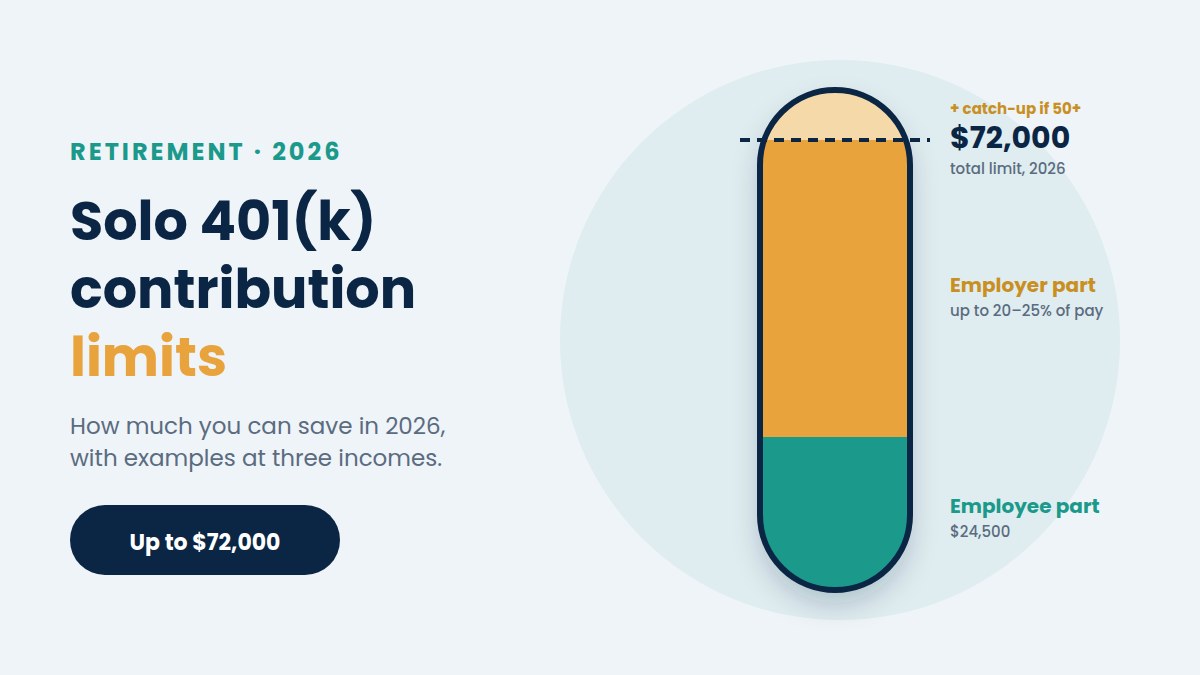
The Solo 401(k) contribution limits for 2026 let you save up to $72,000, or more if you’re 50 or older. That total has two parts. As the “employee,” you can put in up to $24,500. As the “employer,” your business can add up to 20% of your net self-employment earnings.
Because you wear both hats, a Solo 401(k) usually lets you save more than a SEP IRA at the same income. To compare it with other accounts, see our guide to retirement plans for self-employed people.
The 2026 Solo 401(k) contribution limits at a glance
| Limit | 2026 amount |
|---|---|
| Employee deferral | $24,500 |
| Catch-up, age 50 to 59 or 64 and older | +$8,000 |
| Catch-up, age 60 to 63 | +$11,250 |
| Total limit, under 50 | $72,000 |
| Total limit, age 50 to 59 or 64 and older | $80,000 |
| Total limit, age 60 to 63 | $83,250 |
| Maximum compensation counted | $360,000 |
These are the official 2026 limits published by the IRS. Catch-up contributions sit on top of the $72,000 total, so they don’t eat into it. Also, your contributions can never be more than your net self-employment earnings.
How the employer contribution works for sole proprietors
The employee part is simple: any amount up to $24,500, as long as you earn at least that much. The employer part takes a short calculation.
- Start with your net profit from Schedule C.
- Subtract half of your self-employment tax. The result is your net earnings for retirement plan purposes.
- Multiply by 20%. That’s the most your business can contribute as the employer.
You may see “25%” in IRS materials. For employees, the employer can contribute up to 25% of pay. For a sole proprietor, though, the contribution itself is subtracted from your earnings first, so 25% works out to 20% of the amount from step 2.
How it works if you’re an S corp
If your business is taxed as an S corp, the rules use your W-2 salary instead of your profit:
- Employee part: up to $24,500, taken out of your salary.
- Employer part: up to 25% of your W-2 salary, paid by the corporation.
Profit you take as distributions doesn’t count. For example, with a $60,000 salary, you could contribute $24,500 plus $15,000, or $39,500 in total. A higher salary raises the limit but also your payroll taxes, so it’s a trade-off worth checking with an accountant.
One more 2026 rule applies to S corp owners over 50. If your W-2 wages from the company were more than $150,000 in 2025, your catch-up contributions must go in as Roth.
Examples: Solo 401(k) contribution limits at three incomes
These examples are for a single sole proprietor under 50 with no other job, in 2026.
| Net profit | Employee part | Employer part (20%) | Total you can contribute |
|---|---|---|---|
| $50,000 | $24,500 | $9,294 | $33,794 |
| $100,000 | $24,500 | $18,587 | $43,087 |
| $150,000 | $24,500 | $27,881 | $52,381 |
At a net profit of about $250,000, the total reaches the $72,000 cap. For comparison, a SEP IRA at $50,000 of profit would allow only $9,294, the employer part alone. That’s why a Solo 401(k) is usually the better choice at lower and middle incomes.
Every dollar you contribute pre-tax lowers your income tax. It also trims your qualified business income a little, so your QBI deduction gets slightly smaller. Even so, the tax saving from the contribution is much larger.
Traditional or Roth?
Most Solo 401(k) plans let you make the employee part as traditional (pre-tax) or Roth (after-tax) contributions, or a mix. Traditional saves tax now. Roth saves tax later, because qualified withdrawals in retirement are tax-free. Some plans also let the employer part go in as Roth, but you pay income tax on it in the year you contribute.
As a rule of thumb, Roth makes more sense in low-income years, such as your first year of freelancing.
Deadlines and paperwork
- Opening the plan: normally by December 31, 2026, for 2026 contributions. If you’re a sole proprietor or single-member LLC opening your first plan, you can open it as late as your tax filing deadline, April 15, 2027, and still make employee contributions for 2026.
- Employer contributions: by your tax filing deadline, including extensions.
- Form 5500-EZ: you must file it each year once the plan holds $250,000 or more at year-end. The IRS page on one-participant 401(k) plans explains the details.
If you hire an employee who meets the plan’s eligibility rules, a Solo 401(k) no longer fits. You’d need to include them and move to a regular 401(k).
Solo 401(k) contribution limits vs SEP IRA limits
A SEP IRA only allows the employer part. A Solo 401(k), by contrast, adds the $24,500 employee part on top. The gap is widest at lower and middle incomes, as this 2026 comparison shows.
| Net profit | SEP IRA maximum | Solo 401(k) maximum | Extra room with a Solo 401(k) |
|---|---|---|---|
| $40,000 | $7,435 | $31,935 | $24,500 |
| $75,000 | $13,940 | $38,440 | $24,500 |
| $200,000 | $37,177 | $61,677 | $24,500 |
The figures assume a single sole proprietor under 50 with no other job. At very high incomes, both plans eventually hit the same $72,000 ceiling. Below that point, however, the Solo 401(k) always offers $24,500 more room. If you’d still like the simpler option, read our guide to the SEP IRA for freelancers.
How much a Solo 401(k) saves in tax
Traditional contributions lower your taxable income dollar for dollar. So the saving depends mainly on your federal bracket:
- 12% bracket: each $1,000 you contribute saves about $120 in federal income tax.
- 22% bracket: each $1,000 saves about $220.
- 24% bracket: each $1,000 saves about $240.
A large contribution can also drop part of your income into a lower bracket. As a result, the saving per dollar shrinks as you contribute more. That’s one reason many freelancers split their money between traditional and Roth.
Keep in mind that contributions don’t reduce your self-employment tax. That tax is based on your Schedule C profit, before any retirement contributions.
How to open a Solo 401(k) in 4 steps
- Pick a provider. Compare fees, Roth options and investment choices in our review of the best Solo 401(k) providers.
- Get an EIN. Most providers ask for one, even if you’re a sole proprietor. It’s free and takes a few minutes on the IRS website.
- Sign the plan documents. The provider gives you an adoption agreement. Signing it is what legally creates the plan.
- Fund it. Transfer money from your business account and label each deposit as employee or employer money.
Labeling deposits matters, because the two parts follow different limits and deadlines. Your provider’s statements should show both.
Common Solo 401(k) mistakes
- Using gross revenue instead of net profit. The employer part is based on profit after expenses and half of your self-employment tax.
- Forgetting a day-job 401(k). The $24,500 employee limit covers every 401(k) you have, not just this one.
- Missing Form 5500-EZ. Once the plan passes $250,000, late filing penalties can add up quickly.
- Waiting until April to plan. Contributions are much easier to fund when you set money aside during the year.
Frequently asked questions
Do Solo 401(k) contribution limits change if I also have a job with a 401(k)?
Yes, partly. The $24,500 employee limit is shared across every 401(k) you contribute to. So if you defer $15,000 at your job, you can only add $9,500 as an employee to your Solo 401(k). The employer part from your business has its own separate limit.
Can my spouse join my Solo 401(k)?
Yes, if your spouse earns income from your business. Each of you then gets your own employee and employer limits, which can roughly double what your household saves.
What happens if I contribute too much?
You need to take out the excess, plus any earnings on it. For employee deferrals, do this by April 15 of the following year. Otherwise, the extra amount can be taxed twice.
This article is for general information only and is not legal, tax or financial advice.