
If you write for a living, the tools of your trade cost money: a laptop, software, books, a website and sometimes a trip to research a story. Fortunately, most of those costs are tax deductions for freelance writers, and claiming them can cut your tax bill by thousands of dollars. However, many writers miss them because nobody withholds tax from their income and nobody hands them a checklist.
This guide covers the deductions that matter most to freelance writers, copywriters, journalists, bloggers and self-published authors. In addition, it explains the special rules that only apply to writers, shows a worked example and lists the expenses you can’t deduct.
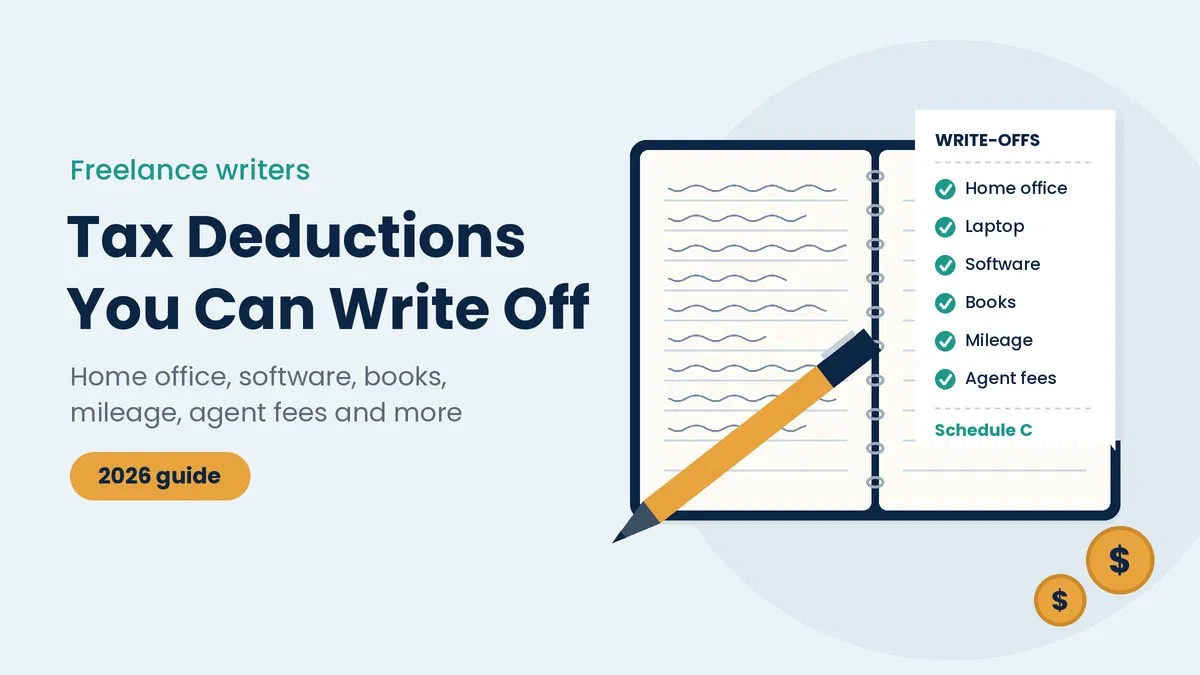
Quick answer: the most valuable tax deductions for freelance writers in 2026 are the home office, computer and equipment, software and subscriptions, internet and phone, books and research materials, professional fees (including literary agent commissions), travel and mileage, education and marketing. You claim them on Schedule C, so each dollar you deduct lowers both your income tax and your 15.3% self-employment tax.
How tax deductions work for freelance writers
As a self-employed writer, you report your business income and expenses on Schedule C. The result, your net profit, is the figure on which you pay both income tax and self-employment tax. Therefore, every legitimate expense reduces two taxes at once.
To be deductible, an expense must be ordinary and necessary for your writing business. In other words, it must be common in your line of work and helpful for earning income. For example, a style-guide subscription clearly qualifies, while a novel you read on vacation usually doesn’t.
Because the 15.3% self-employment tax applies from the very first dollar of profit, deductions are especially valuable for writers with modest incomes. If you’re not sure how that tax works, start with Self-Employment Tax Explained.
The best tax deductions for freelance writers
1. Home office
If you write from a space in your home that you use regularly and exclusively for your business, you can deduct part of your housing costs. For example, a spare room used only as your office qualifies. On the other hand, a kitchen table where the family also eats does not.
There are two methods:
- Simplified method: $5 per square foot of office space, up to 300 square feet, for a maximum deduction of $1,500.
- Regular method: the business percentage of your actual costs, such as rent or mortgage interest, utilities, insurance and repairs, calculated on Form 8829.
The regular method usually gives a bigger deduction for renters in expensive cities. However, it requires more records. You can check the full rules on the IRS home office deduction page, and we compare both options step by step in our guide to the home office deduction.
2. Computer and equipment
Your laptop, monitor, keyboard, printer, headphones and even an ergonomic chair are deductible when you use them for work. In most cases, you can deduct the full cost in the year you buy them. For instance, items costing $2,500 or less each can usually be expensed right away under the de minimis safe harbor, and more expensive equipment can often be written off immediately through Section 179 or bonus depreciation.
If you also use the equipment personally, you can only deduct the business-use percentage. Consequently, a laptop used 80% for writing and 20% for streaming is 80% deductible.
3. Software and subscriptions
Writers rely on a growing list of tools, and almost all of them are deductible. Common examples include:
- Word processors and writing apps such as Microsoft 365, Scrivener or Ulysses
- Grammar and style tools such as Grammarly or ProWritingAid
- Cloud storage and backup services
- SEO and keyword research tools, which are essential for content writers
- AI writing and transcription tools you use for client work
- Password managers, invoicing apps and project management software
Similarly, subscriptions to style guides, such as the AP Stylebook or the Chicago Manual of Style online, also count.
4. Internet and phone
You can deduct the business portion of your internet and mobile phone bills. For example, if about 60% of your internet use is for research, client calls and writing, you can deduct 60% of the bill. Because the IRS may ask how you arrived at the percentage, it’s a good idea to track your usage for a typical month and keep that note with your records.
5. Books, magazines and research materials
This is one of the most overlooked tax deductions for freelance writers. Books, e-books, newspaper and magazine subscriptions, academic databases and paid research reports are deductible when they relate to your work. For instance, a health writer can deduct medical journals, and a travel writer can deduct guidebooks for destinations they cover.
However, general reading for pleasure is a personal expense. As a rule, the clearer the link between the material and a specific project or niche, the safer the deduction.
6. Research travel
When you travel primarily for business, for example to report a story, attend a writers’ conference or research a book, your travel costs are deductible. That includes flights, trains, lodging, rental cars and 50% of your meals while you’re away.
The trip must be mainly for business, though. If you add a few vacation days to a research trip, you can still deduct the travel to and from the destination, but not the costs of the personal days. Meanwhile, a vacation where you happen to write a blog post doesn’t qualify.
7. Mileage and car expenses
If you drive to interviews, client meetings, the library for research or a coworking space, you can deduct those business miles. For tax year 2026, the IRS standard mileage rate is 72.5 cents per mile from January 1 to June 30 and 76 cents per mile from July 1 to December 31, after a mid-year increase. You can confirm the current figures on the IRS standard mileage rates page.
Alternatively, you can deduct the business percentage of your actual car costs. In either case, keep a mileage log with dates, destinations, purpose and miles. Commuting from home to a regular office, however, is never deductible.
8. Professional fees and literary agent commissions
Fees you pay to professionals who help your writing business are deductible. These include:
- Literary agent commissions, typically a percentage of your advances and royalties
- Accountants and tax preparers, for the business part of your return
- Lawyers who review book contracts or publishing agreements
- Freelance editors, proofreaders and virtual assistants you hire
If your publisher pays you after deducting the agent’s commission, make sure you report the gross amount as income and the commission as an expense. Otherwise, your income may not match the forms you receive.
9. Memberships, conferences and education
Membership dues for professional organizations, such as writers’ guilds, journalism associations or copywriting communities, are deductible. In addition, registration fees for writing conferences and workshops count, together with the travel to attend them.
Courses that maintain or improve skills you already use in your business are also deductible. For example, an SEO writing course for a content writer qualifies. In contrast, education that prepares you for a completely new profession generally does not.
10. Website, newsletter and marketing
Your online presence is a business asset. Therefore, you can deduct domain names, hosting, website themes and plugins, portfolio platforms and newsletter tools. Likewise, marketing costs count, including business cards, paid ads, sponsored posts and fees for premium job boards or pitching platforms.
11. Submission fees, contests and copyright
Writers face a few costs that other freelancers don’t. For example, contest entry fees, literary magazine submission fees and copyright registration fees are all deductible business expenses when they relate to your professional writing.
12. Self-publishing costs
If you self-publish books, you can deduct the costs of producing and selling them. These include editing, cover design, formatting, ISBNs, proof copies, audiobook narration and advertising on platforms such as Amazon. As a result, a book that doesn’t sell well in its first year can still reduce your tax bill.
13. Payment platform and bank fees
Fees charged by PayPal, Stripe, freelance marketplaces or your business bank are deductible. This matters because platforms report your gross payments on Form 1099-K, before fees. Consequently, you should report the gross amount as income and deduct the fees separately; our guide to 1099-NEC vs 1099-K explains how.
14. Office supplies and coworking
Notebooks, pens, printer ink, a desk lamp and postage are small costs, but they add up over a year. Similarly, a coworking membership or library carrel rental is deductible if you use it for work.
15. Deductions you take outside Schedule C
Finally, a few valuable deductions don’t go on Schedule C but still reduce your income tax:
- Half of your self-employment tax, which your tax software calculates automatically.
- Self-employed health insurance premiums, if you weren’t eligible for an employer plan.
- Retirement contributions to a SEP IRA or Solo 401(k).
- The QBI deduction, worth up to 20% of your qualified business income for most writers.
Tax deductions for freelance writers at a glance
| Expense | What you can deduct | Where it goes |
|---|---|---|
| Home office | $5/sq ft up to 300 sq ft, or actual costs | Schedule C, line 30 |
| Laptop and equipment | Business-use share, usually all in year one | Schedule C (expenses or depreciation) |
| Software and subscriptions | 100% if used only for business | Schedule C, other expenses |
| Internet and phone | Business-use percentage | Schedule C, utilities or other expenses |
| Books and research | Material related to your work | Schedule C, supplies or other expenses |
| Research travel | Transport, lodging, 50% of meals | Schedule C, travel and meals |
| Mileage | 72.5¢/mile (Jan–Jun), 76¢/mile (Jul–Dec) 2026 | Schedule C, car expenses |
| Agent and professional fees | 100% | Schedule C, commissions or legal and professional |
| Memberships and courses | 100% if business-related | Schedule C, other expenses |
| Website and marketing | 100% | Schedule C, advertising or other expenses |
| Platform fees | 100% | Schedule C, commissions and fees |
Special tax rules for writers
You can usually deduct writing costs before you earn money
Normally, businesses that create a product must spread some of its costs over time. However, the tax code includes an exception for freelance authors, artists and photographers. Under this rule, individuals whose personal efforts create a literary work can generally deduct qualifying creative expenses as they pay them, instead of waiting until the book earns royalties. In practice, this means the costs of writing your book this year can reduce this year’s taxes.
Royalties usually go on Schedule C
If writing is your business, book royalties generally belong on Schedule C, where they’re also subject to self-employment tax. Publishers often report royalties on Form 1099-MISC, and the reporting threshold for royalties is just $10. On the other hand, royalties from a book you wrote as a one-off, while not working as a writer, may go on Schedule E instead.
Business or hobby?
The IRS only allows these deductions if you write to make a profit. If you’ve written for years without earning money, the IRS may treat your writing as a hobby, and hobby expenses currently aren’t deductible. As a general guideline, the IRS presumes you have a profit motive if you made a profit in at least three of the last five years. In addition, acting like a business, for example by pitching, invoicing and keeping records, helps support your case.
Example: how much can a freelance writer save?
Let’s look at a single freelance writer who earned $55,000 in 2026 and had $9,000 in legitimate business expenses: a home office, a new laptop, software, books, internet and phone, a conference and website costs.
| No deductions claimed | Deductions claimed | |
|---|---|---|
| Net profit | $55,000 | $46,000 |
| Self-employment tax | $7,771 | $6,500 |
| Federal income tax | $3,113 | $2,310 |
| Total federal tax | $10,885 | $8,810 |
In this example, claiming $9,000 of expenses saves the writer about $2,075 in federal tax: roughly $1,270 in self-employment tax and $800 in income tax. Moreover, state income tax savings would come on top of that. The figures assume a single filer with the standard deduction and the QBI deduction, and no other income.
What freelance writers can’t deduct
Some expenses look work-related but don’t qualify. For example:
- Books and media for personal enjoyment, even if they inspire you
- Clothing, unless it’s a costume or protective gear unsuitable for everyday wear
- Commuting from home to a regular workplace
- Everyday meals that aren’t part of business travel or a business meeting
- Your own time, such as hours spent on a book that hasn’t sold yet
- A home office that isn’t used exclusively for business
- Fines and penalties, including IRS late-payment penalties
How to claim your deductions
First, keep every receipt and invoice, ideally digitally, and hold on to them for at least three years after you file. Next, use a separate bank account and card for your writing business, so that your expenses are easy to identify. Then, track mileage and business-use percentages as you go instead of reconstructing them in March.
At tax time, your software will ask about each category and fill in Schedule C for you. For the full process, read How to File Taxes as a Freelancer.
Frequently asked questions
What are the most common tax deductions for freelance writers?
The most common tax deductions for freelance writers are the home office, computer equipment, software and subscriptions, internet and phone, books and research materials, professional fees, travel, mileage, education and marketing costs.
Can freelance writers deduct books?
Yes, as long as the books relate to your writing work. For example, research material for an article or a book you’re writing is deductible. However, books you read purely for pleasure are personal expenses.
Can I deduct a laptop as a freelance writer?
Yes. You can deduct the business-use percentage of your laptop and, in most cases, you can deduct the full cost in the year you buy it rather than spreading it over several years.
Are literary agent fees tax deductible?
Yes. Commissions paid to a literary agent are a deductible business expense. If your agent receives your payments and keeps the commission, report the gross amount as income and the commission as an expense.
Can I take writing deductions if I haven’t earned anything yet?
Generally yes, provided you write with a genuine intention to make a profit. Nevertheless, if you show losses year after year without income, the IRS may consider your writing a hobby, and hobby expenses currently aren’t deductible.
Do deductions reduce self-employment tax?
Yes. Expenses you claim on Schedule C reduce your net profit, which lowers both your income tax and your self-employment tax. In contrast, deductions such as retirement contributions or health insurance only reduce income tax.
Key takeaways
To sum up, here’s what to remember about tax deductions for freelance writers:
- Claim every ordinary and necessary business expense on Schedule C, because it lowers two taxes at once.
- The biggest write-offs are usually the home office, equipment, software and professional fees.
- For 2026, business mileage is worth 72.5 cents per mile until June 30 and 76 cents per mile from July 1.
- Writers can generally deduct creative costs as they pay them, even before a book earns money.
- Finally, keep receipts, separate your business money and make sure you write to make a profit.
This article is for general educational purposes and is not tax, legal or financial advice. Tax rules change and your situation may differ. Consult a CPA or Enrolled Agent before making decisions. Figures are for tax year 2026 and are based on IRS published amounts.