
Every January, freelancers start receiving tax forms with almost identical names, and the 1099-NEC vs 1099-K question is usually the first one that comes up. For example, you might get a 1099-NEC from one client, a 1099-K from PayPal or Stripe and, occasionally, a 1099-MISC. As a result, it’s easy to assume they’re interchangeable or to add them all up and report the total. However, both assumptions can cost you money.
The two forms that matter most to freelancers come from different sources and follow different rules. In addition, both changed significantly for 2026. That’s why this guide explains what each one is, who sends it and what the new thresholds are. Finally, it shows you exactly what to do when each form lands in your inbox.
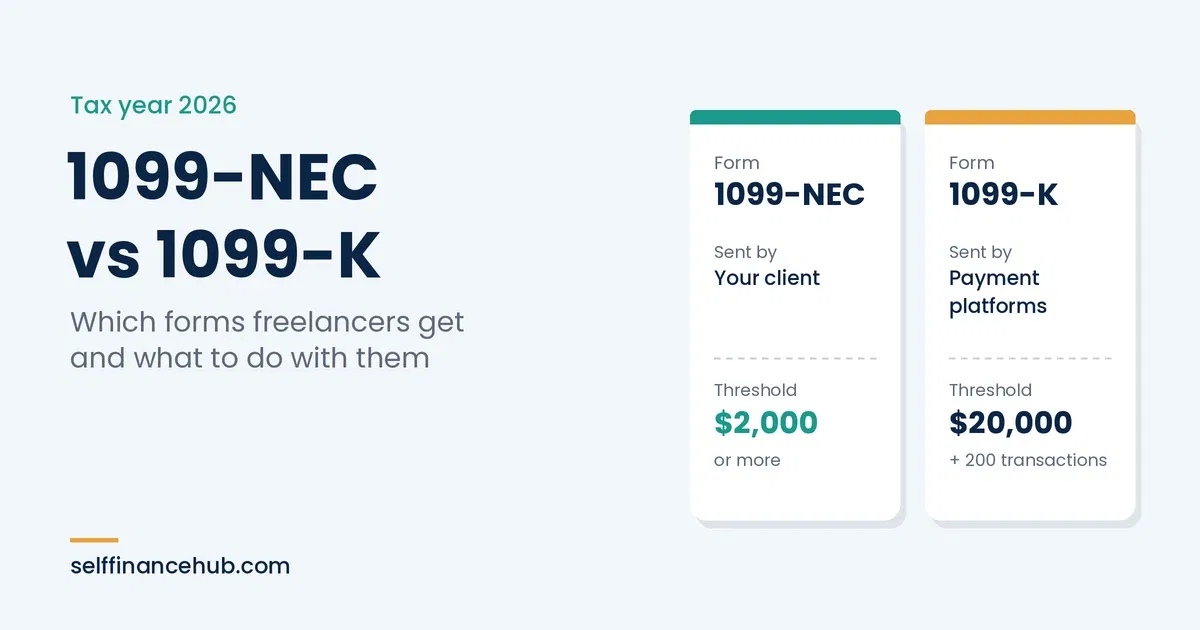
Quick answer: in the 1099-NEC vs 1099-K comparison, the key difference is who sends the form. A 1099-NEC comes from a client who paid you directly (by bank transfer, check or cash) $2,000 or more during 2026. In contrast, a 1099-K comes from a payment platform or card processor such as PayPal, Stripe or Square; federally, platforms only have to send it if you received more than $20,000 across more than 200 transactions. However, neither form changes what’s taxable. Therefore, you report all your business income on Schedule C, whether or not you receive a form, and you make sure not to count the same payment twice.
1099-NEC vs 1099-K at a glance
Before going into detail, here is how the two forms compare side by side.
| Form 1099-NEC | Form 1099-K | |
|---|---|---|
| Full name | Nonemployee Compensation | Payment Card and Third Party Network Transactions |
| Who sends it | A business that paid you for services | A payment processor or online platform |
| Examples of senders | Agencies, companies, other businesses | PayPal, Stripe, Square, Venmo (business), marketplaces |
| How you were paid | Bank transfer, check, cash, direct deposit | Card payments or through a payment app/platform |
| Federal threshold (2026) | $2,000 or more from one payer | More than $20,000 and more than 200 transactions |
| Amount shown | What the client paid you | Gross amount processed, before fees and refunds |
| Adjusted for inflation | Yes, from 2027 | No |
| Where you report it | Schedule C | Schedule C (after reconciling fees, refunds and personal payments) |
What is Form 1099-NEC?
Form 1099-NEC reports nonemployee compensation, in other words, money a business paid you for your services when you weren’t its employee. For example, if you’re a freelance designer and an agency paid you by bank transfer, the agency is the one who sends you a 1099-NEC.
Here are the key points:
- It comes from your client, not from a bank or app.
- For payments made in 2026, the threshold is $2,000. In other words, clients only have to send a 1099-NEC if they paid you $2,000 or more during the year. Until 2025, the threshold was $600, and from 2027 it will also be adjusted for inflation each year.
- It shows the total your client paid you during the calendar year. Therefore, it doesn’t subtract your expenses.
- The IRS gets a copy. Because the IRS matches these forms against your return, any mismatch can trigger a letter.
You can also read the official instructions on the IRS page about Form 1099-NEC.
The W-9 comes first
Before paying you, clients will usually ask you to fill in Form W-9 with your name, business name and taxpayer identification number (your Social Security number or EIN). Afterward, they use that information on your 1099-NEC.
If you don’t provide it, a client may be required to apply backup withholding of 24% to your payments once they reach the reporting threshold. For this reason, many freelancers put an EIN on their W-9 instead of their Social Security number, so they don’t have to share it widely. Besides, an EIN is free to get; see Do You Need an EIN as a Freelancer?.
What is Form 1099-K?
Form 1099-K reports payments you received through payment cards (credit and debit cards) or third-party payment networks (payment apps and online platforms). Unlike the 1099-NEC, it’s sent by the company that processed the money, not by your client.
For instance, if you invoice clients through Stripe, accept card payments through Square or get paid through PayPal Goods & Services, those platforms may send you a 1099-K.
These are the key points:
- The federal threshold is more than $20,000 and more than 200 transactions for third-party payment networks, and both conditions must be met. The One Big Beautiful Bill Act restored this threshold in 2025. However, unlike the 1099-NEC threshold, it isn’t adjusted for inflation.
- Some states have lower thresholds. As a result, a platform may send you a 1099-K for state purposes even if you’re under the federal limit. Platforms can also choose to send one below the threshold.
- It shows gross payments. In other words, the amount includes platform fees, refunds and chargebacks, so it is not your income.
- Personal payments shouldn’t be on it. For example, money from friends to split a dinner isn’t business income. Nevertheless, mistakes happen.
The IRS also explains the form in detail in its guide Understanding your Form 1099-K.
Why fewer freelancers will get these forms from 2026
With the 1099-NEC threshold rising from $600 to $2,000 and the 1099-K back at $20,000 and 200 transactions, many freelancers will receive fewer forms, or none at all, for 2026.
For example, a freelancer with ten clients who each paid $1,500 earned $15,000, yet may not receive a single 1099-NEC. Similarly, a freelancer who took $18,000 through Stripe may not receive a 1099-K.
However, that income is still fully taxable. The thresholds only decide when a payer has to send a form; they don’t change what you owe. Therefore, you must report every dollar of business income on Schedule C. In addition, self-employment tax still applies once your net earnings reach $400, as we explain in Self-Employment Tax Explained.
That’s the most important takeaway of the whole 1099-NEC vs 1099-K debate: build your income total from your own records, such as invoices, bank deposits and platform reports. Then use the 1099s you do receive only to cross-check.
Can the same payment show up on both forms?
It shouldn’t, but it sometimes does.
The IRS rules are designed to prevent double reporting. When a client pays you by credit card or through a payment platform, the platform is responsible for reporting it on a 1099-K. Consequently, the client should not include that payment on a 1099-NEC. On the other hand, when a client pays you directly by bank transfer or check, only the client reports it, on a 1099-NEC.
In practice, however, some clients don’t know this rule. As a result, they send a 1099-NEC for payments they made through PayPal or a card, while the platform also includes them on your 1099-K. If you simply added up every form, you would therefore pay tax twice on the same money.
How to spot it:
- First, list each client and how they paid you: direct transfer or platform/card.
- Next, compare the total on each 1099-NEC with your invoices.
- Finally, check whether any of those payments also passed through a platform that sent you a 1099-K.
What to do: report the income once on Schedule C and, ideally, ask the client for a corrected 1099-NEC. Either way, keep a simple reconciliation, for example a spreadsheet showing which payments appear on which form, in case the IRS asks.
What to do when you receive a 1099-NEC
- Check your details. First of all, make sure your name, taxpayer identification number and address are correct.
- Compare the amount with your invoices from that client for the calendar year. Timing differences are common. For example, if you invoiced in December but the client paid in January, the payment usually belongs to the following year, both on their form and on your return.
- Ask for a correction if it’s wrong. Contact the client and ask them to issue a corrected form. Don’t ignore an incorrect form, because the IRS receives the same figure.
- Include the income on Schedule C. Your total gross receipts should include this income and, in addition, any income for which you received no form.
- Keep it with your records. You don’t attach 1099s to your federal return; however, you should keep them with your tax documents.
What to do when you receive a 1099-K
A 1099-K needs more work, because the amount shown is not the income you report as-is.
1. Reconcile the gross amount
Start with the total on the form and identify the following items:
- Platform and processing fees. These are deductible business expenses. Therefore, you can report the gross amount as income and deduct the fees as an expense, which ties your return to the 1099-K figure.
- Refunds and chargebacks you issued to customers, which you report as returns and allowances.
- Payments that aren’t business income, such as personal transfers or reimbursements.
- Payments also reported on a 1099-NEC, as described above.
2. Handle personal payments included by mistake
If your 1099-K includes money that isn’t business income, first ask the platform for a corrected form. If you can’t get one, the IRS generally lets you report the wrong amount on Schedule 1 as “Form 1099-K received in error”, both in the income section and in the adjustments section, so that it cancels out. Fortunately, most tax software will walk you through it.
3. Match your Schedule C to the form
Your Schedule C gross receipts should be at least the business portion of your 1099-K total. Otherwise, reporting a lower figure without explanation is one of the most common triggers for an IRS mismatch notice (CP2000).
4. Consider separating accounts
Using the same PayPal or Venmo account for personal and business payments is the main reason 1099-Ks get messy. Instead, use a dedicated business account for payments, together with a separate business bank account, so that next year’s form stays clean. See Best Business Bank Accounts for Freelancers.
What about Form 1099-MISC?
Freelancers occasionally receive a 1099-MISC instead. Since 2020, however, it’s no longer used for payments for services, which go on the 1099-NEC. Instead, the 1099-MISC now covers things like rent, prizes, awards and royalties. For payments made in 2026, most of its categories also use the $2,000 threshold, although some, like royalties, keep a much lower one.
If a client mistakenly sends a 1099-MISC for your freelance services, the income still goes on Schedule C. In addition, you can ask them to reissue it on the correct form.
When should you receive your forms?
Payers generally have to send 1099-NEC and 1099-K forms by January 31, or the next business day when that date falls on a weekend. For 2026 income, that means around the start of February 2027.
If a form hasn’t arrived by mid-February, follow these steps:
- First, check your email and the payment platform’s tax section, since many forms are delivered electronically.
- Then, contact the client or platform.
- Finally, if it still doesn’t arrive, file using your own records. After all, you don’t need to wait for a form to file your return.
For the complete filing process, see How to File Taxes as a Freelancer.
Common mistakes with 1099 forms
- Only reporting what’s on your 1099s. With higher thresholds from 2026, many payments won’t generate a form. Even so, all of them are taxable.
- Reporting the 1099-K gross amount as profit. Fees and refunds are part of that number; therefore, they reduce your taxable income when handled correctly.
- Counting the same payment twice because it appears on both a 1099-NEC and a 1099-K.
- Ignoring an incorrect form. The IRS has the same number you do, so ask for a correction or, alternatively, document the difference.
- Mixing personal and business payments in the same payment app account.
- Reporting by invoice date instead of payment date. Most freelancers use the cash method; in other words, income counts in the year you received it.
Frequently asked questions
1099-NEC vs 1099-K: what is the difference?
A 1099-NEC comes from a client who paid you directly for your services. In contrast, a 1099-K comes from a payment platform or card processor that handled payments to you. Because they report different payment methods, the same payment shouldn’t appear on both.
What is the 1099-NEC threshold for 2026?
For payments made in 2026, clients must send a 1099-NEC if they paid you $2,000 or more during the year. Previously, the threshold was $600, and from 2027 it will be adjusted for inflation.
What is the 1099-K threshold for 2026?
Federally, payment networks must send a 1099-K if you received more than $20,000 across more than 200 transactions in the year. However, some states require forms at lower amounts, and platforms may also send one voluntarily.
Do I have to report income if I didn’t get a 1099?
Yes. All business income is taxable whether or not you receive a form. Therefore, use your invoices, bank statements and platform reports to calculate your total.
My 1099-K includes personal payments. What do I do?
First, ask the platform for a corrected form. If you can’t get one, you can generally report the incorrect amount on Schedule 1 as a Form 1099-K received in error and then remove it in the adjustments section, so it isn’t taxed.
Do I attach my 1099s to my tax return?
No. You don’t attach 1099-NEC or 1099-K forms to your federal return. Instead, keep them with your records.
I got a 1099-NEC and a 1099-K for the same money. Do I pay tax twice?
No. Report the income once on Schedule C and, if possible, ask the client for a corrected 1099-NEC. In addition, keep a reconciliation showing which payments appear on which form.
Key takeaways
To sum up, this is what you need to remember about 1099-NEC vs 1099-K:
- 1099-NEC means a client paid you directly, and the threshold is $2,000 for 2026 payments.
- 1099-K means a payment platform or card processor paid you, with a federal threshold of more than $20,000 and 200 transactions.
- Higher thresholds mean fewer forms but not less tax, so report all business income.
- Because a 1099-K shows gross payments, deduct fees and remove refunds and personal payments.
- Finally, never count the same payment twice, and keep a reconciliation in case the IRS asks.
This article is for general educational purposes and is not tax, legal or financial advice. Tax rules change and your situation may differ. Consult a CPA or Enrolled Agent before making decisions. Figures are for tax year 2026 and are based on IRS guidance and the One Big Beautiful Bill Act.