
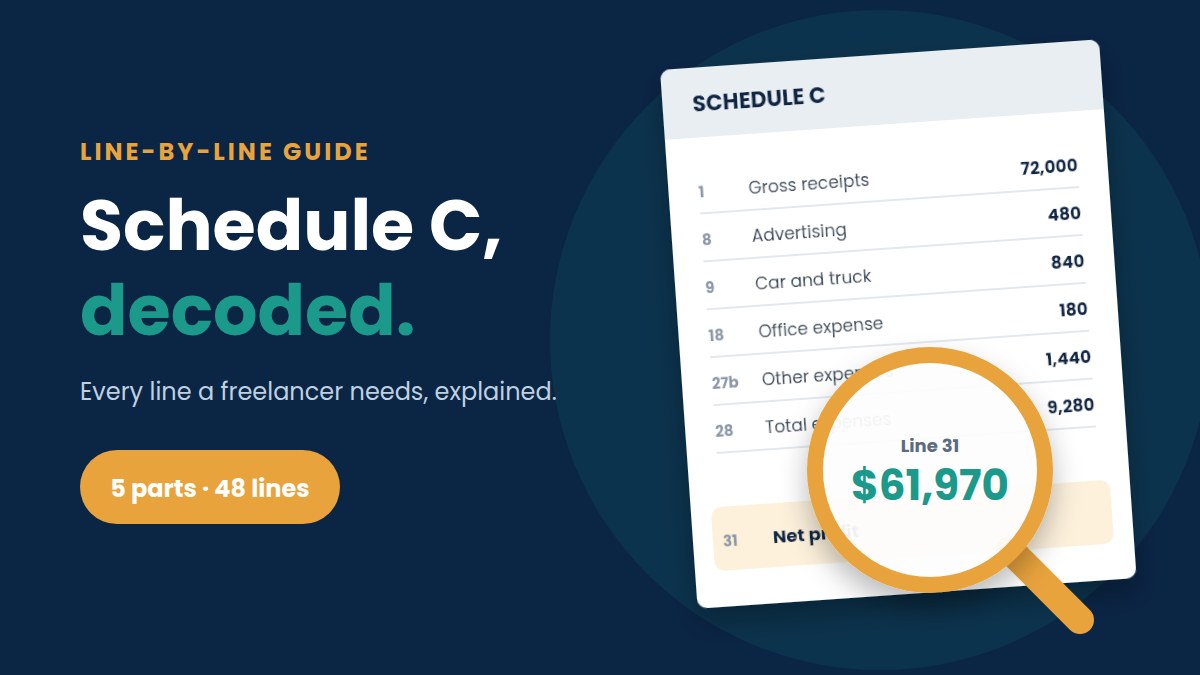
If you freelance, this guide shows you how to fill out Schedule C line by line, from your first dollar of income to the net profit you’ll pay tax on. Schedule C (Form 1040), Profit or Loss From Business, is the form where sole proprietors and single-member LLC owners report what they earned and what they spent.
Quick answer: Schedule C has five parts, but most freelancers only need three. Report your income in Part I, subtract your business expenses in Part II, and the result on line 31 is your net profit. That number flows to your Form 1040 for income tax and to Schedule SE for self-employment tax.
You need to file Schedule C if you earned money working for yourself and weren’t set up as a partnership or corporation. That includes freelance writers and designers, consultants, Uber and DoorDash drivers, and anyone with side-hustle income reported on a 1099. There’s no minimum: even a small profit goes on Schedule C, and once net earnings reach $400 you’ll also owe self-employment tax.
The line numbers below follow the latest Schedule C released by the IRS (the 2025 form, filed in 2026). The IRS sometimes adds or renumbers lines, so check the current form before you file.
What you need before you fill out Schedule C
Gather these before you start. With them in hand, the form itself takes less than an hour.
- Your income records: every invoice, plus any Forms 1099-NEC or 1099-K you received. Report all income, even payments that didn’t come with a form. See 1099-NEC vs 1099-K.
- Your expense records: receipts, bank and card statements, or the export from your bookkeeping app, sorted by category.
- Your mileage log, if you drove for work.
- Your home office measurements, if you work from home: the office’s square footage and your home’s total square footage.
- Your EIN, if you have one. Most solo freelancers don’t need one and can leave that line blank. Find out if you need an EIN as a freelancer.
The top section: lines A to J
These lines describe your business. They don’t change your tax, but getting them right avoids letters from the IRS.
| Line | What it asks | What to enter |
|---|---|---|
| A | Principal business or profession | A plain description, such as “Freelance graphic design” or “Food delivery” |
| B | Business code | The six-digit code from the list in the Schedule C instructions. Freelance writers, for example, usually use 711510 |
| C | Business name | Leave blank if you work under your own name |
| D | Employer ID number (EIN) | Your EIN if you have one; otherwise leave blank |
| E | Business address | Only if it’s different from the home address on your Form 1040 |
| F | Accounting method | Almost every freelancer checks Cash: you count income when you’re paid and expenses when you pay them |
| G | Did you materially participate? | Yes, if you actively run the business yourself |
| H | Started or acquired this year? | Check it only in your first year |
| I | Did you make payments that require a Form 1099? | Yes if you paid a contractor $600 or more for 2025 work. For payments made in 2026, the threshold rises to $2,000 |
| J | Did you or will you file those 1099s? | If you answered Yes on line I, you should answer Yes here too |
Part I: Income (lines 1–7)
Part I adds up everything your business earned. In most cases, for freelancers it’s just two numbers.
| Line | Name | What to enter |
|---|---|---|
| 1 | Gross receipts or sales | Everything clients paid you during the year, whether or not you got a 1099 for it |
| 2 | Returns and allowances | Refunds you gave clients. Usually $0 for service businesses |
| 3 | Line 1 minus line 2 | Calculated |
| 4 | Cost of goods sold | Only if you sell physical products (from Part III). Leave blank for services |
| 5 | Gross profit | Line 3 minus line 4 |
| 6 | Other income | Rare for freelancers: things like a fuel tax credit or a bad debt you later recovered |
| 7 | Gross income | Line 5 plus line 6 |
Common mistake on line 1: only adding up your 1099s. Clients who paid you less than the reporting threshold don’t have to send a form, and payment apps often don’t either. The IRS still expects that income on line 1. Instead, start from your own records, then check that every 1099 you received is included.
If a payment app sent you a 1099-K, it may include personal payments, like a friend paying you back for dinner. Don’t report those as business income; keep a note of why the totals differ.
Part II: Expenses (lines 8–27)
This is where you lower your taxes. That’s because every legitimate business expense reduces your profit, and with it both your income tax and your 15.3% self-employment tax. Put each expense on one line only, and use line 27b for anything that doesn’t fit the other categories.
Lines 8–15: marketing, car, fees and insurance
First, the costs of finding clients and getting to them. For most freelancers, these are also the easiest to track.
| Line | Name | What freelancers put here |
|---|---|---|
| 8 | Advertising | Website hosting for your portfolio, paid ads, business cards, promoted posts |
| 9 | Car and truck expenses | Business driving. Use the standard mileage rate (70¢ per mile for 2025; for 2026, 72.5¢ through June and 76¢ from July) or actual costs. Fill in Part IV too |
| 10 | Commissions and fees | Platform fees from Upwork, Fiverr or Etsy, and payment processing fees from Stripe or PayPal |
| 11 | Contract labor | Other freelancers you hired, such as a virtual assistant or subcontractor |
| 12 | Depletion | Oil, gas and timber only. Leave blank |
| 13 | Depreciation and section 179 | Big equipment like a computer or camera, when you deduct it over time or all at once with Section 179. Requires Form 4562 |
| 14 | Employee benefit programs | Only if you have employees. Leave blank if you work alone |
| 15 | Insurance (other than health) | Professional liability, business property or equipment insurance. However, your own health insurance goes on Schedule 1, not here |
Lines 16–23: interest, services, rent and supplies
Next come the costs of running your business day to day. In other words, the bills you pay to keep working.
| Line | Name | What freelancers put here |
|---|---|---|
| 16a / 16b | Interest | Interest on business loans or a card used only for business |
| 17 | Legal and professional services | Your accountant, tax preparer, lawyer or contract review |
| 18 | Office expense | Postage, printer ink, small office items |
| 19 | Pension and profit-sharing plans | Contributions for employees only. Instead, your own SEP IRA or Solo 401(k) contributions go on Schedule 1 |
| 20a / 20b | Rent or lease | 20a for equipment or vehicles you lease, 20b for a coworking space or studio |
| 21 | Repairs and maintenance | Fixing business equipment, like a laptop repair |
| 22 | Supplies | Materials you use up in your work |
| 23 | Taxes and licenses | Business licenses and permits. Never federal income tax or self-employment tax |
Lines 24–27: travel, meals, utilities and other expenses
Finally, travel, meals and everything that doesn’t fit elsewhere. Pay special attention to meals, because only half of the cost counts.
| Line | Name | What freelancers put here |
|---|---|---|
| 24a | Travel | Flights, hotels and transport for business trips away from home |
| 24b | Deductible meals | Business meals with clients or while traveling: enter 50% of the cost |
| 25 | Utilities | Utilities for a separate business location. Home utilities go through the home office on line 30. Many freelancers put the business share of their phone and internet here |
| 26 | Wages | Paid employees only, not yourself |
| 27a | Energy efficient commercial buildings | Leave blank |
| 27b | Other expenses | Total from Part V: software subscriptions, online courses, professional memberships, coworking day passes |
Don’t deduct what you pay yourself. Money you move from your business account to your personal account is not an expense. As a sole proprietor, you’re taxed on your profit, not on what you withdraw.
Want ideas for expenses you might be missing? See our full list of freelancer tax deductions and the guides to the home office deduction and standard mileage vs actual expenses.
Lines 28–32: your net profit
Next, the bottom of Part II turns your income and expenses into the number that matters.
| Line | Name | What happens here |
|---|---|---|
| 28 | Total expenses | The sum of lines 8 to 27b |
| 29 | Tentative profit or loss | Line 7 minus line 28 |
| 30 | Business use of your home | Your home office deduction (see below) |
| 31 | Net profit or loss | Line 29 minus line 30. This is the key number |
| 32a / 32b | At-risk investment | Almost every freelancer checks 32a, all investment is at risk. It only matters if you have a loss |
Line 30: the home office deduction
If you use part of your home regularly and exclusively for work, you can deduct it here, never on line 25 or 27b. You have two options:
- Simplified method: $5 per square foot, up to 300 square feet, for a maximum of $1,500. You fill in a short worksheet on Schedule C itself, with no extra form.
- Regular method: the office’s share of your rent or mortgage interest, utilities, insurance and repairs, calculated on Form 8829. It takes more work. On the other hand, it often gives a bigger deduction in expensive areas.
Our guide to the home office deduction compares both with examples.
Where line 31 goes next. Your net profit is copied to Schedule 1 (Form 1040), line 3, where it’s added to your other income. It also goes on Schedule SE, which calculates your self-employment tax. Plug it into our self-employment tax calculator to see what you’ll owe.
If line 31 is a loss, you can usually use it to reduce other income, like wages from a job. Check box 32a and keep good records: the IRS looks more closely at businesses that report losses year after year.
Parts III to V: the back of the form
Part III: Cost of goods sold (lines 33–42). Skip this if you sell services. It’s for freelancers who sell physical products, like an illustrator selling prints or a maker on Etsy. You list your inventory at the start of the year, add what you bought or made, subtract what’s left at the end, and the result goes to line 4.
Part IV: Information on your vehicle (lines 43–47). Fill this in if you claimed car expenses on line 9 and don’t have to file Form 4562. It asks:
- Line 43: the date you started using the car for business.
- Line 44: your business, commuting and other miles for the year.
- Lines 45–46: whether the car, or another one, was available for personal use.
- Line 47: whether you have evidence of your mileage, and whether it’s written. Answer honestly: without a mileage log, the deduction is hard to defend in an audit.
However, driving from home to a regular office is commuting, which isn’t deductible. Trips to clients, the post office or a supplier are business miles.
Part V: Other expenses (line 48). List each expense that doesn’t fit lines 8 to 26, with a short description and the amount. For example: “Software subscriptions $1,140”, “Online courses $300”, “Professional association dues $150”. The total goes on line 48 and then on line 27b.
Example: how to fill out Schedule C as a freelance designer
Let’s see how to fill out Schedule C for a real-world case. Alex is a freelance graphic designer filing for the 2025 tax year. Clients paid her $72,000, and she works from a 150-square-foot home office.
| Line | Item | Amount |
|---|---|---|
| 1 | Gross receipts (all client payments) | $72,000 |
| 7 | Gross income (no returns, no products) | $72,000 |
| 8 | Advertising: portfolio site and ads | $480 |
| 9 | Car: 1,200 business miles × 70¢ | $840 |
| 10 | Commissions and fees: platform and payment fees | $1,150 |
| 13 | Section 179: new laptop | $2,400 |
| 15 | Professional liability insurance | $420 |
| 17 | Tax preparer | $600 |
| 18 | Office expense | $180 |
| 24a | Travel: design conference | $900 |
| 24b | Deductible meals: $300 of client meals × 50% | $150 |
| 25 | Business share of phone and internet | $720 |
| 27b | Other expenses: software $1,140 + online course $300 | $1,440 |
| 28 | Total expenses | $9,280 |
| 29 | Tentative profit ($72,000 − $9,280) | $62,720 |
| 30 | Home office, simplified: 150 sq ft × $5 | $750 |
| 31 | Net profit | $61,970 |
By tracking $10,030 of expenses (lines 28 and 30 together), Alex pays tax on $61,970 instead of $72,000. That alone saves her about $1,400 in self-employment tax, plus income tax. Her self-employment tax on the $61,970 comes to about $8,756, and she’ll deduct half of it on her Form 1040.
In other words, the time you spend on Part II is the best-paid hour of your tax year.
Common mistakes when you fill out Schedule C
- Reporting only your 1099 income. Line 1 must include every payment, with or without a form.
- Mixing personal and business expenses. A separate business bank account makes Part II much easier and cleaner.
- Deducting 100% of meals. Most business meals are only 50% deductible on line 24b.
- Putting your health insurance or retirement contributions on Schedule C. They’re deductible, but on Schedule 1, not here.
- Claiming a home office you also live in. The space must be used regularly and only for work. A kitchen table doesn’t qualify.
- Forgetting Schedule SE. If line 31 is $400 or more after the 92.35% adjustment, you must also file Schedule SE and pay self-employment tax.
- Not keeping records. Keep receipts, statements and your mileage log for at least three years after you file.
Frequently asked questions
Can I fill out Schedule C myself?
Yes. Most freelancers with simple businesses fill it out themselves, usually through tax software that asks questions and fills in the lines for you. Consider a CPA or Enrolled Agent if you have inventory, employees, big equipment purchases or a loss.
Do I need to fill out Schedule C if I didn’t get a 1099?
Yes. A 1099 is just an information form. You must report all self-employment income on Schedule C, whether or not any client sent you one.
Does a single-member LLC file Schedule C?
Yes, by default. The IRS treats a single-member LLC as a “disregarded entity”, so you report its income and expenses on Schedule C just like a sole proprietor. That changes only if the LLC elects to be taxed as an S corp or C corp.
What if I have more than one business?
File a separate Schedule C for each business. Freelance writing and a separate photography business, for example, each get their own form. Different clients in the same line of work stay on one Schedule C.
This article is for general information only and isn’t tax advice. Line numbers follow the 2025 Schedule C; check the current form and instructions before you file, and talk to a CPA or Enrolled Agent about your specific situation.