
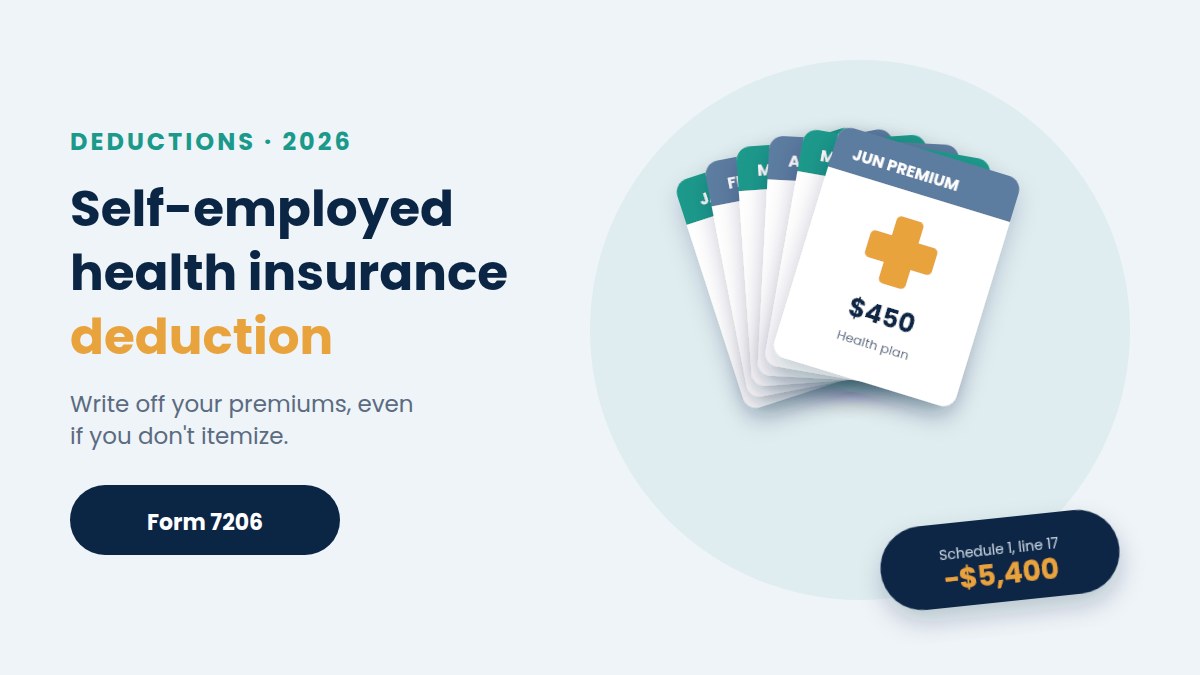
The self-employed health insurance deduction lets you subtract the health insurance premiums you pay from your income. You take it on Schedule 1 of your Form 1040, so you get it even if you don’t itemize. It’s one of the most valuable freelancer tax deductions, because health coverage is often a freelancer’s biggest monthly bill.
There are two main conditions. Your business must show a profit, and you can’t be eligible for an employer’s subsidized health plan for that month.
Who qualifies for the self-employed health insurance deduction
You can usually take the deduction if you:
- had a net profit as a sole proprietor or single-member LLC on Schedule C,
- were a partner with self-employment income, or
- owned more than 2% of an S corporation and received wages from it.
The plan can be in your business’s name or in your own name. Either way, it counts as established under your business.
What premiums count
You can deduct premiums for coverage for yourself, your spouse, your dependents and any child under age 27 at the end of the year, even if that child isn’t your dependent. Eligible premiums include:
- Medical insurance, including Marketplace plans.
- Dental and vision insurance.
- Medicare premiums, such as Part B and Part D.
- Qualified long-term care insurance, up to a yearly limit based on age.
| Age at year-end | 2026 long-term care limit |
|---|---|
| 40 or younger | $500 |
| 41 to 50 | $930 |
| 51 to 60 | $1,860 |
| 61 to 70 | $4,960 |
| 71 or older | $6,200 |
If you’re still choosing a plan, compare your options in our guide to health insurance for freelancers.
The 3 limits you need to know
- The net profit limit. Your deduction can’t be more than the earned income from the business that provides the plan. That’s your net profit, minus the deductible half of your self-employment tax and any SEP or Solo 401(k) contributions.
- The employer plan rule. You can’t deduct premiums for any month in which you could join a subsidized employer plan. This includes a plan through your spouse’s job, even if you don’t enroll in it.
- The no double-dip rule. You can’t deduct premiums that you also count as a medical expense on Schedule A, or the part paid by a premium tax credit.
Also keep in mind that the deduction lowers your income tax, not your self-employment tax.
How to claim the self-employed health insurance deduction
- Add up the premiums you paid for the year, month by month.
- Remove any months you were eligible for an employer plan.
- Complete Form 7206. It checks your premiums against the net profit limit.
- Enter the result on Schedule 1 (Form 1040), line 17. It then reduces your adjusted gross income.
The IRS explains each line in the Form 7206 instructions. Most tax software fills in the form for you once you enter your premiums.
If you get a premium tax credit
If you bought a Marketplace plan with a premium tax credit, you can only deduct the part of the premium you actually paid. There’s a catch, though. The deduction lowers your income, which can raise your credit, which in turn changes the deduction.
The IRS solves this loop with a special calculation in Publication 974. In practice, good tax software runs it for you, so you just need to enter your Form 1095-A correctly.
Example: the self-employed health insurance deduction in action
Elena is a single freelance translator with $60,000 of net profit in 2026. She pays $450 a month for a Marketplace plan with no tax credit, and she has no access to an employer plan.
| Step | Amount |
|---|---|
| Premiums paid (12 × $450) | $5,400 |
| Earned income limit ($60,000 minus $4,239 of deductible self-employment tax) | $55,761 |
| Deduction (the smaller amount) | $5,400 |
Because her taxable income falls in the 12% bracket, the deduction saves Elena about $648 in federal income tax. She’d save more in a higher bracket, and many states give a matching break.
S corp owners
If you own more than 2% of an S corp, the rules change slightly. The corporation should pay or reimburse your premiums and add them to your W-2 wages. You then claim the deduction on Form 7206, just like a sole proprietor.
If the premiums aren’t on your W-2, you can lose the deduction. So, tell your payroll provider before the end of the year.
4 common mistakes
- Missing a spouse’s employer plan. Even if you didn’t join it, being eligible for it blocks the deduction for those months.
- Deducting premiums twice. Don’t also list them as medical expenses on Schedule A.
- Claiming more than your profit. In a year with a loss, the deduction isn’t available from that business.
- Forgetting dental, vision and Medicare. These premiums count too, and they add up.
How much the deduction saves by tax bracket
The value of the deduction depends on your federal tax bracket. Here’s what $6,000 of yearly premiums is worth at each common rate.
| Federal bracket | Tax saved on $6,000 of premiums |
|---|---|
| 12% | $720 |
| 22% | $1,320 |
| 24% | $1,440 |
| 32% | $1,920 |
On top of that, most states with an income tax start from your federal adjusted gross income. As a result, the deduction often lowers your state tax too.
How retirement contributions can shrink the deduction
The net profit limit catches some freelancers by surprise. Your earned income for this test is your profit minus half of your self-employment tax and minus your SEP or Solo 401(k) contributions.
For example, Marcus has $25,000 of profit and pays $6,000 a year in premiums. He also puts $20,000 into a Solo 401(k).
| Step | Amount |
|---|---|
| Net profit | $25,000 |
| Minus half of self-employment tax | −$1,766 |
| Minus Solo 401(k) contributions | −$20,000 |
| Earned income limit | $3,234 |
| Health insurance deduction | $3,234 (not $6,000) |
The other $2,766 isn’t lost completely. You can count it as a medical expense if you itemize on Schedule A. However, only medical costs above 7.5% of your adjusted gross income help there. So, in a low-profit year, check this limit before you max out retirement savings.
Starting or stopping freelancing mid-year
The employer plan rule works month by month. That matters in the year you leave a job or take one.
- You left a job in April. If your job’s coverage ended on April 30, you can deduct your own premiums from May to December.
- You took a job in September. Once you’re eligible for its subsidized plan, those months no longer count, even if you keep your own policy.
- Your spouse changed jobs. Check the months their new employer’s plan was open to you as well.
A simple month-by-month table in your tax folder makes Form 7206 much faster to fill in.
Records to keep
- Form 1095-A if you had a Marketplace plan, or Form 1095-B from a private insurer.
- Premium statements or bank records showing each payment.
- Form SSA-1099 if Medicare premiums came out of your Social Security benefits.
- Your profit and loss figures for the business that provides the plan.
Finally, if you have a high-deductible plan, pair this deduction with an HSA for self-employed people. Together, they cover both your premiums and your out-of-pocket costs with pre-tax money.
Frequently asked questions
Can I take the self-employed health insurance deduction if I have a side business and a job?
Only for months when you weren’t eligible for your employer’s subsidized health plan. If your job offers coverage all year, you can’t take it, even if you buy your own plan instead.
Does the deduction lower my self-employment tax?
No. It reduces your income tax only. You still pay self-employment tax on your full net earnings.
Can I deduct HSA contributions too?
Yes, but separately. HSA contributions have their own deduction on Form 8889, and they aren’t part of this one.
What if my plan is in my own name, not my business’s?
That’s fine for a sole proprietor or single-member LLC. A plan in your own name still counts as established under your business.
This article is for general information only and is not legal, tax or financial advice.