
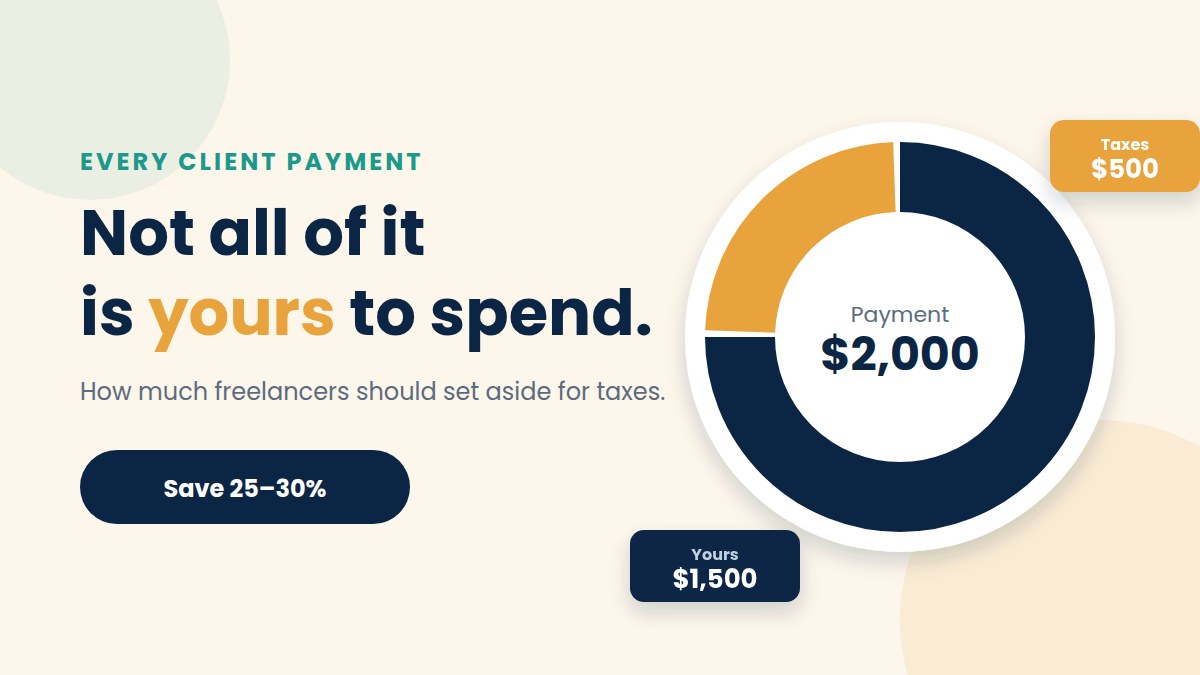
Quick answer: Set aside 25–30% of every payment you receive. That covers federal income tax and self-employment tax for most freelancers, plus a typical state income tax. If you earn under about $40,000 in profit, 20% is usually enough. If you earn six figures or live in a high-tax state like California or New York, save 30–35%.
Nobody withholds taxes from a 1099 paycheck. When a client pays you $2,000, all $2,000 lands in your account, but part of it already belongs to the IRS and your state. The freelancers who get into trouble aren’t the ones who earn too little. They’re the ones who spend money that was never theirs to spend.
This guide shows you the real percentages for 2026, based on the IRS’s current tax brackets, so you can pick a number that fits your income instead of guessing. You’ll also see worked examples, what pushes your percentage up or down, and a simple system to make saving automatic.
What you’re actually saving for
Your set-aside has to cover three separate taxes. Each one is calculated on your net profit: what you earn minus your business expenses.
1. Self-employment tax: 15.3%. This is Social Security (12.4%) and Medicare (2.9%). An employee splits it with their employer; you pay both halves. It applies to 92.35% of your net profit, and the Social Security part stops at $184,500 of earnings in 2026. For most freelancers it works out to about 14.1% of profit, and it starts at just $400 of profit, before any income tax kicks in.
2. Federal income tax: 10–37%. This is the same income tax employees pay, using the 2026 brackets. Three things shrink the income it’s charged on:
- The standard deduction: $16,100 if you’re single, $32,200 if you’re married filing jointly.
- Half of your self-employment tax, which you deduct from your income.
- The Qualified Business Income (QBI) deduction, which lets most freelancers deduct up to 20% of their business income.
Because of those deductions, your effective income tax rate is much lower than your bracket. A single freelancer with $75,000 of profit is in the 12% bracket in 2026, not the 22% one.
3. State income tax: 0–13%. Nine states have no tax on wages and earned income (including Texas and Florida). Most others charge 3–6% for typical freelance incomes. A few cities, like New York City, add their own.
Self-employment tax is the one that catches new freelancers off guard. It’s why the rule of thumb is higher than what you’d expect from your tax bracket alone.
How much to set aside by income (2026)
The table below shows what a single freelancer with no other income owes in federal taxes in 2026, and what share of each payment to save. It uses the standard deduction, the deduction for half of self-employment tax and the QBI deduction.
| Net profit | Self-employment tax | Federal income tax | Total federal tax | % of profit | Save (no state tax) | Save (≈5% state tax) |
|---|---|---|---|---|---|---|
| $30,000 | $4,239 | $942 | $5,181 | 17% | 20% | 25% |
| $40,000 | $5,652 | $1,775 | $7,427 | 19% | 20% | 25% |
| $50,000 | $7,065 | $2,667 | $9,732 | 19% | 20% | 25% |
| $60,000 | $8,478 | $3,559 | $12,037 | 20% | 25% | 25% |
| $75,000 | $10,597 | $4,898 | $15,495 | 21% | 25% | 30% |
| $100,000 | $14,130 | $8,235 | $22,365 | 22% | 25% | 30% |
| $125,000 | $17,662 | $12,324 | $29,986 | 24% | 25% | 30% |
| $150,000 | $21,194 | $16,413 | $37,608 | 25% | 30% | 30–35% |
The “Save” columns round up on purpose. A small cushion covers a better-than-expected year, and whatever is left over in April is a bonus, not a bill.
Two things stand out. First, self-employment tax is a bigger bill than federal income tax at every income level in the table. Second, the percentage climbs slowly: going from $50,000 to $150,000 in profit only adds about 6 points to your federal rate.
Want a figure for your exact income? Use our self-employment tax calculator to plug in your own numbers.
Three real-world examples
These examples use the same 2026 rules as the table. Names are illustrative.
Maya, graphic designer in Texas: $42,000 profit
Maya bills $48,000 a year and spends $6,000 on software, a laptop and her home office, so her net profit is $42,000. Texas has no state income tax.
- Self-employment tax: $5,934
- Federal income tax: $1,954
- Total: $7,888, or about 19% of profit
Maya saves 20% of every invoice. On a $2,000 payment, she moves $400 into her tax account the day it arrives.
Jordan, freelance writer: $80,000 profit, 5% state tax
Jordan earns $90,000 and has $10,000 of expenses. He lives in a state with a flat 5% income tax.
- Self-employment tax: $11,304
- Federal income tax: $5,344
- State income tax: about $3,717
- Total: about $20,365, or roughly 25.5% of profit
Jordan saves 30%. The extra few points give him room for a strong fourth quarter and keep April stress-free.
Sam, full-time job plus a side hustle: $20,000 freelance profit
Sam earns a $70,000 salary with taxes withheld, and makes $20,000 of profit from freelance web design on weekends.
- Self-employment tax on the side income: $2,826
- Extra federal income tax: $3,271
- Total extra tax: $6,097, or about 30% of his freelance profit, before any state tax
That’s about double the 15% a full-time freelancer would pay on $20,000. His salary already uses up the standard deduction and the lower brackets, so every freelance dollar is taxed at his 22% bracket, plus self-employment tax. Sam should save 30–35% of his side income. Read more in our guide to side hustle taxes.
What pushes your percentage up or down
The table assumes a single freelancer whose only income is freelance work. Adjust your number if any of these apply to you.
Save more if:
- You have a W-2 job or a working spouse. Their income fills the lower brackets first, so your freelance profit is taxed at a higher rate, like Sam’s. Add 5–10 points.
- You live in a high-tax state or city. California, New York, New Jersey, Oregon and Minnesota can take 6–10% of a solid freelance income. Add your state’s rate on top of the federal figure.
- You’re a high earner. Above roughly $200,000 of income for single filers, an extra 0.9% Medicare tax kicks in, and freelancers in service fields (consulting, law, accounting) start to lose the QBI deduction.
- You had a big year after a small one. Your income may jump into a higher bracket, so base your savings on this year’s income, not last year’s.
Save less if:
- You track every business expense. Tax is calculated on profit, so each deductible dollar you spend lowers the tax you owe. See our list of freelancer tax deductions.
- You pay for your own health insurance. The self-employed health insurance deduction lowers your income tax (though not your self-employment tax).
- You contribute to a SEP IRA or Solo 401(k). Contributions cut your federal income tax, which is why retirement accounts are one of the best tax tools freelancers have.
- You’re married and your spouse earns little or nothing. Filing jointly doubles your standard deduction and widens the lower brackets.
A simple system to set the money aside
Knowing your percentage only helps if the money actually moves. This four-step system takes about two minutes per payment.
- Open a separate savings account just for taxes. Money you can see in your checking account feels spendable. A dedicated account, ideally at a different bank, removes the temptation. Here’s why every freelancer needs a separate bank account.
- Transfer your percentage every time you get paid. Don’t wait until the end of the month. When a $3,000 payment lands and your rate is 25%, move $750 that same day.
- Earn interest while it waits. Your tax money sits for up to three months between payments. A high-yield savings account pays you for holding it, and many business bank accounts for freelancers include a savings option.
- Recheck your percentage every quarter. If your income is running well ahead of last year, bump your rate up by a few points. It’s easier to adjust in June than to find $5,000 in April.
Some business bank accounts and apps can do step 2 automatically, sweeping a set percentage of each deposit into a tax sub-account. If you tend to forget, that automation is worth having.
When the money leaves: quarterly estimated taxes
Saving the money is half the job. The IRS expects freelancers to pay during the year, not all at once in April. If you expect to owe $1,000 or more when you file, you generally need to make quarterly estimated payments.
| Payment | Covers income earned | Due date (2026 tax year) |
|---|---|---|
| 1st quarter | January 1 – March 31 | April 15, 2026 |
| 2nd quarter | April 1 – May 31 | June 15, 2026 |
| 3rd quarter | June 1 – August 31 | September 15, 2026 |
| 4th quarter | September 1 – December 31 | January 15, 2027 |
The quarters aren’t equal: the second covers just two months and the fourth covers four. When a payment is due, send the IRS what’s in your tax account for that period, and keep your state’s share for your state payment. Details are in our guide to quarterly estimated taxes.
How to avoid an underpayment penalty. You won’t owe a penalty if your payments during the year cover the smaller of:
- 90% of your 2026 tax, or
- 100% of your 2025 tax (110% if your 2025 adjusted gross income was over $150,000).
That second option is called the safe harbor rule, and it’s a relief for freelancers with unpredictable income. If last year’s total tax was $12,000, paying $3,000 each quarter protects you from penalties even if this year turns out bigger. You’d still owe the difference in April, which is exactly why your savings percentage should be based on this year’s income.
Tip for side hustlers: if you also have a W-2 job, you can skip quarterly payments by raising the withholding on your paycheck with a new Form W-4. The IRS treats withholding as paid evenly through the year.
Frequently asked questions
Should I set aside a percentage of gross income or net profit?
Taxes are calculated on net profit. But saving a percentage of every payment you receive (gross) is simpler and builds in a cushion. If your expenses are high, say 30% or more of revenue, base your rate on profit instead so you don’t over-save.
Is 30% too much to set aside?
For many freelancers earning under $60,000 in a no-tax state, yes, 30% is more than needed. But over-saving costs you almost nothing if the money sits in a high-yield account. Under-saving can cost you penalties, interest and a stressful April.
What if I didn’t set anything aside this year?
Start now with a higher rate, around 35–40%, to catch up. Make a payment by the next quarterly due date. If you still can’t pay in full when you file, file on time anyway and ask the IRS for a payment plan. Filing late costs far more than paying late.
Do I need to set aside money in my first year of freelancing?
Yes. If you owed no tax at all last year, you generally can’t be penalized for underpaying this year. But you still owe the full tax in April. First-year freelancers are the most likely to be surprised by self-employment tax.
Does this apply to Uber, DoorDash and other gig work?
Yes. Gig income reported on a 1099 is self-employment income. Drivers often owe less than the table suggests because the standard mileage deduction lowers their profit a lot.
Calculations assume a single filer with no other income, taking the standard deduction, the deduction for half of self-employment tax and the QBI deduction, using 2026 federal figures. Your situation may differ. This article is for general information and isn’t tax advice; talk to a CPA or Enrolled Agent about your specific case.