
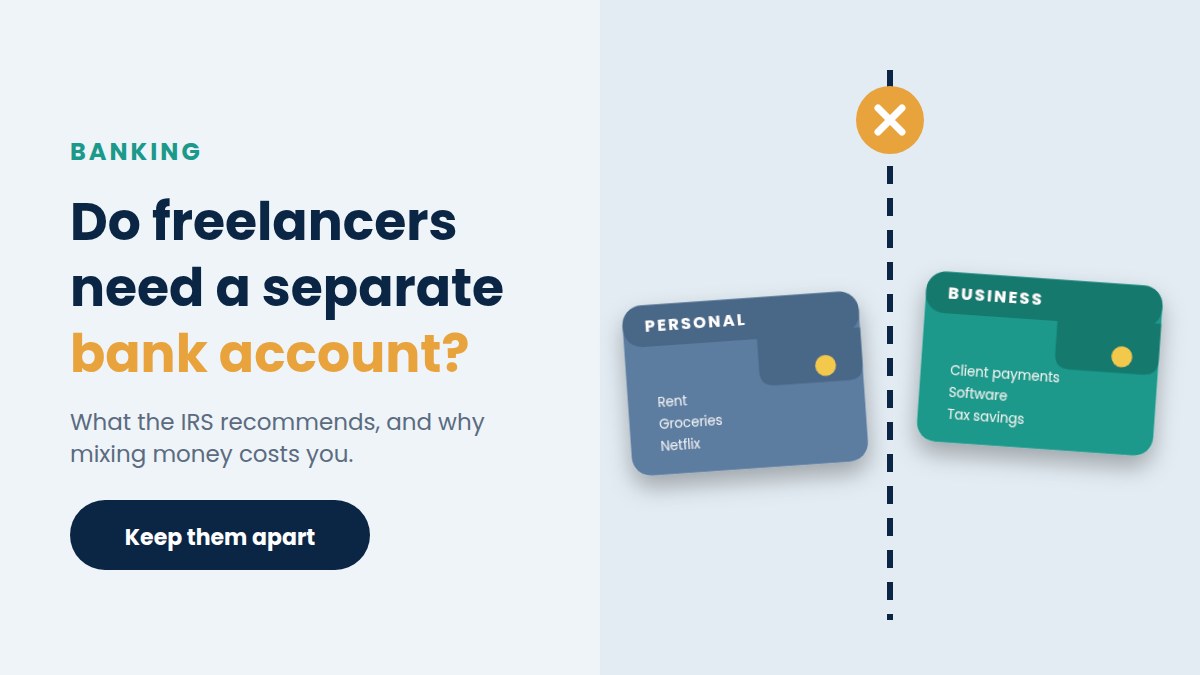
A separate bank account for freelancers isn’t always required by law, but you should have one anyway. If you work as a sole proprietor, you can legally run everything through your personal account. However, the IRS recommends a separate account, and it makes taxes, bookkeeping and audits far easier. If you have an LLC, a separate account is essential to keep your liability protection.
The good news is that opening one is free and takes about 15 minutes online.
When a separate bank account is required for freelancers
It depends on how your business is set up:
- Sole proprietor: not legally required. You and your business are the same person, so you can use one account.
- Single-member LLC: not required by federal law, but strongly recommended. Mixing money can let a court ignore your LLC and go after your personal assets.
- Multi-member LLC or corporation: in practice, yes. The business is a separate legal entity, so it needs its own account.
If you’re not sure which structure fits you, see our guide on LLC vs sole proprietor.
Why the IRS recommends one
The IRS is clear on this point. In Publication 583, it says that one of the first things you should do when you start a business is open a business checking account and keep it separate from your personal one.
The reason is simple. Your bank statements become the main record of your business income and expenses. When everything sits in one account, proving which purchases were for business gets much harder.
5 benefits of a separate bank account for freelancers
- Easier taxes. At tax time, your business income and expenses are already in one place, so filling out Schedule C takes minutes instead of days.
- Fewer missed deductions. Every business purchase shows up in one statement, so you don’t forget the software subscription or the client lunch.
- Stronger proof in an audit. If the IRS asks questions, clean business statements back up your numbers.
- A clear view of your profit. You can see at a glance whether your business actually makes money.
- Easier budgeting. You can pay yourself a fixed salary from the business account, which is the core of our system for how to budget with irregular income.
The risk of mixing money
Mixing business and personal money is called commingling. For a sole proprietor, it mostly causes headaches: messy records, missed deductions and stressful audits.
For an LLC owner, though, the risk is bigger. If you pay your rent or groceries from the LLC account, a court may decide that the LLC isn’t really separate from you. In legal terms, this is called piercing the corporate veil. As a result, your personal savings and home could be exposed to business debts or lawsuits.
Personal or business: which separate bank account should freelancers open?
You have two options:
- A second personal checking account. This is the simplest choice for a sole proprietor just starting out. Still, check your bank’s terms, because some don’t allow business use on personal accounts.
- A business checking account. This is the better choice for most freelancers, and the only real option for an LLC. Many online business accounts are free and include tools to set money aside for taxes.
To compare the best free options, read our guide to the business bank accounts we recommend.
How to set up a separate bank account in 4 steps
- Choose your account. Pick one with no monthly fee and, ideally, tax sub-accounts.
- Gather your documents. You’ll need a photo ID, your Social Security number or an EIN, and your LLC documents if you have an LLC.
- Move your income. Ask clients to pay into the new account, and update your payment details on invoices and platforms.
- Move your expenses. Switch business subscriptions and cards to the new account. From then on, pay business costs only from it.
A simple 3-account system for freelancers
One separate bank account is a great start. Even so, many freelancers go one step further and use three accounts. Each one has a single job, so you always know which money you can spend.
- Business checking: every client payment lands here, and every business expense leaves from here.
- Tax savings: a savings account, ideally with interest, that holds the money you’ll owe the IRS.
- Personal checking: you pay yourself a set amount into it, then cover rent, food and bills from it.
Many online business banks let you create sub-accounts for taxes inside the same login. In that case, you need only two banks, or even one.
Example: one month of money flow
Jordan is a freelance web designer. In March, two clients pay her a total of $6,000. Here’s how the money moves:
| Step | Amount | Where it goes |
|---|---|---|
| Client payments arrive | $6,000 | Business checking |
| Business expenses paid | −$600 | Software, phone, hosting |
| 25% of profit set aside | −$1,350 | Tax savings |
| Fixed monthly pay | −$3,500 | Personal checking |
| Left as a buffer | $550 | Stays in business checking |
Because she pays herself the same $3,500 every month, a slow month doesn’t hit her personal budget right away. The buffer covers the gap. Later, when quarterly taxes are due, the money is already waiting in the tax account. Our guide on how much to set aside for taxes helps you pick the right percentage.
What to pay from your separate bank account
The rule is simple: business costs come out of the business account, and personal costs don’t. Typical business payments include:
- Software, apps and subscriptions you use for work
- Equipment such as a laptop, camera or monitor
- The business share of your phone and internet bills
- Contractors, platform fees and payment processing fees
- Estimated tax payments to the IRS and your state
What about a mixed cost, like a phone you also use personally? Pay the full bill from one account, then note the business share in your records. Consistency matters more than which account you pick.
Paying yourself: owner’s draws
As a sole proprietor or single-member LLC owner, you don’t get a paycheck. Instead, you move money to your personal account. This transfer is called an owner’s draw.
A draw is not a business expense, so you can’t deduct it. At the same time, it isn’t taxed again, because you already pay tax on your business profit. In your records, simply label it “owner’s draw” so it doesn’t look like income or an expense.
Mistakes to avoid with a separate bank account
- Paying personal bills from the business account. If it happens by mistake, record it as an owner’s draw right away.
- Leaving clients on your old account. Update every invoice template and platform, or payments will keep landing in the wrong place.
- Treating the balance as profit. Part of that money belongs to the IRS until you pay your taxes.
- Skipping monthly checks. Take 15 minutes each month to label transactions while you still remember them.
Frequently asked questions
Can I use a second personal account?
Yes, if you’re a sole proprietor. Just keep it for business only, and check that your bank allows it. If you form an LLC later, switch to a business account in the LLC’s name.
Do I need an LLC to open a business account?
No. Many banks let sole proprietors open a business account with just a Social Security number. Some may ask for an EIN or a business name registration.
What if I already mixed my money?
Don’t worry. Open a separate account now and use it from today on. Then, go through your past statements, mark which transactions were for business and keep the receipts. That’s enough to support your deductions.
Does a separate bank account for freelancers cost money?
Usually not. Most online business accounts have no monthly fee and no minimum balance. Traditional banks often charge a monthly fee, but you can usually avoid it by keeping a minimum balance.
This article is for general information only and is not legal, tax or financial advice.