
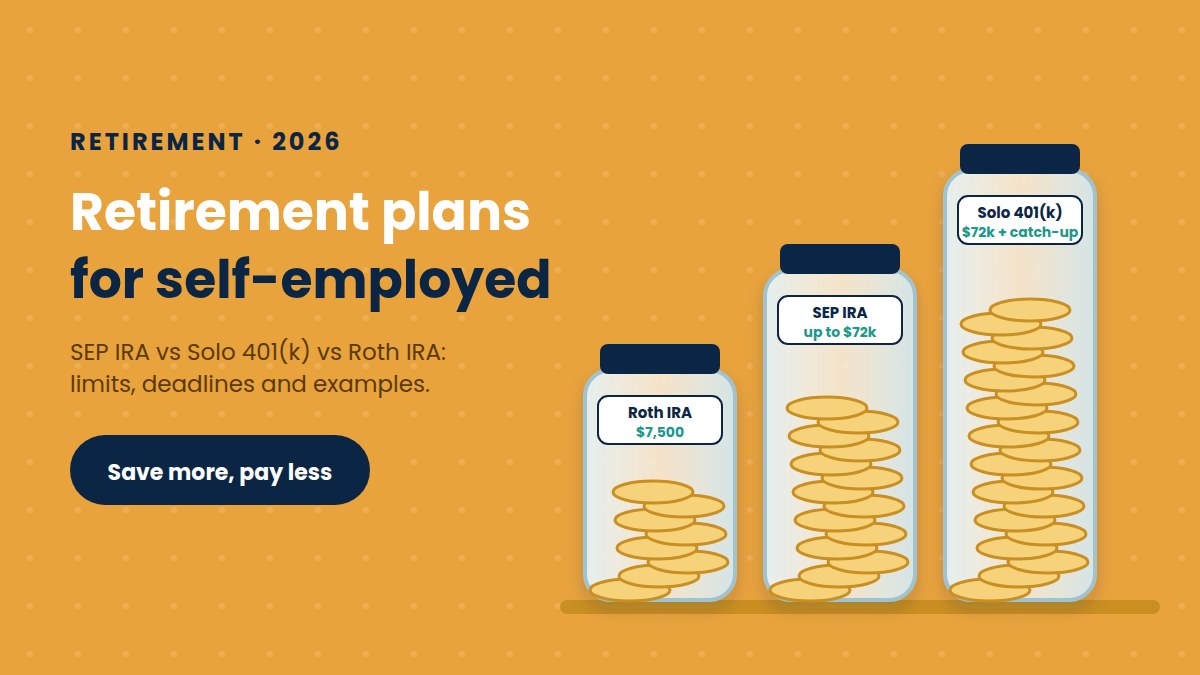
Retirement plans for self-employed workers let you save far more than most employees can, and cut your taxes at the same time. The three main options are the SEP IRA, the Solo 401(k) and the Roth IRA. For most freelancers with no employees, a Solo 401(k) allows the biggest contributions. A SEP IRA is the simplest, and a Roth IRA adds tax-free growth on top of either one.
In fact, contributions to a SEP IRA or a traditional Solo 401(k) are among the biggest freelancer tax deductions available. Every dollar you put in lowers your taxable income for the year.
Retirement plans for self-employed compared
| SEP IRA | Solo 401(k) | Roth IRA | |
|---|---|---|---|
| 2026 limit | Up to $72,000 | Up to $72,000, plus catch-up | $7,500 |
| How the limit works | About 20% of net self-employment income | $24,500 as “employee” + about 20% as “employer” | Flat amount |
| Catch-up at 50+ | None | $8,000 ($11,250 at ages 60–63) | $1,100 |
| Tax break | Deduction now | Deduction now or Roth option | Tax-free withdrawals later |
| Income limit | None | None | Phases out at $153,000 (single) |
| Employees allowed | Yes, but you must contribute for them | No, only you and your spouse | Not applicable |
| Paperwork | Very little | Form 5500-EZ once assets reach $250,000 | None |
| Deadline to contribute | Tax filing deadline, including extensions | Depends on the type of contribution | April 15 of the next year |
These are the official 2026 contribution limits published by the IRS.
SEP IRA: the simplest option
A SEP IRA (Simplified Employee Pension) works like a regular IRA, but with a much higher limit. You open one at a brokerage in a few minutes, usually with no setup fee.
How much you can put in
You can contribute up to 25% of your compensation, with a cap of $72,000 for 2026. For self-employed people, however, compensation means net profit minus half of your self-employment tax and minus the contribution itself. In practice, that works out to about 20% of your net self-employment income. IRS Publication 560 includes the worksheets for the exact math.
Pros and cons
- Easy to open and run. There’s no annual IRS filing.
- Flexible. You can contribute a lot in a good year and nothing in a slow one.
- Late deadline. You can open and fund it up to your tax filing deadline, including extensions.
- Lower limit at modest incomes. Because it’s based only on 20% of profit, it falls behind the Solo 401(k) unless you earn a lot.
- Employee rule. If you hire eligible employees later, you must contribute the same percentage for them.
Solo 401(k): the highest limits for most freelancers
A Solo 401(k), also called a one-participant 401(k), is designed for business owners with no employees other than a spouse. It’s the best choice for most freelancers who want to save aggressively.
How much you can put in
You contribute in two roles, and both count:
- As the employee, you can defer up to $24,500 of your earnings in 2026. If you’re 50 or older, add $8,000, or $11,250 if you’re 60 to 63.
- As the employer, you can add about 20% of your net self-employment income, the same as a SEP.
The total can’t exceed $72,000 for 2026, not counting catch-up contributions. Because of the employee part, you can put in much more than with a SEP at the same income.
Pros and cons
- Highest limits at low and middle incomes.
- Roth option. Many providers let you make Roth contributions, which grow tax-free.
- Catch-up contributions if you’re 50 or older.
- More paperwork. You file Form 5500-EZ once the account holds $250,000 or more.
- No employees. If you hire someone who qualifies, you’ll need a different plan.
Roth IRA: tax-free growth on top
A Roth IRA isn’t tied to your business. Still, it pairs well with a SEP or a Solo 401(k). You don’t get a deduction now, but qualified withdrawals in retirement are tax-free.
Who can contribute
For 2026, you can contribute up to $7,500, or $8,600 if you’re 50 or older. You need earned income, and net self-employment income counts. However, the limit shrinks once your modified AGI passes $153,000 if you’re single, or $242,000 if you’re married filing jointly. It disappears completely at $168,000 and $252,000.
How much retirement plans for self-employed people let you save: 3 examples
These examples assume a single freelancer under age 50 with no employees in 2026:
| Net profit | SEP IRA | Solo 401(k) | Roth IRA (on top) |
|---|---|---|---|
| $50,000 | $9,294 | $33,794 | $7,500 |
| $100,000 | $18,587 | $43,087 | $7,500 |
| $150,000 | $27,881 | $52,381 | $7,500 |
As you can see, the Solo 401(k) allows more at every level, thanks to the $24,500 employee part. The gap only closes at very high incomes, where both plans hit the $72,000 cap.
The tax savings add up quickly too. For example, a $20,000 contribution in the 22% bracket cuts your federal income tax by about $4,400.
Traditional or Roth: which tax break is better?
With traditional contributions, you save tax now and pay it when you withdraw. With Roth contributions, you pay tax now and withdraw tax-free later.
As a rule of thumb, traditional makes sense in high-income years, while Roth makes sense in low-income years. Since freelance income goes up and down, many people mix both. For instance, you might choose Roth deferrals in a slow year and traditional ones in a big year.
Deadlines for retirement plans for self-employed workers
- SEP IRA: open and fund it by your tax filing deadline, including extensions. For 2026, that can be as late as October 15, 2027, with an extension.
- Solo 401(k): the plan can generally be set up by your tax filing deadline, and employer contributions can be made until then too. Employee deferrals, however, normally have to be elected by December 31. In the first year only, a new sole proprietor plan can still accept deferrals if it’s opened before the filing deadline. Check with your provider, because some set earlier cutoffs.
- Roth IRA: contribute by April 15, 2027, for the 2026 tax year. Extensions don’t apply.
How to choose among retirement plans for self-employed people
- Choose a Solo 401(k) if you have no employees and want to save as much as possible, especially if your profit is under $200,000.
- Choose a SEP IRA if you want the simplest setup, if you might hire employees or if you’re deciding after December 31.
- Add a Roth IRA if your income is below the limits and you want tax-free money in retirement.
If you run an S corp, the math changes, because contributions are based on your W-2 salary rather than your total profit. Our guide on when to become an S corp explains that trade-off.
Frequently asked questions
Can I combine retirement plans for self-employed workers with a Roth IRA?
Yes. A Roth IRA has its own limit, so you can fund one alongside a SEP IRA or a Solo 401(k), as long as your income is below the Roth limits.
Can I have a Solo 401(k) and a workplace 401(k)?
Yes, but the $24,500 employee limit is shared across all your 401(k) plans. Employer contributions to your Solo 401(k), on the other hand, have their own limit. This often comes up for people with a side hustle on top of a regular job.
Do retirement plans for self-employed workers lower self-employment tax?
No. Contributions lower your income tax, but self-employment tax is still calculated on your full net profit. That’s a common surprise for new freelancers.
What if I hire employees?
A Solo 401(k) only works with no employees other than a spouse. With a SEP IRA, you must contribute the same percentage for eligible employees. At that point, a SIMPLE IRA or a regular 401(k) may fit better.
This article is for general information only and is not tax or investment advice. Contribution limits change every year, so check IRS.gov or a tax professional before you contribute.