
Yes, freelancers can deduct their phone and internet, but only the part used for business. The phone and internet deduction is one of the easiest freelancer tax deductions to claim, and one of the most often missed.
Quick answer:
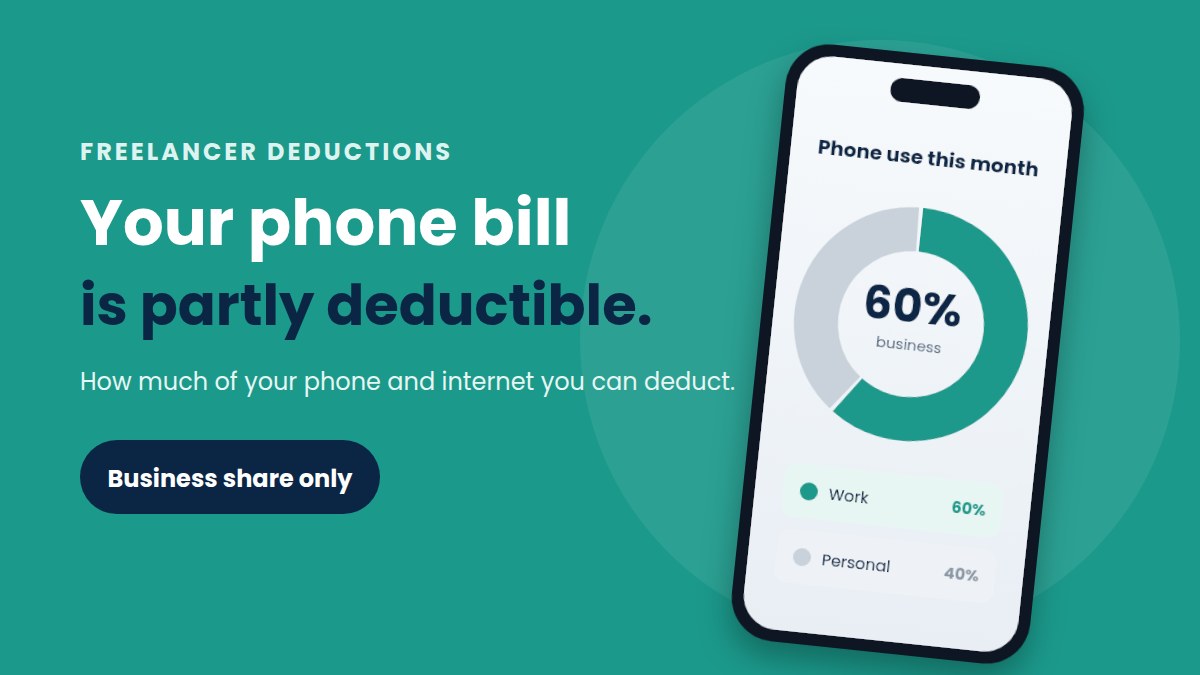
- Phone bill: deduct your business-use percentage. Use your phone 60% for work? Deduct 60% of the bill.
- The phone itself: deduct the business share of the purchase price.
- A second phone or line used only for work: deduct 100%.
- Home internet: deduct the business share, usually based on the hours you work online.
- Not allowed: the basic monthly charge for the first landline into your home.
The key is a reasonable, documented percentage. Below you’ll see what counts, how to calculate your share, and a worked example of what it’s worth.
Your phone: what you can deduct
| Phone cost | Deductible? | How much |
|---|---|---|
| Monthly cell phone plan | Yes | Your business-use percentage |
| The phone itself | Yes | Business share of the price, usually all in the year you buy it |
| A second phone or line used only for work | Yes | 100% |
| Business apps and phone accessories | Yes | Business share, or 100% if only for work |
| Family plan | Partly | Only your own line, times your business share |
| Basic charge for your home’s first landline | No | Always personal |
| Business long-distance calls on that landline | Yes | 100% of those calls |
The landline rule surprises people. According to IRS Publication 587, the basic monthly charge for the first landline into your home is a personal expense, even if you use it for work. A second line used only for business is fully deductible.
A dedicated work phone makes life easy. If you buy a separate phone and plan only for your business, you can deduct 100% with no percentage to calculate. For many freelancers, a cheap second plan pays for itself in simplicity.
Buying a new phone? If you use it 70% for work and it costs $1,000, you can deduct $700. Phones under $2,500 can usually be deducted all at once in the year you buy them, rather than spread over several years.
Your internet: what you can deduct
Home internet works the same way as your phone: you deduct the share you use for business.
- Home internet plan: your business-use percentage of the monthly bill.
- Equipment you buy: a router, modem or mesh system, at your business share.
- Coworking or café Wi-Fi: passes and memberships you buy to work are fully deductible.
- Mobile hotspot plans: the business share, or 100% if used only for work.
Avoid counting it twice with your home office
If you claim the home office deduction with the regular method, your utilities are already shared by your office percentage. You then have two options for internet:
- Include it with your utilities on Form 8829, at your home office percentage (for example, 15%).
- Deduct it separately at your actual business-use percentage (for example, 50%), and leave it out of Form 8829.
The second option is usually higher, because you use the internet for work far more than your office’s share of the floor space. Just never do both. With the simplified home office method, internet isn’t included at all, so you deduct the business share separately.
How to calculate your phone and internet deduction
The IRS doesn’t set a fixed percentage. It expects a reasonable estimate you can explain. The simplest approach is to track a typical stretch of time, then apply that percentage to the whole year.
Three ways to find your business share
- Time: for your phone, compare work calls and screen time to the total. For internet, compare your working hours online to your total hours online.
- Usage: check your call log or data usage for a month and mark what was for work.
- Sample period: track one representative month, or better, two or three, and use the average for the year. Redo it if your work changes a lot.
Write down how you got your number and keep it with your tax records.
Example: what it’s worth
Dana is a freelance marketer. After tracking two months, she uses her phone 60% for work and her home internet 50%.
| Expense | Yearly cost | Business share | Deduction |
|---|---|---|---|
| Phone plan ($85/month) | $1,020 | 60% | $612 |
| New phone | $1,000 | 60% | $600 |
| Home internet ($70/month) | $840 | 50% | $420 |
| Total | $1,632 |
Because this lowers both her income tax and her self-employment tax, a $1,632 deduction saves Dana roughly $450 to $500 in federal tax in the 22% bracket. To see the effect on your own numbers, enter your profit with and without these costs in our self-employment tax calculator.
Where the phone and internet deduction goes on your return
Phone and internet costs go on line 25 (Utilities) of Schedule C, not on the home office line. The phone itself goes on line 22 (Supplies) if you deduct it right away, or line 13 if you depreciate it. IRS Publication 334 covers the general rules for small business expenses.
Records to keep
- Your monthly phone and internet bills.
- The receipt for any phone, router or equipment you buy.
- Your tracking notes: the months you sampled and the percentage you got.
- For a family plan, the part of the bill for your own line.
Keep them for at least three years after you file.
Common phone and internet deduction mistakes
- Deducting 100% of a personal phone. Unless the phone is only for work, the IRS expects a business share.
- Counting internet twice, once with the home office and again separately.
- Deducting the whole family plan instead of just your line.
- Deducting costs your employer already pays. If a job reimburses your phone, you can’t deduct that part again.
- Guessing a high percentage with no records. A tracked 55% is far safer than an untracked 90%.
Frequently asked questions
Can I take the phone and internet deduction if my employer pays part of my bill?
Only for the part you pay yourself and use for your freelance work. Anything your employer reimburses isn’t deductible.
Can I deduct my internet if I work at a coworking space?
Yes. Your coworking membership is fully deductible, and you can still deduct the business share of your home internet if you also work from home.
Is there a safe percentage to claim?
No. There’s no standard percentage the IRS accepts automatically. Use your own tracked numbers. Many freelancers land somewhere between 30% and 70%, but yours could be higher or lower.
Do I need a separate business phone?
No, but it simplifies things. With a dedicated work phone and plan, you deduct 100% and skip the percentage calculation altogether.
This article is for general information only and isn’t tax advice. Talk to a CPA or Enrolled Agent about your situation.