
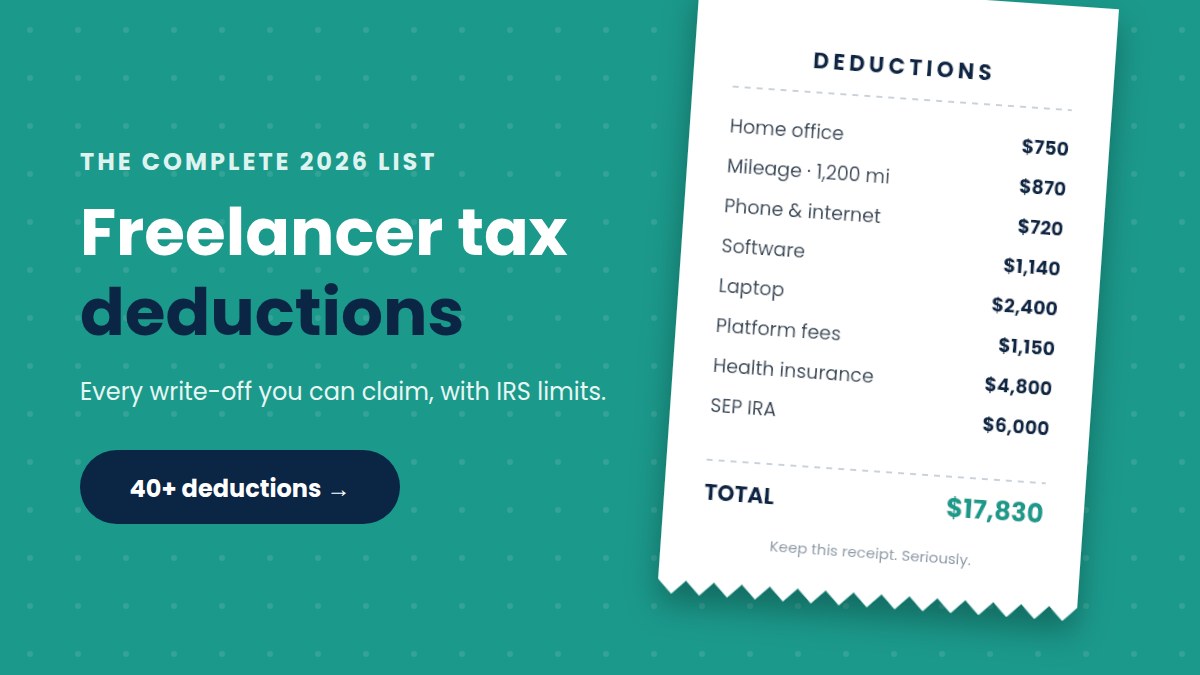
Freelancer tax deductions are business expenses you can subtract from your income before you pay tax. Every legitimate expense lowers both your income tax and your 15.3% self-employment tax, so missing them is like paying the IRS a tip.
The IRS rule is simple: you can deduct any expense that is ordinary (common in your line of work) and necessary (helpful and appropriate for your business). If you use something for both business and personal life, like your phone, you deduct only the business share.
The 10 deductions freelancers miss most often:
- Home office ($5 per square foot, up to $1,500, with the simplified method)
- Business share of your phone and internet
- Business mileage (72.5¢ per mile for January to June 2026, 76¢ from July)
- Software and app subscriptions
- Platform and payment fees (Upwork, Fiverr, Stripe, PayPal)
- Computer and equipment
- Half of your self-employment tax
- Self-employed health insurance premiums
- Retirement contributions to a SEP IRA or Solo 401(k)
- The 20% qualified business income (QBI) deduction
Below is the complete list, grouped by type, with the 2026 IRS limits and where each one goes on your return.
How freelancer tax deductions work
There are two kinds of deductions, and the difference matters.
| Type | Where it goes | What it lowers |
|---|---|---|
| Business expenses | Schedule C | Income tax and self-employment tax |
| Personal-level deductions | Form 1040 (Schedule 1) | Income tax only |
Business expenses are the more valuable kind, because they shrink the profit that self-employment tax is charged on.
What a deduction is really worth. For a freelancer in the 22% bracket, $1,000 of business expenses saves about $141 in self-employment tax plus around $160 in income tax: roughly $300 in total. In the 12% bracket, it’s still around $230. To see the effect on your own numbers, enter your profit before and after expenses in our self-employment tax calculator.
Lower taxes also mean you need to save less from each payment. Our guide on how much to set aside for taxes shows how expenses change the percentage.
One rule to remember: a deduction lowers your taxable income, not your tax bill dollar for dollar. Never buy something just for the write-off. Spending $1,000 to save $300 still leaves you $700 poorer.
Freelancer tax deductions for your home and office
| Deduction | What you can claim | Schedule C line |
|---|---|---|
| Home office | A room or area used regularly and only for work. Simplified method: $5 per sq ft, up to 300 sq ft ($1,500). Regular method: the office’s share of rent or mortgage interest, utilities, insurance and repairs | 30 |
| Coworking or studio rent | Desk memberships, day passes, a rented studio | 20b |
| Phone | The business share of your monthly bill, plus the phone itself if you buy it mainly for work | 25 or 27b |
| Internet | The business share of your home internet | 25 or 27b |
| Office supplies | Paper, ink, pens, postage, shipping supplies | 18 or 22 |
| Office furniture | Desk, chair, monitor stand, lighting | 13, or 22 if under $2,500 per item |
The home office test is strict. The space must be used exclusively for business: a desk in the corner of your bedroom can qualify, but the kitchen table you also eat at can’t. Most freelancers start with the simplified home office method, since it needs no receipts beyond the measurements.
How to work out the business share. Use a reasonable, consistent method. For a phone, check a typical month’s calls and data; for internet, estimate your working hours as a share of total use. If you use your phone 60% for work, deduct 60% of the bill, and write down how you got that number.
Freelancer tax deductions for your car, travel and meals
| Deduction | What you can claim | Schedule C line |
|---|---|---|
| Car: standard mileage | 72.5¢ per business mile from January to June 2026, and 76¢ from July to December 2026 (70¢ for 2025). Parking and tolls are extra | 9 |
| Car: actual expenses | The business share of gas, insurance, repairs, registration and depreciation, instead of the mileage rate | 9 |
| Business travel | Flights, hotels, rental cars and transport for trips away from home overnight | 24a |
| Meals | 50% of business meals with clients, or meals while traveling for work | 24b |
| Business gifts | Up to $25 per person per year | 27b |
The IRS updates the standard mileage rates each year, and in 2026 it raised them in the middle of the year, so track the date of every trip.
Commuting doesn’t count. Driving from home to a regular office is personal. However, if your home office is your main place of business, trips from home to clients, suppliers or the post office are business miles. Keep a mileage log with the date, destination, purpose and miles, either on paper or with an app.
Entertainment isn’t deductible. Concert tickets, sports events and golf with clients haven’t been deductible since 2018, even if you talk business. The meal itself can still be 50% deductible if it’s billed separately. The full rules for travel, gifts and meals are in IRS Publication 463.
Freelancer tax deductions for equipment, software and tech
| Deduction | What you can claim | Schedule C line |
|---|---|---|
| Computer, tablet, camera | The business share of the purchase price | 13, or 22 if under $2,500 per item |
| Software and apps | Design tools, accounting apps, video editors, password managers, AI tools you use for work | 27b |
| Cloud storage | Business share of storage subscriptions | 27b |
| Website | Hosting, domain, website builder, themes and plugins | 8 or 27b |
| Repairs | Fixing business equipment | 21 |
| Small accessories | Keyboard, mouse, cables, headset, hard drives | 22 |
How to deduct a big purchase like a laptop
You have three options, and most freelancers can deduct the whole cost in the year they buy it:
- De minimis safe harbor. Items that cost $2,500 or less each can be deducted right away as supplies. You make this choice with a short statement attached to your return; tax software usually handles it.
- Section 179. Lets you deduct the full cost of equipment in the year you start using it. The 2026 limit is $2.56 million, so it won’t hold back a freelancer.
- Depreciation. Spreads the deduction over several years. It rarely makes sense for freelancers unless their income is very low this year and expected to rise.
If you also use the item for personal things, only the business share is deductible, whichever method you choose.
Freelancer tax deductions for running your business
| Deduction | What you can claim | Schedule C line |
|---|---|---|
| Platform fees | Upwork, Fiverr, Etsy and similar service fees | 10 |
| Payment fees | Stripe, PayPal, Square and card processing fees | 10 |
| Contractors | Other freelancers you hire, like a virtual assistant or editor | 11 |
| Advertising | Ads, sponsored posts, business cards, portfolio sites | 8 |
| Professional services | Accountant, tax preparer, lawyer, contract review | 17 |
| Business insurance | Professional liability, equipment insurance | 15 |
| Education | Courses, books and workshops that improve skills for your current business | 27b |
| Memberships | Professional associations, industry subscriptions | 27b |
| Bank fees | Fees on a business bank account | 27b |
| Licenses and permits | Business licenses, local permits | 23 |
| Business interest | Interest on a business loan or a card used only for business | 16b |
Education has one catch. It must maintain or improve skills for the work you already do. A designer taking a course on a new design tool can deduct it. A designer studying to become a nurse can’t, because it qualifies them for a new trade.
Platform fees are easy to miss. If Upwork or Fiverr pays you after taking their cut, your 1099-K or 1099-NEC may show the full amount before fees. Report the full amount as income on line 1, then deduct the fees on line 10, or you’ll pay tax on money you never received.
Freelancer tax deductions on your Form 1040
These deductions don’t go on Schedule C, so they don’t lower your self-employment tax. They do lower your income tax, often by a lot.
| Deduction | 2026 rules | Where it goes |
|---|---|---|
| Half of self-employment tax | Automatic: half of what you pay on Schedule SE | Schedule 1 |
| Self-employed health insurance | Premiums for you, your spouse and dependents, up to your net profit. Not allowed for months you could join an employer plan, including a spouse’s | Schedule 1 |
| SEP IRA | Up to 25% of compensation, max $72,000. For self-employed people, that works out to about 20% of net profit | Schedule 1 |
| Solo 401(k) | Up to $24,500 as “employee” ($32,500 if 50+, $35,750 if 60–63), plus an “employer” contribution, with a combined cap of $72,000 before catch-ups | Schedule 1 |
| Traditional IRA | Up to $7,500. Deductibility can be limited if you or your spouse have a workplace plan | Schedule 1 |
| QBI deduction | Up to 20% of qualified business income. Phases out for service businesses above $201,750 of taxable income (single) or $403,500 (married filing jointly) | Form 1040 |
Retirement accounts are the biggest lever. A freelancer with $80,000 of profit who puts $10,000 into a SEP IRA or Solo 401(k) cuts their taxable income by $10,000 and saves roughly $1,800 to $2,200 in federal income tax in the 22% bracket, while building their retirement savings.
The QBI deduction is automatic for most freelancers below the income threshold. You don’t need to spend anything to get it, but it’s worth checking that your tax software applies it.
What freelancers can’t deduct
Some expenses feel like work costs but the IRS says no. Claiming them is one of the fastest ways to attract unwanted attention.
| Not deductible | Why |
|---|---|
| Commuting to a regular office | Considered personal travel |
| Everyday clothes | Even if you only wear them to meet clients. Costumes and protective gear can qualify |
| Gym memberships | Personal, even if fitness helps your work |
| Entertainment | Concerts, sports tickets and golf haven’t been deductible since 2018 |
| Traffic and parking fines | Penalties are never deductible |
| Your own time or “salary” | Sole proprietors are taxed on profit; paying yourself isn’t an expense |
| Federal income tax and self-employment tax | Only half of SE tax is deductible, on your Form 1040 |
| Personal share of mixed-use items | Only the business portion of your phone, internet or car counts |
| Political contributions | Not deductible for anyone |
When in doubt, ask two questions: would a typical freelancer in your field spend money on this, and would you have bought it if you didn’t run a business? If the answers are “yes” and “no”, it’s probably deductible.
Records to keep for your freelancer tax deductions
A deduction is only as good as the proof behind it. If the IRS asks, you need to show what you paid, when, and why it was for business.
- Receipts or invoices for every expense. A photo on your phone is fine.
- Bank and card statements, ideally from an account used only for business.
- A mileage log with dates, destinations, purpose and miles.
- Home office measurements: the office’s square footage and your home’s total.
- A note on business-use percentages for your phone, internet and car, explaining how you calculated them.
Keep everything for at least three years after you file. Good tax software or a bookkeeping app can import your expenses and sort them into the right Schedule C lines, which saves hours at tax time.
Frequently asked questions
Can I deduct expenses if I made no money this year?
Yes, if you’re genuinely running a business and trying to make a profit. Your expenses create a loss that can reduce other income, such as wages. Repeated losses year after year may lead the IRS to treat it as a hobby, and hobby expenses aren’t deductible.
Do I need receipts for small expenses?
You need records for all expenses, but they don’t have to be paper receipts. A bank or card statement showing the payment, plus a note about the business purpose, is often enough for small items.
Can I deduct expenses from before I started freelancing?
Some start-up costs, like market research or setting up your website before your first client, can be deducted: up to $5,000 in your first year, with the rest spread over 15 years.
Are freelancer tax deductions different for gig workers?
The rules are the same, but the most valuable deductions differ. For Uber, Lyft and DoorDash drivers, the mileage deduction is usually by far the largest, followed by phone costs and platform fees.
This article is for general information only and isn’t tax advice. Limits are for the 2026 tax year unless noted; talk to a CPA or Enrolled Agent about your situation.