
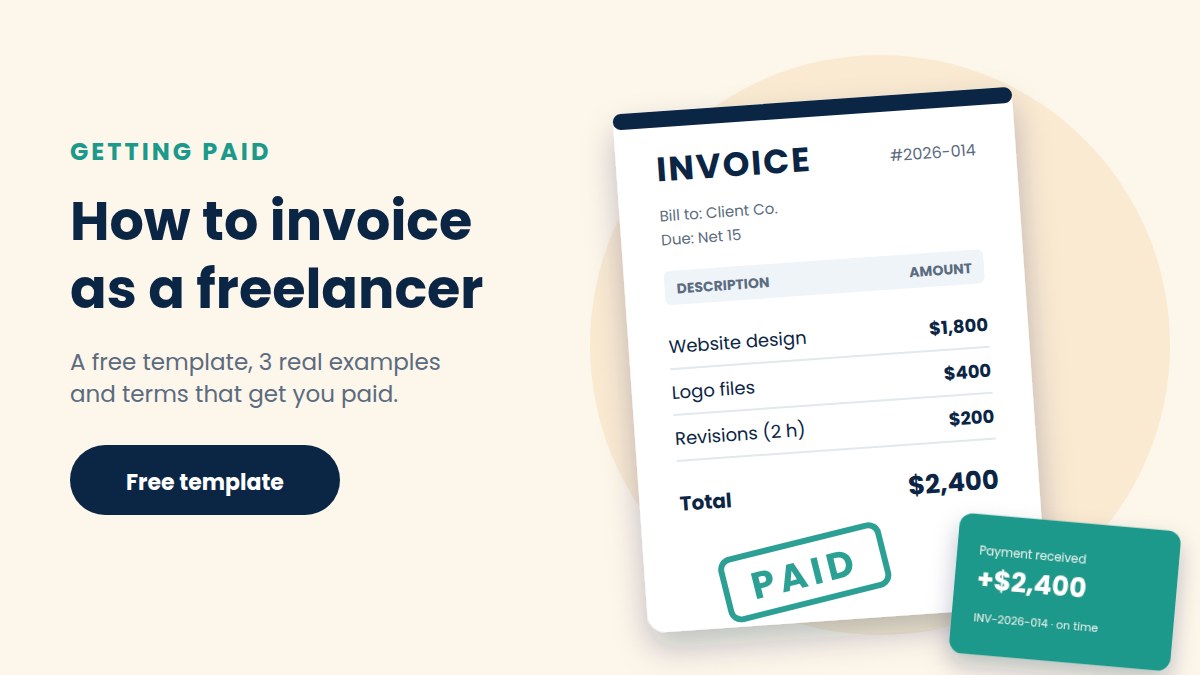
To learn how to invoice as a freelancer, start with one rule: every invoice must tell the client exactly what they owe, for what, and by when. In practice, that means a clear list of your work, a total, a due date and simple ways to pay.
This guide gives you a free template you can copy, three real examples and the payment terms that help you get paid on time. Most freelancers can send their first professional invoice in under 20 minutes.
What to include when you invoice as a freelancer
A professional invoice has 10 parts. Missing even one of them is a common reason clients pay late.
- The word “Invoice” at the top. It sounds obvious. Still, some clients’ accounting teams won’t process a document that isn’t clearly labeled.
- Your name and contact details. Use your legal name or business name, plus your email and address.
- Your tax ID, if the client asks for it. Use an EIN instead of your Social Security number, since invoices get forwarded and stored by many people.
- The client’s details. Include the company name, the contact person and their billing address.
- A unique invoice number. For example, INV-2026-001. Numbering each invoice in order makes it easy to track who has paid.
- The invoice date and the due date. Write the due date as a real date, such as October 27, 2026, not just “Net 15.”
- A line-by-line description of the work. List each service, the hours or quantity, the rate and the amount.
- The total amount due. Show any deposit already paid, then the balance.
- Payment instructions. Add your bank transfer details or a payment link. Ideally, point clients to a separate bank account used only for your business.
- Your payment terms. State when payment is due and any late fee your contract allows.
Free freelance invoice template
Copy this template into Google Docs, Word or a spreadsheet. Then, replace the text in brackets with your own details.
| INVOICE | |
|---|---|
| From | (Your name or business name), (email), (address) |
| Bill to | (Client company), (contact name), (billing address) |
| Invoice number | INV-2026-001 |
| Invoice date | (Date you send it) |
| Due date | (Exact date, for example 15 days later) |
| Description | (Service 1): (hours or quantity) × (rate) = (amount) |
| (Service 2): (hours or quantity) × (rate) = (amount) | |
| Subtotal | (Sum of all lines) |
| Deposit paid | (Amount, if any) |
| Total due | (Subtotal minus deposit) |
| How to pay | (Bank transfer details or payment link) |
| Terms | Payment due within 15 days. A late fee of 1.5% per month applies after the due date. |
Only include a late fee if your contract allows it. In addition, check your state’s rules, since some limit how much you can charge.
How to invoice as a freelancer in 6 steps
- Agree on the price and terms first. Before you start the work, put the rate, the scope and the payment terms in writing. A short email that the client confirms is better than nothing.
- Choose your invoicing tool. A free template works for your first clients. Later, an invoicing app saves time with reminders and online payments.
- Fill in every field. Use the 10 items above as a checklist, and double-check the client’s billing details.
- Save the invoice as a PDF. A PDF looks professional and can’t be edited by mistake. Name the file clearly, such as INV-2026-001-ClientName.pdf.
- Send it to the right person. Email it to whoever approves payments, which is often not your day-to-day contact. Put the invoice number and the amount in the subject line.
- Track it until it’s paid. Note the due date in a spreadsheet or app. Once the money arrives, mark the invoice as paid and send a quick thank-you.
How to invoice a company for freelance work
Invoicing a company works the same way, but larger clients usually have an accounts payable team with its own rules. Before you send your first invoice, ask your contact how their billing works. Then make sure your invoice includes these details:
- The company’s legal name. Use the exact name on their contract or W-9 request, not just the brand name.
- A purchase order (PO) number, if they use one. Many companies won’t pay an invoice without it, so ask for it before you start.
- Your Form W-9. US clients need it on file before they can pay you. Send it with your first invoice, using your EIN instead of your SSN.
- Their payment terms. Large companies often pay on Net 30 or Net 45. Agree on the terms in writing, then show the exact due date on the invoice.
- The right recipient. Send the invoice to the accounts payable email they give you, and copy your main contact.
How to write an invoice for freelance work (3 examples)
The way you bill depends on how you charge. Below are three common setups, each with a filled-in example.
Example 1: hourly invoice for a freelance writer
Ava writes blog posts and bills by the hour. She sends her invoice on October 1, 2026, with Net 15 terms.
| Description | Hours | Rate | Amount |
|---|---|---|---|
| Research and writing, 4 blog posts | 12 | $60 | $720 |
| Editing and client revisions | 3 | $60 | $180 |
| Total due by October 16, 2026 | $900 |
For hourly work, keep a simple time log. If a client questions the hours, you can show exactly where they went.
Example 2: project invoice with a deposit
Jordan designs a brand identity for $2,400. To reduce the risk of not getting paid, he asks for 50% up front and sends two invoices.
| Invoice | Description | Amount | Due |
|---|---|---|---|
| INV-2026-014 | 50% deposit, brand identity package | $1,200 | On receipt |
| INV-2026-015 | Brand identity package, $2,400, minus deposit paid | $1,200 | Net 15 |
As a result, Jordan never works more than half a project without payment. Deposits of 25% to 50% are common for project work.
Example 3: monthly retainer for a social media manager
Lena manages a client’s social media for a fixed $1,500 a month. She bills the retainer at the start of each month and adds any extra work from the month before.
| Description | Quantity | Rate | Amount |
|---|---|---|---|
| Social media management, November 2026 | 1 month | $1,500 | $1,500 |
| Extra work in October: ad campaign setup | 4 hours | $50 | $200 |
| Total due by November 16, 2026 | $1,700 |
Billing the retainer in advance gives Lena a steady income. Meanwhile, extra hours are billed only after she does them.
Payment terms that get you paid faster
Your payment terms tell the client when to pay. Short, clear terms usually mean faster payments.
| Term | What it means | Best for |
|---|---|---|
| Due on receipt | Pay as soon as the invoice arrives | Deposits and small jobs |
| Net 15 | Pay within 15 days of the invoice date | Most freelance work |
| Net 30 | Pay within 30 days | Large companies that require it |
| 2/10 Net 30 | 2% discount if paid in 10 days, otherwise due in 30 | Clients who tend to pay late |
For most freelancers, Net 15 is a good default. Also, ask for a deposit on any project longer than a few weeks.
How to send an invoice and follow up
Send the invoice the day you finish the work, or on a fixed day each month. The longer you wait, the longer you wait to get paid.
If payment doesn’t arrive, follow a simple schedule:
- 3 days before the due date: send a friendly reminder with the invoice attached.
- On the due date: send a short note saying payment is due today.
- 7 days late: follow up and mention any late fee in your terms.
- 14 days late: call or message your contact directly.
- 30 days late: send a final notice, and pause any new work until you’re paid.
Keep every message polite and factual. In most cases, a late invoice is an admin delay, not a client who refuses to pay.
Tools to invoice as a freelancer
You don’t need paid software to start. Here are the main options:
- A template in Google Docs or Word. Free and fine for your first few clients, but you track payments yourself.
- Free invoicing apps. Wave, for example, lets you create unlimited invoices on its free Starter plan.
- Invoicing in your business bank account. Several online business accounts include free invoicing, so payments land straight in the right place.
- Paid accounting software. QuickBooks or FreshBooks add automatic reminders, expense tracking and reports. They’re worth it once you have many clients.
Whichever tool you pick, use it for every client. That way, all your income records stay in one place.
How each invoice affects your taxes as a freelancer
Most freelancers use the cash method of accounting. Under this method, you report income in the year you receive the payment, not the year you send the invoice. For example, an invoice sent in December 2026 and paid in January 2027 counts as 2027 income. The IRS explains the rules in Publication 538.
Each payment you receive is also a reminder to save for taxes. Move part of every payment to a tax savings account, and see our guide on how much to set aside for taxes to pick the right share.
At the start of each year, clients who paid you $2,000 or more in 2026 should send you a Form 1099-NEC. Payment apps may send a Form 1099-K instead. Our guide to 1099-NEC vs 1099-K explains what to do with each one.
Finally, the IRS lists invoices among the documents that support your business income. So, keep invoices as records for at least 3 years after you file.
Frequently asked questions
What if a client doesn’t pay my invoice?
First, follow the reminder schedule above and keep a record of every message. If that fails, send a formal demand letter with a final deadline. For unpaid amounts within your state’s limit, small claims court is a low-cost option.
Should I put my Social Security number on an invoice?
No. Invoices are shared with many people, so your SSN could end up in the wrong hands. Instead, get a free EIN from the IRS and use that whenever a client needs a tax ID.
Can I send an invoice before the work is done?
Yes. Deposit invoices are common for projects, and retainers are usually billed in advance. Just make sure the client agreed to these terms before you start.
How do I invoice as a freelancer without a business name?
Use your own legal name. Sole proprietors don’t need a business name to send invoices or get paid. If you later choose a brand name, you may need to register it as a DBA in your state or county.
This article is for general information only and is not legal, tax or financial advice.