
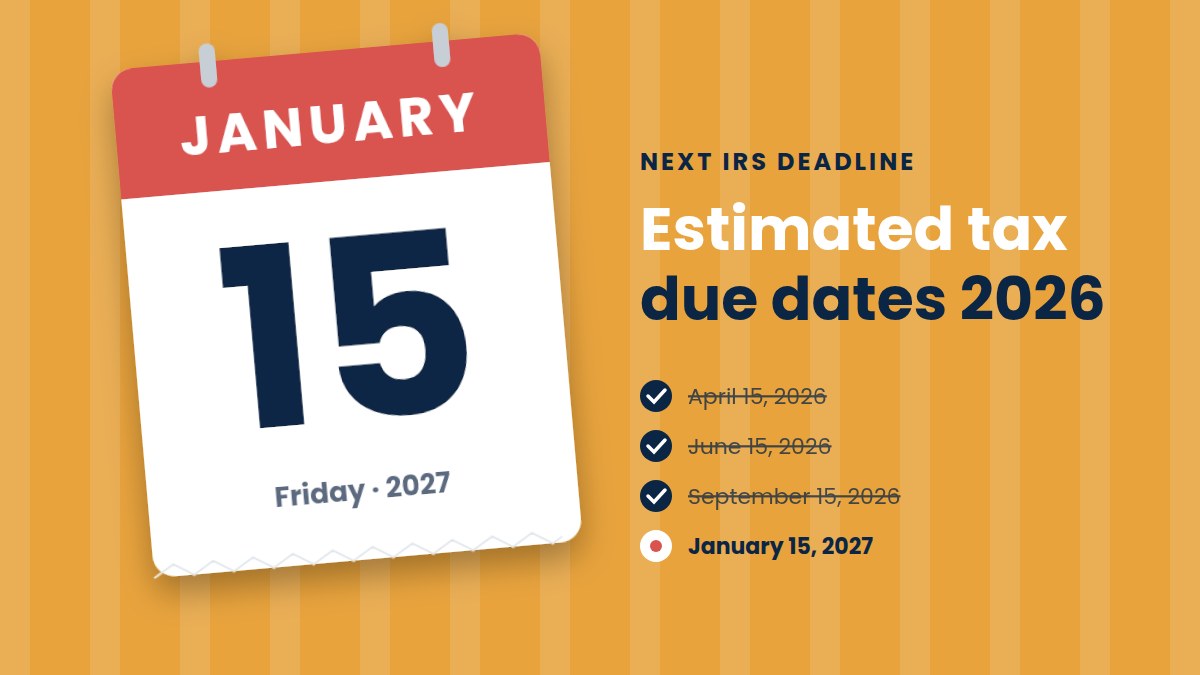
The estimated tax due dates for the 2026 tax year are April 15, June 15 and September 15, 2026, and January 15, 2027. Miss one and the IRS starts charging interest on what you owe, even if you pay everything in April.
Quick answer:
- April 15, 2026 – income from January to March
- June 15, 2026 – income from April and May
- September 15, 2026 – income from June to August
- January 15, 2027 – income from September to December
Next up: January 15, 2027. Add all the dates to your calendar with one click.
Below you’ll find the dates for 2026 and 2027, the other tax deadlines freelancers should know, and a simple system so you never miss a payment again. If you’re new to estimated payments, start with our complete guide to quarterly estimated taxes.
Estimated tax due dates for 2026
These are the official dates from Form 1040-ES for income you earn in 2026:
| Payment | Income it covers | Due date | Day |
|---|---|---|---|
| 1st | January 1 – March 31 | April 15, 2026 | Wednesday |
| 2nd | April 1 – May 31 | June 15, 2026 | Monday |
| 3rd | June 1 – August 31 | September 15, 2026 | Tuesday |
| 4th | September 1 – December 31 | January 15, 2027 | Friday |
Two things are easy to miss. First, the periods aren’t equal: the second payment covers only two months, while the fourth covers four. Second, you can skip the January 15, 2027 payment if you file your 2026 return by February 1, 2027, and pay the full balance with it. That’s only realistic if your records are ready early, so most freelancers simply make the January payment.
Estimated tax due dates for 2027
The IRS publishes the official 2027 dates with the new Form 1040-ES, usually in early 2027. Based on the standard schedule and the calendar, these are the expected dates:
| Payment | Income it covers | Expected due date | Day |
|---|---|---|---|
| 1st | January 1 – March 31, 2027 | April 15, 2027 | Thursday |
| 2nd | April 1 – May 31, 2027 | June 15, 2027 | Tuesday |
| 3rd | June 1 – August 31, 2027 | September 15, 2027 | Wednesday |
| 4th | September 1 – December 31, 2027 | January 18, 2028 | Tuesday |
Why January 18? January 15, 2028 falls on a Saturday, and the following Monday, January 17, is Martin Luther King Jr. Day. When a due date lands on a weekend or federal holiday, the payment is due the next business day. We’ll update this page as soon as the IRS confirms the dates.
Other tax dates freelancers should know
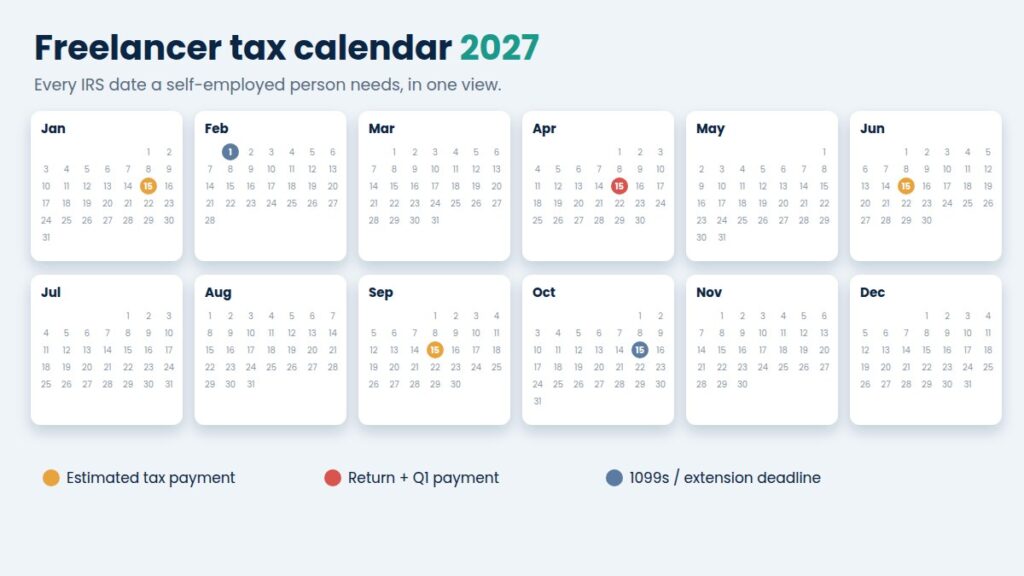
Estimated payments aren’t the only deadlines on a freelancer’s calendar. Here’s the full picture from now through 2027:
| Date | What’s due |
|---|---|
| January 15, 2027 | 4th estimated payment for 2026 |
| February 1, 2027 | Send Forms 1099-NEC to contractors you paid $2,000 or more in 2026, and file them with the IRS (January 31 falls on a Sunday) |
| February 1, 2027 | Optional: file your 2026 return and pay in full to skip the January payment |
| April 15, 2027 | 2026 tax return and any balance due, plus the 1st estimated payment for 2027 |
| June 15, 2027 | 2nd estimated payment for 2027 |
| September 15, 2027 | 3rd estimated payment for 2027 |
| October 15, 2027 | Deadline for 2026 returns filed with an extension |
An extension gives you more time to file, not to pay. If you request one, you still need to pay what you expect to owe by April 15, or interest and penalties start adding up.
Your state may have its own dates. Most states with an income tax follow the federal schedule, but some don’t. Check your state’s revenue department each year.
Disasters can move the deadlines. After hurricanes, wildfires or floods, the IRS often postpones due dates for people in the affected areas. You can check current postponements on the IRS disaster relief page.
How to never miss an estimated tax due date
Most missed payments aren’t about money. They happen because the date sneaks up on a busy week. This five-step system takes about 20 minutes to set up, once a year.
1. Put every date in your calendar
Download our calendar file and open it: it adds all the dates to Google Calendar, Apple Calendar or Outlook, each with a reminder seven days before. A week gives you time to check your numbers and move money if needed.
2. Decide how much to pay, once
Work out your four payments at the start of the year with our self-employment tax calculator. Write the amount next to each date in your calendar, so the reminder already tells you what to pay.
3. Schedule the payments in advance
This is the step that makes missing a date almost impossible. IRS Direct Pay lets you schedule a payment up to 365 days ahead. So in January, you can schedule all four payments for the year at once. If your income changes, you can cancel a scheduled payment and set up a new one.
4. Keep the money in a separate account
A scheduled payment only works if the money is there. Move a fixed share of every client payment into a dedicated tax savings account the day it arrives. Our guide on how much to set aside for taxes shows the right percentage for your income.
5. Or skip the dates entirely with withholding
If you also have a W-2 job, you can cover your freelance taxes through extra paycheck withholding instead. There are no dates to remember, and the IRS treats withholding as paid evenly through the year. See our guide to side hustle taxes for how to set it up.
Missed an estimated tax due date? Do this
Don’t wait for the next quarter. The underpayment penalty works like interest (7% a year for late 2026) and grows every day the money is late, so paying a week late costs far less than paying three months late.
- Pay the missed amount now with Direct Pay, choosing “Estimated Tax” and the correct tax year.
- Make the next payment on time as usual. Don’t fold the missed amount into it and wait.
- Know what stops the clock. Each payment is judged on its own date, so a late one can cost a little even if your yearly total ends up right. The penalty only grows until you catch up, which is why paying today matters.
- Let your tax software or the IRS work out any penalty when you file. It’s calculated on Form 2210, and for a single short delay it’s often just a few dollars.
Then set up step 3 of the system above, so it doesn’t happen again.
Frequently asked questions
When are estimated taxes due in 2027?
The expected IRS estimated tax due dates for 2027 are April 15, June 15 and September 15, 2027, and January 18, 2028. The last date moves from January 15 because it falls on a Saturday and the following Monday is Martin Luther King Jr. Day. Before those, the final 2026 payment is due on January 15, 2027.
What happens if an estimated tax due date falls on a weekend?
The payment is due the next business day. For example, January 15, 2028 is a Saturday and the following Monday is a federal holiday, so that payment is expected to be due on Tuesday, January 18, 2028.
Do I have to pay on the exact due date?
No, you can pay any time before it. Many freelancers pay as soon as a big invoice is paid, or schedule the payment weeks in advance.
Are state estimated tax due dates the same?
Often, but not always. Most states with an income tax use the federal dates, while a few use their own schedule. Check with your state’s tax agency.
Does filing an extension change my estimated tax due dates?
No. An extension only moves the deadline to file your return. Your quarterly payments, and the balance due on April 15, keep their usual dates.
This article is for general information only and isn’t tax advice. The 2027 dates are expected dates until the IRS publishes the 2027 Form 1040-ES.